



The Ultimate Hydraulic Breaker Hammer Guide [2026]: Maximize Efficiency & ROI
- Executive Summary: Key Takeaways for 2026
- What is a Hydraulic Breaker Hammer?
- Anatomy & Mechanics: How It Works
- Core Components
- Sizing Guide: Matching Breakers to Carriers
- The Compatibility Matrix
- Operational Excellence: Dos and Don'ts
- Critical Best Practices
- Maintenance & Longevity: The Expert's Schedule
- The Maintenance Checklist
- ROI Analysis: Maximizing Profitability
- Financial Decision Matrix
- Future Trends: Smart Breakers & Automation
- Conclusion
- FAQ
- How does a hydraulic breaker work?
- What is the difference between a moil point and a chisel tool?
- How often should I grease my hydraulic hammer?
- Why is my hydraulic breaker losing power?
- Can I use a hydraulic breaker underwater?
- What happens if the hydraulic breaker is too big for the excavator?
- What is 'blank firing' and why is it bad?
- How much nitrogen pressure does a hydraulic hammer need?
In the high-stakes world of demolition and mining, the hydraulic breaker is your profit engine. As we move into 2026, the technology behind these heavy-duty attachments has evolved, offering smarter percussion systems and better fuel efficiency. Whether you are breaking concrete pads or trenching through granite, understanding your tool is the key to reducing downtime.
At Guangzhou Huilian Machines Co., Ltd (Huilian), we have spent over two decades manufacturing OEM-quality breaker parts. From our founding in 2005 to exporting to 90+ countries today, we have seen firsthand how the right maintenance and sizing strategies can double the lifespan of a hammer. This guide combines our engineering experience with industry best practices to help you maximize your return on investment.
Executive Summary: Key Takeaways for 2026
A hydraulic breaker's efficiency in 2026 relies on precise carrier matching, automated lubrication, and data-driven maintenance schedules.
To stay competitive, operators must move beyond basic operation and embrace total lifecycle management. Key trends driving the industry include:
- Efficiency Trends: Modern breakers are designed to deliver higher impact energy with lower hydraulic flow.
- Tech Integration: The shift towards auto-lubrication systems and silent housings to meet urban noise regulations.
- Economic Impact: The direct ROI correlation between matching the hammer correctly to the carrier weight class.
What is a Hydraulic Breaker Hammer?
A hydraulic breaker is a heavy-duty percussion attachment powered by an excavator's auxiliary hydraulic system, designed to demolish concrete, rock, and asphalt.
It functions by converting the hydraulic fluid pressure from the carrier machine into kinetic impact energy. This energy drives a piston onto a tool bit, shattering the material below. While technically named a "hydraulic breaker," you will often hear it referred to by several industry synonyms:
- Hoe Ram
- Percussion Hammer
- Pecker
- Rock Breaker
The core hydraulic percussion mechanism is what separates high-quality breakers from the rest. It must withstand immense internal pressure while delivering consistent blows per minute (BPM).
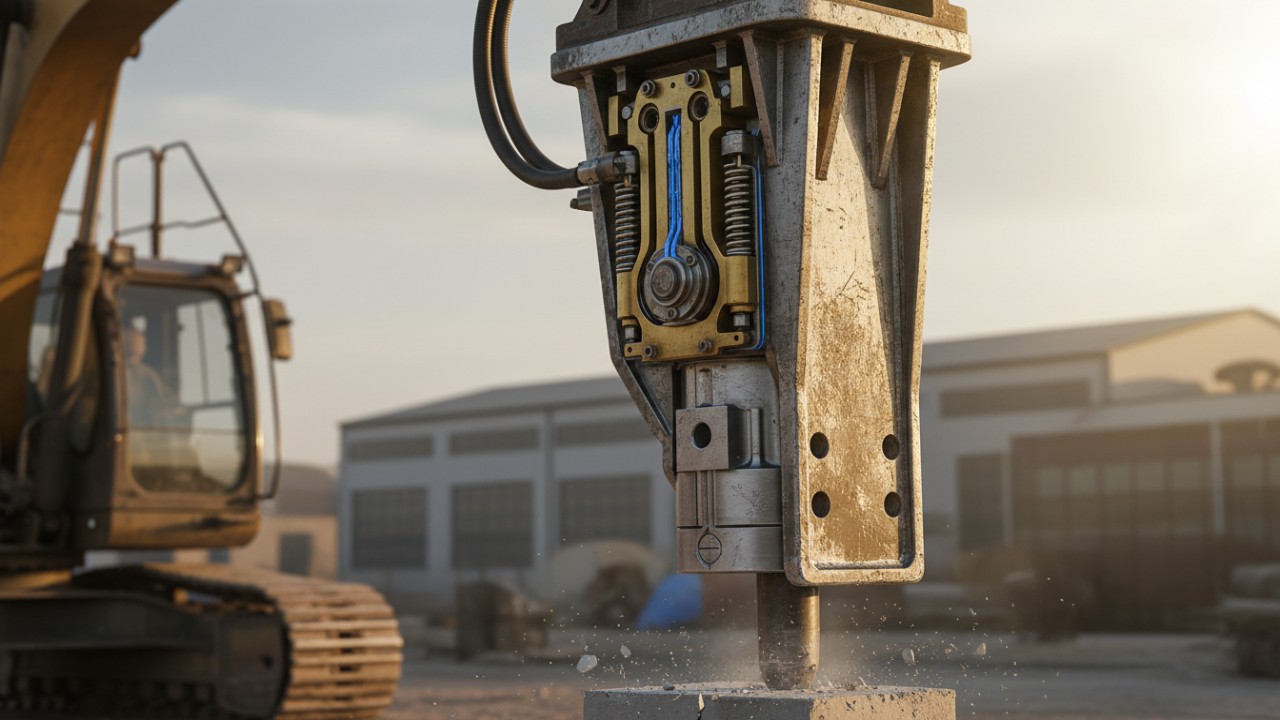
Anatomy & Mechanics: How It Works
The breaker operates through a cycle where hydraulic oil lifts a piston, and a nitrogen gas charge accelerates it downward to strike the tool bit.
Understanding the internal mechanics helps in diagnosing low-power issues. The system relies heavily on Pascal's Law, which states that pressure applied to a confined fluid is transmitted undiminished in every direction. As noted by Wikipedia, this principle allows the excavator's hydraulic pump to generate the massive force required to break granite.
Core Components
- The Piston Cycle: The heart of the hammer. It rises using hydraulic pressure and falls using a combination of oil pressure and expanding gas.
- Nitrogen Gas Firing System: A chamber filled with nitrogen acts as a shock absorber and a power booster. When the piston rises, it compresses the gas; when the valve opens, the gas expands, firing the piston down with explosive force.
- The Control Valve: This regulates the oil flow, determining the speed and timing of the stroke.
- Demolition Tool Bit Types:
- Moil Point: Multipurpose, pencil-point shape for concrete.
- Chisel: Wedge shape for trenching and cutting.
- Blunt: Flat face for crushing large boulders.
At Huilian, our R&D experts focus heavily on the diaphragms and seals that contain this pressure. We have found that using high-grade Parker seal kits significantly reduces the risk of internal bypass, ensuring the nitrogen charge remains effective for longer periods.
Sizing Guide: Matching Breakers to Carriers
You must match the breaker's required flow rate (GPM) and operating pressure (PSI) to the excavator's hydraulic output to ensure safety and performance.
Improper sizing is the most common reason for equipment failure. If a breaker is too small, productivity plummets. If it is too big, it can destabilize the excavator or damage the boom pins.
The Compatibility Matrix
When evaluating excavator attachment compatibility, consider these weight classes:
- Compact/Skid Steer: 0.5 – 6 ton carriers.
- Mid-Range: 7 – 15 ton excavators.
- Heavy Duty: 20 – 50+ ton excavators.
Consequences of Mismatching:
- Oversizing: Causes dangerous tipping and structural damage to the carrier.
- Undersizing: Results in excessive wear on the hammer and slow project completion.
Our team at Huilian utilizes a dynamic compatibility matrix to help mixed-fleet owners pair their breakers correctly, ensuring that the hydraulic flow matches the hammer's specifications perfectly.
Operational Excellence: Dos and Don'ts
Operators should limit continuous burst durations to 15-20 seconds and always maintain a 90-degree angle to the work surface.
Violating these basic rules leads to overheating and premature failure. According to safety guidelines published by the Association of Equipment Manufacturers (AEM), following strict operational protocols is essential for operator safety and equipment longevity.
Critical Best Practices
- The 15-Second Rule: Never operate the hammer in a single spot for more than 15 seconds. If the rock doesn't break, reposition. This prevents the tool bit from annealing (softening) due to heat friction.
- Angle of Attack: Always keep the tool perpendicular to the surface. Striking at an angle puts side-load pressure on the tool bushings and piston.
- Avoid Blank Firing: This occurs when the hammer is fired without the tool pressing firmly against the rock. The piston strikes the retainer pins instead of the material, which is the #1 cause of internal damage.
- Underwater Operation: You generally cannot use a standard breaker underwater without modification. It requires a specific compressed air kit to prevent water from entering the percussion chamber.
Maintenance & Longevity: The Expert's Schedule
Perform a visual inspection and grease the tool bushings every two hours of continuous operation to prevent metal-on-metal friction.
Maintenance is not just about fixing what is broken; it is about preventing the break. Huilian technicians recommend a strict schedule to protect your investment.
The Maintenance Checklist
- Daily Checks: Grease the hammer manually every 2 hours unless an auto-lube system is installed. Inspect the retainer bars and through bolts for tightness.
- Nitrogen Charge: Monitor impact power. If the hammer strikes rapidly but with weak force, the nitrogen pressure is likely low. Refill according to the manual (typically 145-230 PSI).
- Seal Kit Replacement: Watch for hydraulic oil leaking down the tool bit. This indicates worn seals. Huilian offers specialized replacement seal kits that resist high temperatures.
- Storage: If storing for more than a month, release the nitrogen gas and store the hammer vertically to prevent seal deformation.
ROI Analysis: Maximizing Profitability
To calculate true ROI, measure the Total Cost of Ownership (TCO) against the tons of material moved per hour, rather than just the initial purchase price.
Cheaper breakers often have higher fuel consumption and lower durability. Analyzing rock breaking efficiency metrics reveals that investing in a quality unit often pays off within the first 6 months.
Financial Decision Matrix
- Cost Per Hour: Factor in fuel, operator wages, and maintenance reserves.
- New vs. Reconditioned: Reconditioned units can offer 80% of the performance for 50% of the price, provided they use high-quality aftermarket parts like those from Huilian.
- Fuel Efficiency: Modern, efficient hydraulic circuits reduce the load on the excavator engine, saving thousands in diesel over a year.
Case Study: A quarry client recently upgraded their attachment tech to include auto-shutoff sensors. This reduced idle firing time, lowering fuel burn by 12% and improving overall site turnover by 20%.
Future Trends: Smart Breakers & Automation
The future of demolition lies in internal sensors that monitor stroke rate and telematic data integration for remote fleet management.
As we look toward 2026 and beyond, regulatory bodies are tightening rules on noise and vibration. Breakers with "silent" housing options and noise-suppression technology are becoming mandatory for urban projects.
- Stroke Monitoring: Sensors that adjust the blow frequency based on rock hardness.
- Telematics: Real-time alerts sent to the fleet manager when service is due.
- Green Demolition: Compliance with stricter noise ordinances in city centers.
Conclusion
Selecting the right hydraulic breaker involves more than just checking the price tag; it requires balancing carrier compatibility, operational discipline, and a rigorous maintenance schedule. By adhering to the 15-second rule, ensuring proper nitrogen pressure, and sourcing high-quality replacement parts from trusted OEM suppliers like Huilian, you can maximize your equipment's lifespan and project ROI.
Contact us today to optimize your hydraulic breaker strategy with Huilian's expert solutions.
FAQ
How does a hydraulic breaker work?
It uses the excavator's hydraulic oil to move a piston up and down. Nitrogen gas provides additional downward force. The piston strikes the tool bit to break the material.
What is the difference between a moil point and a chisel tool?
Moil point: Conical shape, best for concrete and sedimentary rock. Chisel tool: Wedge shape, best for cutting trench lines and abrasive rock. Blunt tool: Flat face, best for crushing boulders and igneous rock.
How often should I grease my hydraulic hammer?
Every 2 hours of continuous operation manually. Ideally, use an automatic lubrication system. Use high-temp molybdenum paste (chisel paste), not standard bearing grease.
Why is my hydraulic breaker losing power?
Low nitrogen gas pressure in the backhead. Worn internal seals causing internal oil bypass. Insufficient hydraulic flow from the carrier machine.
Can I use a hydraulic breaker underwater?
Yes, but only with an underwater kit installed. You must supply compressed air to the hammer housing. Without air, water enters the percussion chamber and damages the piston.
What happens if the hydraulic breaker is too big for the excavator?
The excavator becomes unstable and may tip. Excessive weight damages the boom and pins. Hydraulic flow may be insufficient, causing slow operation.
What is 'blank firing' and why is it bad?
Firing the hammer when the tool is not pressed firmly against rock. The piston strikes the retainer pins instead of the rock. It causes catastrophic damage to the tool, piston, and front head.
How much nitrogen pressure does a hydraulic hammer need?
Varies by model, typically between 145 PSI to 230 PSI. Refer to the specific operator's manual. Check pressure when the hammer is cool.
Wholesale Excavator Breaker Part manufacturer and supplier
Top hydraulic excavator breaker Manufacturers and Suppliers in China

Inventory Strategies for MTB-255 Parts and Maintenance
Top 10 Hydraulic Pump Seal Kits for Popular Excavator Models
About
How can I ensure I’m selecting the right part for my equipment?
Our expert team can assist you in finding the right part based on your machine model, specifications, and requirements. Contact us for personalized support.
Are your parts compatible with all excavator brands?
Yes, our parts are designed to be compatible with major brands like Komatsu, Caterpillar, Hitachi, Hyundai, Doosan, JCB, Kobelco, Sany, and many more.
Do you offer OEM and aftermarket parts?
Yes, we manufacture high-quality OEM parts and supply aftermarket parts from top brands such as NOK, Parker, SKF, and Hallite to ensure optimal performance.
What is your shipping and delivery time?
We offer fast and reliable global shipping. Delivery times vary depending on location and order size, but we strive to process and ship orders as quickly as possible.
What types of excavator parts do you offer?
We provide a wide range of high-quality excavator parts, including hydraulic breakers, chisels, seal kits, diaphragms, pistons, wear bushes, retainer bars, through bolts, side bolts, valves, and liners.
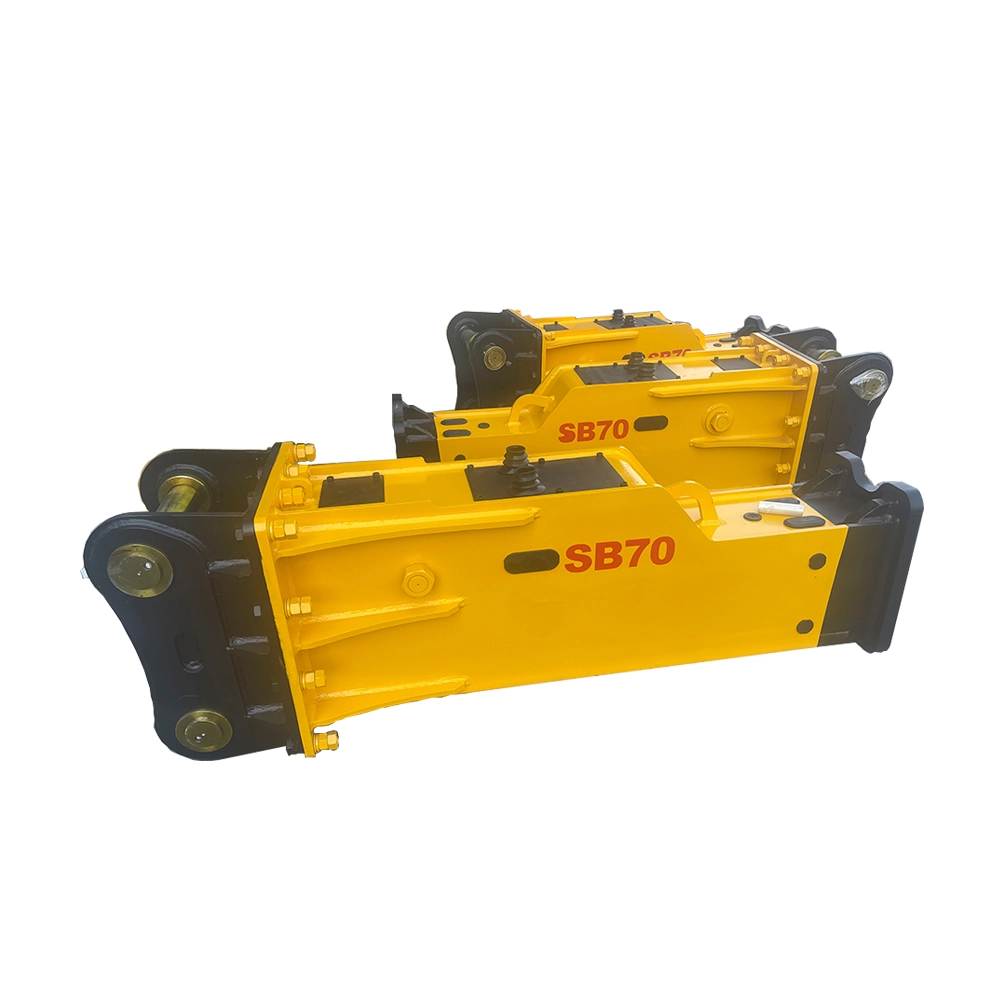
Huilian OEM Hydraulic Hammer Breaker SB70 For Soosan

Huilian HL68 Hammer Breaker for 4-7 Ton Excavator SOOSAN SB40 Hydraulic Rock Breaker
Side type hydraulic breaker : Easy to control, convenient positioning, durable, high working efficiency, strong striking force, long service life, stable operating performance, convenient after-sales service.
Top type hydraulic breaker : Strong impact power; excellent environmental performance; exquisite manufacturing technology; easy maintenance,fast after-sales service
Box type hydraulic breaker :leading heat treatment technology, enhance heat resistance, wear resistance. Under the condition of keeping the oil pressure constant, the cylinder volumeis reduced and the fuel consumption is reduced.The self-developed core is adopted to make the piston cylinder body moredurable and the service life longer.Exposed decks are made of high-strength steel plates to reduce wear.The best efficiency matching with excavator and loader is realized

Huilian OEM Factory SB130 Hydraulic Rock Breaker for 30-45 Ton Soosan Breaker
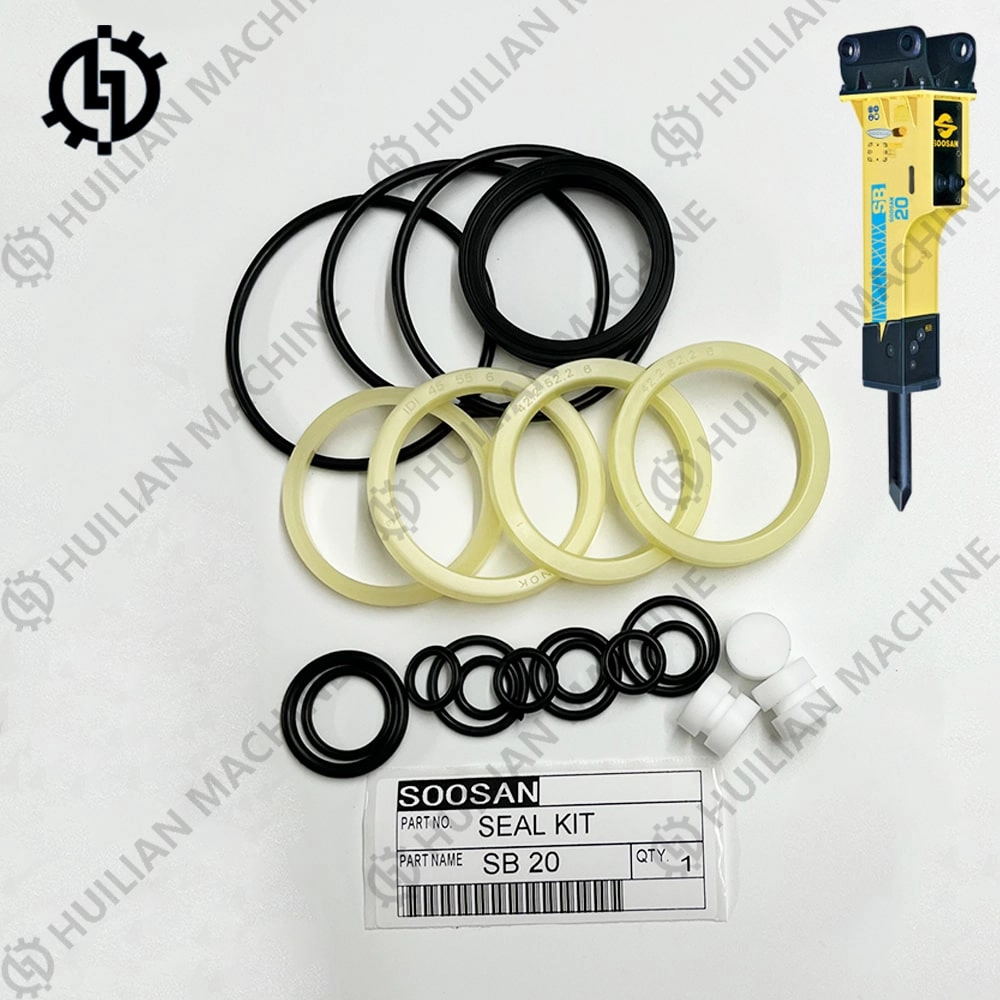
SOOSAN SB20 Breaker Seal Kit F01012 F0X001 SB20Ⅱ SB20TSP SQ20 Hydraulic Rock Hammer Oil Repair Kit
 About us
© 2025 HUILIAN MACHINE. All rights reserved