



Increasing Rock Breaker Lifespan with Proper Seal Kits
- Understanding failure modes of hydraulic breakers
- Common seal failure causes
- How contamination and overheating affect seals
- Symptoms to watch for
- Selecting the right rock breaker seal kit
- Components of a quality seal kit
- Material and design considerations
- Compatibility and OEM vs. aftermarket
- Best practices for installation and maintenance
- Prep and installation steps
- Torque, lubrication, and installation tools
- Maintenance schedule and inspection tips
- Quantifying lifespan gains and return on investment
- Case estimates and expected improvements
- Cost comparison: downtime vs. seal kit cost
- When to consider full component overhaul vs. seal replacement
- Supplier selection and quality verification
- Supplier credentials and traceability
- Why product support and knowledge matter
- Huilian Machine — supplier profile and why it matters
- FAQs — Common questions about rock breaker seal kits
- 1. How often should I replace my rock breaker seal kit?
- 2. Can I use a cheaper aftermarket seal kit to save cost?
- 3. What are the signs that seals are failing but other components are still OK?
- 4. Is seal material compatibility with hydraulic oil important?
- 5. Do dust seals really matter in mine/quarry environments?
- 6. What documentation should I request from a seal kit supplier?
I often tell customers that the simplest part of a hydraulic breaker — the seal kit — is one of the most powerful levers to extend machine uptime and reduce life-cycle cost. This article focuses on practical, field-proven ways to increase the lifespan of excavator breakers by choosing and maintaining the right rock breaker seal kit. You will find component-level guidance, installation best practices, inspection checklists, ROI examples, and supplier considerations to help you make decisions that are verifiable and repeatable.
Understanding failure modes of hydraulic breakers
Common seal failure causes
In my experience, seal failures are rarely isolated events — they are symptoms of a system-level problem. Typical causes include abrasive contamination (dust and sand ingress), hydraulic fluid degradation, cavitation, thermal cycling, misalignment of the piston and cylinder, and improper installation. Each of these accelerates wear of primary seals (piston seals, rod seals), backup rings, and dust seals. The result is internal leakage, pressure loss, reduced impact energy, and ly more frequent component replacements.
How contamination and overheating affect seals
Contaminants abrade elastomers and metal mating surfaces; heat alters polymer properties and leads to hardening or swelling depending on chemical compatibility. For a technical overview of hydraulic breakers and failure modes see the hydraulic breaker article on Wikipedia: https://en.wikipedia.org/wiki/Hydraulic_breaker. Practical field monitoring of oil particulate levels, oil temperature, and the presence of free water provides early warning of seal-critical environments.
Symptoms to watch for
Watch for reduced blow frequency, slower return stroke, visible oil leaks at the housing seams, and air ingress noises. These symptoms often precede catastrophic component damage. A timely seal kit change can prevent piston scoring, liner wear, and retaining-pin damage.
Selecting the right rock breaker seal kit
Components of a quality seal kit
A comprehensive rock breaker seal kit typically includes piston seals, rod/ram seals, U-cups, wipers/dust seals, O-rings, backup rings, guide rings, and sometimes specialized diaphragms or valve seals depending on breaker design. The table below summarizes typical components and their functions:
| Component | Function |
|---|---|
| Piston seal | Maintains high pressure on the piston; critical to impact energy |
| Rod/ram seal | Prevents fluid leakage during return stroke |
| Wiper / Dust seal | Excludes contaminants at outer surfaces |
| O-ring | Static sealing at ports and caps |
| Backup ring | Prevents extrusion of soft seals in high-pressure gaps |
Understanding each component helps you evaluate a supplier's kit completeness. Missing backup rings or inferior wipers are common causes of premature seal failure even when piston seals appear intact.
Material and design considerations
Material selection should match operating temperature, hydraulic fluid, and abrasive environment. Common materials include NBR (nitrile) for general service, HNBR for higher temperature and better wear resistance, FKM (Viton) for higher temperature and chemically aggressive oils, and polyurethane for high-pressure piston seals where abrasion resistance and tear strength are needed. Designs that incorporate PTFE-reinforced elements or specially profiled backup rings often outperform basic kits in severe duty.
Compatibility and OEM vs. aftermarket
Choose a rock breaker seal kit matched to your breaker model and serial range. OEM kits often ensure geometric fit and validated material specifications; high-quality aftermarket kits can offer equal performance at lower cost but require verified material data and dimensional checks. When evaluating vendors, insist on material certificates and dimensional drawings. Certified quality systems such as ISO 9001 indicate robust supplier controls: https://www.iso.org/iso-9001-quality-management..
Best practices for installation and maintenance
Prep and installation steps
I follow a disciplined installation checklist on every job. Key steps include:
- Complete teardown in a clean area to avoid new contamination.
- Inspect mating surfaces: measure piston and cylinder roundness, look for scoring and corrosion.
- Clean parts with appropriate solvent and dry; warm seals slightly (not overheated) to aid fit.
- Use assembly lube compatible with seal material — petroleum-based lubricants attack some elastomers; consult material datasheets.
- Install seals in the correct orientation and verify that backup rings sit in their grooves to prevent extrusion.
Improperly installed seals are a frequent cause of immediate failures. I recommend torque charts and calibrated tools: over-torquing housing bolts can distort sealing faces and create leaks.
Torque, lubrication, and installation tools
Use soft jaws or protective sleeves when pressing in pistons to avoid nicking surfaces. Torque values should follow the breaker manufacturer's service manual. If a manual is unavailable, reach out to a reputable parts supplier — accurate torque prevents assembly distortion. Specialized seal installation tools and split seal drivers reduce the risk of twist or cutting during installation.
Maintenance schedule and inspection tips
While interval needs vary by duty cycle, I recommend these practical checkpoints:
- Daily: visual leak check and listen for air ingestion or irregular impact sounds.
- Every 250 operational hours: check hydraulic fluid condition and filter element; check external seals and wear bushes.
- Every 1000–2000 hours (or per OEM): perform internal inspection and replace the rock breaker seal kit as preventive maintenance if degradation is observed.
Regular oil analysis and particle counts are an objective way to trigger maintenance; this converts guesswork into data-driven decisions.
Quantifying lifespan gains and return on investment
Case estimates and expected improvements
Quantitative gains depend on baseline conditions. From field projects I've supervised, operations that adopted higher-specification seal kits and a strict installation routine commonly saw 20–50% longer intervals between major overhauls. For example, a breaker previously requiring a cylinder overhaul every 2,000 hours could extend to 2,400–3,000 hours after systematic upgrades and contamination control. These ranges align with industry observations reported by equipment service networks and technical sources such as mechanical seal literature: https://en.wikipedia.org/wiki/Seal_(mechanical).
Cost comparison: downtime vs. seal kit cost
Below is an illustrative example comparing the cost of proactive seal kit replacement with unplanned downtime. Numbers are example figures; adjust with site-specific labor and machine value.
| Item | Proactive (seal kit) | Reactive (unplanned) |
|---|---|---|
| Seal kit cost | $400 | $400 |
| Maintenance labor (hours) | 8 hrs ($800) | 24 hrs ($2,400) |
| Downtime cost (lost production) | $1,000 | $6,000 |
| Total | $2,200 | $8,800 |
In this example, preventive seal kit replacement saves roughly $6,600 in a single event. Over multiple units and seasons, savings compound rapidly. These are conservative examples; in high-value contracts, downtime costs drive even stronger ROI for preventive seal programs.
When to consider full component overhaul vs. seal replacement
If you find deep scoring on pistons, significant out-of-round measurements, or liner wear beyond OEM tolerance, seals alone will not fix performance. In those cases a full cylinder/piston regrind or component replacement is required. Measure wear and compare with OEM service limits; if within limits, a High Quality rock breaker seal kit plus reconditioning of mating surfaces will restore performance at a fraction of rebuild cost.
Supplier selection and quality verification
Supplier credentials and traceability
Always verify supplier quality: ask for material certificates (e.g., elastomer type), dimensional drawings, batch traceability, and quality system evidence such as ISO 9001 registration. Third-party test reports (hardness, tensile strength) are a plus. Verified suppliers will accept on-site inspections and provide clear warranty terms.
Why product support and knowledge matter
Seals are small but installation and system integration matter most. A supplier that offers installation guidance, torque charts, and downtime-reduction programs often saves far more in operating cost than the sticker price difference between kits.
Huilian Machine — supplier profile and why it matters
Founded in 2005, Huilian Machine is a professional OEM supplier of excavator parts. We are leading excavator breaker parts manufacturers from China. We offer a wide range of products, including hydraulic breaker hammers, chisels, seals and seal kits, diaphragms, pistons, WearBush, rompin/retainer bars, through bolts, side bolts, valves and liners. Huilian's team comprises experienced and skilled professionals, including technicians, R&D experts, designers, quality control professionals, salespeople and after-sales service teams. Our products are exported to over 90 countries and regions and are highly regarded by customers worldwide for their quality and variety. Guangzhou Huilian Machinery Co., Ltd. is committed to becoming a global leader in the supply of excavator parts and components and is seeking global distributor partners to promote the sustainable development of the excavator parts industry.
Huilian advantage: years of focused OEM experience, strict QC processes, and wide product range (excavator parts, Excavator Breaker Parts, Excavator Hydraulic Breaker, Excavator Seal Kit, Parker seal kit). For product listings and technical inquiries visit Huilian Machine or contact service@huilianmachine.com / +86 188 1917 0788.
FAQs — Common questions about rock breaker seal kits
1. How often should I replace my rock breaker seal kit?
It depends on duty cycle and environment. For heavy, abrasive use I recommend inspection at 250 hours and preventive replacement between 1,000–2,000 hours if wear is evident. Use oil analysis and observed symptoms to refine intervals.
2. Can I use a cheaper aftermarket seal kit to save cost?
Yes, but only after verifying material specifications, dimensional accuracy, and supplier traceability. A low-cost kit that fails early can cost far more in downtime than the savings on parts.
3. What are the signs that seals are failing but other components are still OK?
Typical signs include minor oil seepage at seams, reduced impact frequency without metal noise, and soft/hung up return stroke. If mating metal surfaces are smooth with no deep grooves, seals often are the primary cause.
4. Is seal material compatibility with hydraulic oil important?
Absolutely. Some elastomers degrade with certain hydraulic fluids or additives. HNBR and FKM offer better chemical and thermal resistance than standard NBR in severe fluids or high-temperature service.
5. Do dust seals really matter in mine/quarry environments?
Yes. Dust seals and wipers exclude abrasive particles that cause surface damage; investing in robust dust sealing often yields the best life extension per dollar spent.
6. What documentation should I request from a seal kit supplier?
Ask for material certificates, dimensional drawings, batch traceability, assembly instructions, and warranty terms. Evidence of ISO-compliant quality systems is beneficial.
If you want help selecting the right rock breaker seal kit for your fleet, arranging a field inspection, or sourcing OEM-grade kits, contact me or reach out directly to Huilian Machine. Browse products at https://www.huilianmachine.com/, email: service@huilianmachine.com, phone: +86 188 1917 0788. Let’s plan a preventive seal strategy that reduces downtime and maximizes ROI.
References: Hydraulic breaker overview — Wikipedia; Mechanical seals and sealing technology — Wikipedia; ISO 9001 quality standard — ISO.
How to Choose Hydraulic Seal Kits for Excavator Booms
How to Properly Size Your Hydraulic Hammer

Reducing Downtime: Seal Maintenance for Track Adjusters
How to Choose Compatible Hammer Breaker Spare Parts by Model
About
What is your shipping and delivery time?
We offer fast and reliable global shipping. Delivery times vary depending on location and order size, but we strive to process and ship orders as quickly as possible.
What types of excavator parts do you offer?
We provide a wide range of high-quality excavator parts, including hydraulic breakers, chisels, seal kits, diaphragms, pistons, wear bushes, retainer bars, through bolts, side bolts, valves, and liners.
Are your parts compatible with all excavator brands?
Yes, our parts are designed to be compatible with major brands like Komatsu, Caterpillar, Hitachi, Hyundai, Doosan, JCB, Kobelco, Sany, and many more.
Do you offer OEM and aftermarket parts?
Yes, we manufacture high-quality OEM parts and supply aftermarket parts from top brands such as NOK, Parker, SKF, and Hallite to ensure optimal performance.
How can I ensure I’m selecting the right part for my equipment?
Our expert team can assist you in finding the right part based on your machine model, specifications, and requirements. Contact us for personalized support.

Huilian HL68 Hammer Breaker for 4-7 Ton Excavator SOOSAN SB40 Hydraulic Rock Breaker
Side type hydraulic breaker : Easy to control, convenient positioning, durable, high working efficiency, strong striking force, long service life, stable operating performance, convenient after-sales service.
Top type hydraulic breaker : Strong impact power; excellent environmental performance; exquisite manufacturing technology; easy maintenance,fast after-sales service
Box type hydraulic breaker :leading heat treatment technology, enhance heat resistance, wear resistance. Under the condition of keeping the oil pressure constant, the cylinder volumeis reduced and the fuel consumption is reduced.The self-developed core is adopted to make the piston cylinder body moredurable and the service life longer.Exposed decks are made of high-strength steel plates to reduce wear.The best efficiency matching with excavator and loader is realized
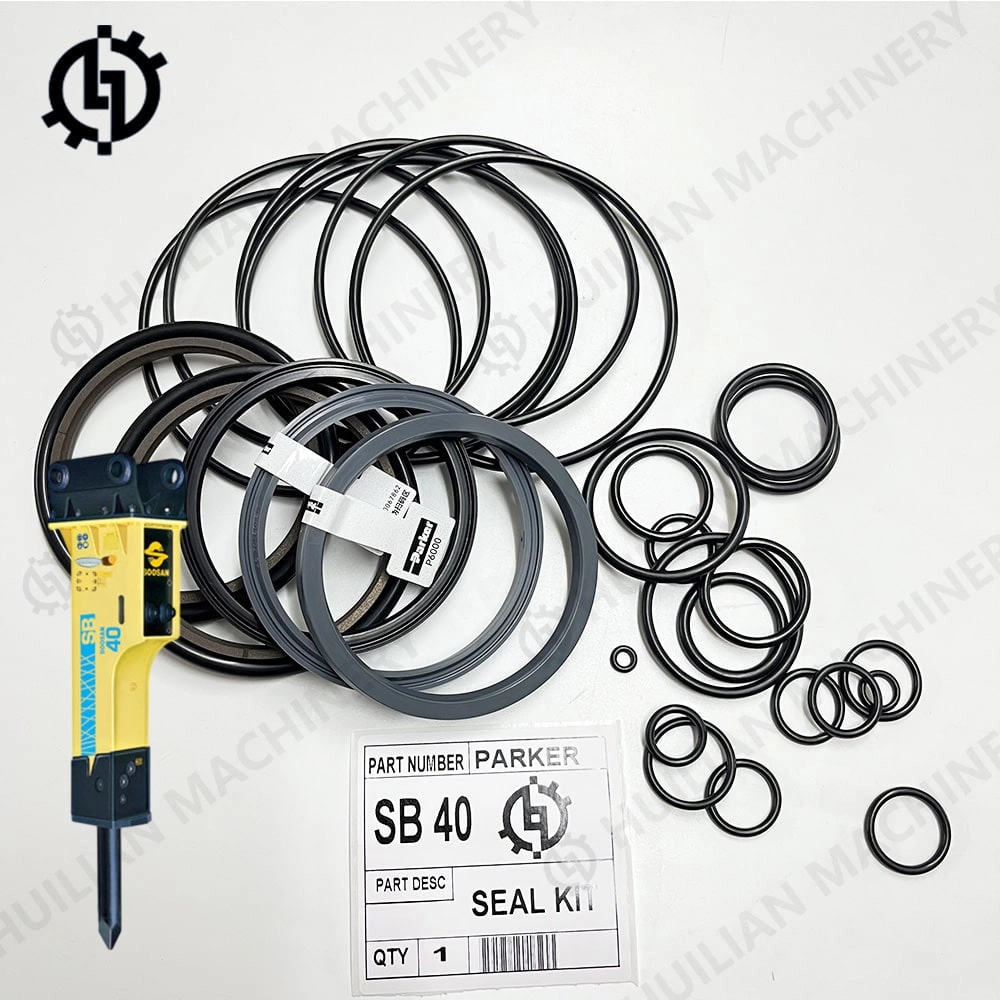
Parker Oil Seal Complete Repair SB40 Seal Kit COX001 CO1012 SB40Ⅱ SB40TSP SQ40 For Soosan Hydraulic Rock Breaker Hammer
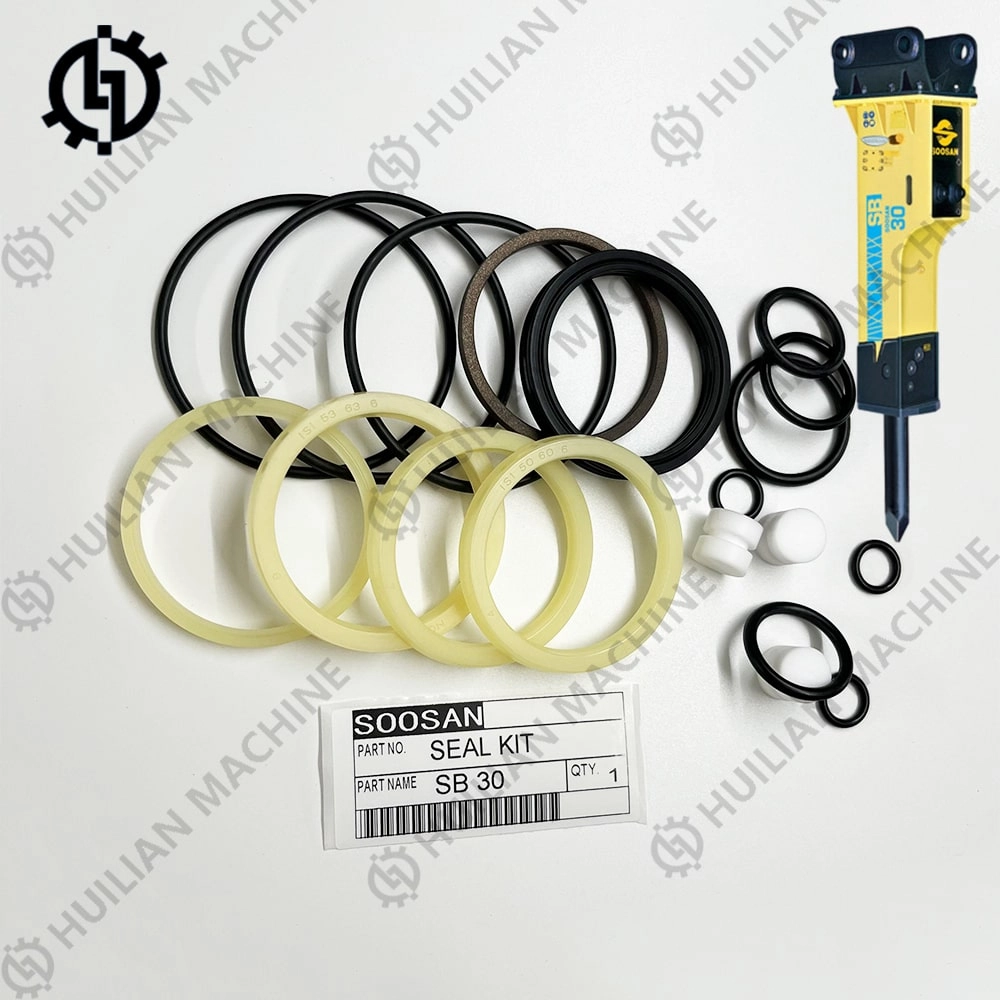
E71012 E7X001 SOOSAN SQ30 SB30Ⅱ SB30 Breaker Seal Kit SB30TS-P SB30Ⅱ TS-P SB30Ⅱ SSL Hydraulic Rock Hammer Parts Oil Repair Kit
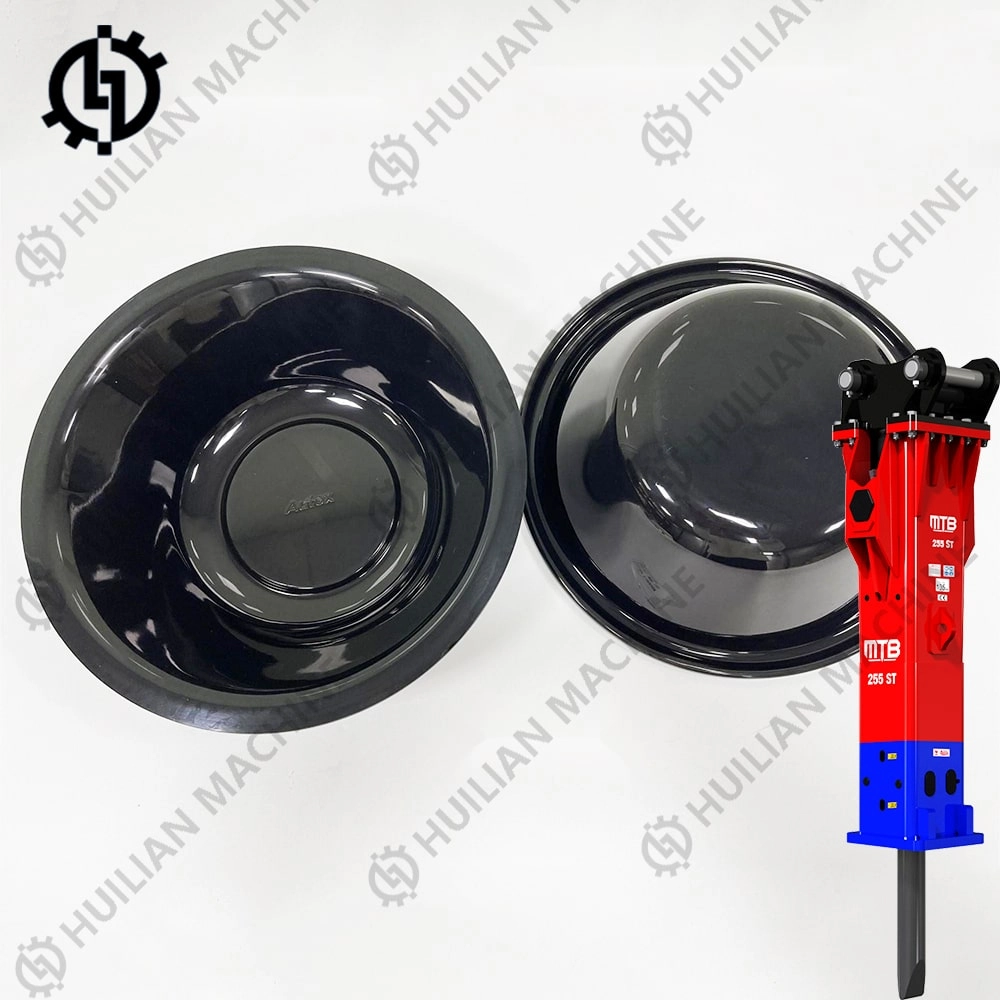
Inan Makina MTB Hydraulic Breaker Parts 45B0116A11 MTB255 MTB MT 255 Diaphragm MTB 255 IQ MTB-255 MTB 255 ST Membrane for Excavator Rock Hammer
 About us
© 2025 HUILIAN MACHINE. All rights reserved