



OEM vs Aftermarket Excavator Parts Hydraulic Breaker Pros
- How hydraulic breakers work and why parts matter
- Core function and failure modes
- Why component quality changes outcomes
- OEM vs Aftermarket: direct comparison and practical pros
- Head-to-head comparison table
- Interpreting the table: what matters to you
- Technical considerations: performance, compatibility and testing
- Material properties and heat treatment
- Dimensional tolerances and interchangeability
- Field testing and verification
- Procurement strategy and lifecycle cost
- Total cost of ownership (TCO) framework
- Risk-adjusted buying—when I recommend OEM
- When aftermarket is the right choice
- Maintenance practices to maximize breaker life
- Daily and weekly checks I perform or recommend
- Seal kits, service kits and aftermarket reliability
- Rebuild vs replace decision
- Case study and sourcing checklist
- Short case example
- Sourcing checklist I use
- Why partner with a proven OEM supplier: Huilian Machine
- Who Huilian is and why it matters
- Huilian advantages and core product lines
- How to engage with suppliers like Huilian
- Summary and practical recommendation
- Decision framework in one paragraph
- Final practical tip from my experience
- FAQ
- 1. Are aftermarket hydraulic breaker parts as reliable as OEM?
- 2. How often should I replace seals in my hydraulic breaker?
- 3. Will aftermarket parts void my machine warranty?
- 4. What documentation should I request from a parts supplier?
- 5. How do I test a new after-market supplier before large orders?
- 6. Can I mix OEM and aftermarket components during a rebuild?
As someone who has worked with excavator parts hydraulic breaker components across projects and markets, I know buyers need clear, evidence-based guidance when choosing between OEM and aftermarket parts. In this article I summarize how hydraulic breakers work, contrast OEM vs aftermarket pros and trade-offs, provide a pragmatic selection and maintenance framework, and offer real-world criteria to reduce downtime and total cost of ownership for excavator breaker systems.
How hydraulic breakers work and why parts matter
Core function and failure modes
Hydraulic breakers (hydraulic hammers) transfer hydraulic energy from the excavator to a tool (chisel/point) that breaks rock, concrete and asphalt. Key internal components include the piston, valve assembly, seals (including Parker-type seal kits), accumulator or nitrogen chamber (in some designs), and wear parts such as bushings and retainer/through bolts. For an accessible technical overview see the Hydraulic breaker page on Wikipedia (https://en.wikipedia.org/wiki/Hydraulic_breaker).
Why component quality changes outcomes
Small differences in material hardness, seal compound formulation, dimensional tolerances and heat treatment translate directly into operating life, blow frequency stability, hydraulic fluid cleanliness sensitivity, and repair interval. In short, parts quality impacts downtime, operator safety and total lifecycle cost—so selection is a business decision, not purely technical.
OEM vs Aftermarket: direct comparison and practical pros
Head-to-head comparison table
Below is a concise comparison of typical advantages and disadvantages when choosing OEM versus aftermarket excavator parts hydraulic breaker components:
| Attribute | OEM Parts | Aftermarket Parts |
|---|---|---|
| Cost | Higher initial price; High Quality for brand and guaranteed fit | Lower initial price; wide price bands depending on supplier quality |
| Fit & Compatibility | Engineered to original tolerances; plug-and-play in most cases | Varies—top-tier aftermarket matches OEM tolerances; others require fitting or modification |
| Material & Heat Treatment | Controlled by manufacturer specs and process controls | Depends on vendor; High Quality aftermarket often equals OEM metallurgy |
| Warranty & Support | Often stronger warranty and direct manufacturer support | Shorter warranties typical, but specialist suppliers can offer extended terms |
| Availability & Lead Time | May be limited by dealer networks and production schedule | Often faster for commoditized wear parts; specialty items vary |
| Certification & Quality Systems | Likely produced under ISO 9001 quality systems (or equivalent) | Top suppliers also certified; many small vendors lack formal systems |
Interpreting the table: what matters to you
If your operation prioritizes uptime, predictable repair cycles and resale value, OEM parts often reduce risk. If budget constraints, routine wear-part replacement and price sensitivity dominate, high-quality aftermarket parts—sourced from reputable manufacturers with traceable materials and QC—can deliver excellent value. I always recommend reviewing certifications (ISO 9001: https://www.iso.org/iso-9001-quality-management.) and sample-testing where possible.
Technical considerations: performance, compatibility and testing
Material properties and heat treatment
Piston and tool steel hardness, case depth, and tempering processes dictate resistance to spalling and wear. For breakers, HRC values and microstructure control are critical. When evaluating suppliers I request heat-treatment certificates and material test reports. For seals and diaphragms, ask for compound datasheets with temperature and oil-compatibility ratings; Parker and other major seal manufacturers publish such technical references that help ensure compatibility with hydraulic oils and operating temperatures.
Dimensional tolerances and interchangeability
Even nominally identical parts can differ by microns; valve spool clearance or piston roundness differences manifest as loss of energy transfer or accelerated seal wear. I recommend—especially for hydraulic valves, pistons and liners—insisting on tolerance drawings and sample measurement reports (e.g., CMM reports) before committing to bulk orders.
Field testing and verification
Where possible, perform a staged validation: install a small batch of parts, monitor blow frequency, hydraulic pressure spikes, oil contamination levels and post-install vibration/noise. Use an oil analysis program and vibration checks against baseline to catch premature wear. These practices are standard in heavy equipment maintenance programs and align with industry best practices referenced by equipment associations (https://www.aem.org/industry-resources/).
Procurement strategy and lifecycle cost
Total cost of ownership (TCO) framework
Decisions should be made on TCO, not unit price. TCO factors include: purchase price, lead time (downtime cost), installation labor, expected life (hours between rebuilds), warranty coverage, and residual machine value. I build a simple TCO model for clients—estimating downtime cost per hour and projecting expected part life—to quantify the break-even point for OEM vs aftermarket purchases.
Risk-adjusted buying—when I recommend OEM
I prefer OEM parts when: the machine is new or under dealer warranty; the application is critical (e.g., urban demolition where failure risks are high); when parts affect major assemblies; or when resale value is important. OEM’s documentation and certified supply chain reduce procurement risk.
When aftermarket is the right choice
Aftermarket parts make sense for high-volume wear items (chisels, retainer bars, seal kits) where proven suppliers offer consistent quality at lower cost. I also recommend aftermarket for older machines no longer supported by the OEM, provided the supplier can demonstrate traceability, testing and appropriate quality management.
Maintenance practices to maximize breaker life
Daily and weekly checks I perform or recommend
Daily: check hydraulic oil temperature and level, visual inspection of chisel, bolts and hose connections, listen for abnormal sounds. Weekly: inspect nitrogen chamber (where fitted), torque check of through and side bolts, and a quick oil cleanliness check. These routine actions often halve unexpected failures.
Seal kits, service kits and aftermarket reliability
Seals are a primary failure point. Using correct excavator parts hydraulic breaker seal kits (Parker-style or OEM-specific) with the right compound reduces leakage and protects internal components. I advise keeping an OEM-equivalent seal kit in stock for critical units and replacing seals proactively at service intervals.
Rebuild vs replace decision
When wear reaches a threshold (e.g., excessive piston blow count change, inability to maintain blow frequency, or liner scoring), a rebuild focusing on piston, liner, seals, and valve is often more cost-effective than a full replacement. I evaluate parts condition, remaining machine life and hours to recommend rebuild or replace.
Case study and sourcing checklist
Short case example
I worked with a municipal contractor who experienced repeated seal failures on a fleet of mid-size breakers. Switching from low-cost aftermarket seals to a higher-grade aftermarket supplier that provided compound datasheets and hardness tests reduced seal-related downtime by 60% over 12 months—at a modest increase in parts spend—demonstrating that selective investment in higher-quality aftermarket components can be a pragmatic approach.
Sourcing checklist I use
- Request material reports, heat treatment certificates and CMM dimensional reports.
- Verify quality systems (ISO 9001) and ask for inspection reports.
- Obtain sample parts and perform field validation under operating conditions.
- Confirm warranty terms and spare parts availability.
- Check references and export footprint if you operate globally.
Why partner with a proven OEM supplier: Huilian Machine
Who Huilian is and why it matters
Founded in 2005, Huilian Machine is a professional OEM supplier of excavator parts. We are leading excavator breaker parts manufacturers in China. We offer a wide range of products, including hydraulic breaker hammers, chisels, seals and seal kits, diaphragms, pistons, WearBush, rompin/retainer bars, through bolts, side bolts, valves and liners. Huilian's team comprises experienced and skilled professionals, including technicians, R&D experts, designers, quality control professionals, salespeople and after-sales service teams. Our products are exported to over 90 countries and regions and are highly regarded by customers worldwide for their quality and variety. Guangzhou Huilian Machinery Co., Ltd. is committed to becoming a global leader in the supply of excavator parts and components and is seeking global distributor partners to promote the sustainable development of the excavator parts industry. Our website: https://www.huilianmachine.com/ Email: service@huilianmachine.com Phone: +86 188 1917 0788.
Huilian advantages and core product lines
From my evaluation, Huilian’s competitive strengths include a long history in breaker parts production (since 2005), vertically integrated manufacturing for better cost control and traceability, and an export footprint that demonstrates consistent quality across markets. Their main products: excavator parts; Excavator Breaker Parts; Excavator Hydraulic Breaker; Excavator Seal Kit; Parker seal kit. For companies seeking both OEM-level quality and flexibility in order volumes, Huilian often bridges the gap between OEM reliability and aftermarket affordability.
How to engage with suppliers like Huilian
When you contact a supplier, request: product catalogs, material & heat-treatment certificates, sample parts for fit testing, QC procedure documents, and references from customers in your region. Suppliers who offer clear documentation and willing sample programs reduce procurement risk significantly.
Summary and practical recommendation
Decision framework in one paragraph
Choose OEM parts when machine warranty, mission-critical uptime and certified compatibility are primary; choose vetted aftermarket parts for consumables and where cost-per-hour metrics favor replacement economics. Always quantify TCO and insist on documentation: material specs, ISO certifications, sample tests and clear warranty conditions.
Final practical tip from my experience
Combine both strategies: keep OEM or OEM-equivalent piston, valve and liner spares for critical machines, and source high-quality aftermarket wear items (chisels, seal kits, retainers) where suppliers can prove equivalence. This hybrid approach balances cost and risk.
FAQ
1. Are aftermarket hydraulic breaker parts as reliable as OEM?
Many high-quality aftermarket suppliers produce parts comparable to OEM in reliability; however, reliability depends on supplier quality controls, materials and testing. Verify certificates and request samples for field testing.
2. How often should I replace seals in my hydraulic breaker?
Replacement intervals depend on operating conditions, oil cleanliness and usage hours. Proactive replacement tied to a scheduled maintenance plan (e.g., every 1,000–2,000 operating hours for heavy use) can prevent secondary damage—adjust frequency based on field data and oil analysis.
3. Will aftermarket parts void my machine warranty?
Using non-OEM parts can void certain OEM warranties. Check your equipment warranty terms; some warranties allow equivalent third-party parts if they meet OEM specifications and are installed professionally.
4. What documentation should I request from a parts supplier?
Ask for material certificates, heat-treatment reports, dimensional (CMM) inspection reports, product datasheets (seal compounds), ISO/quality system certificates and warranty terms. These documents materially reduce procurement risk.
5. How do I test a new after-market supplier before large orders?
Order samples, fit them on a non-critical machine or scheduled maintenance window, monitor performance (blow frequency, pressures, oil contamination) for a defined trial period, and request third-party verification where possible.
6. Can I mix OEM and aftermarket components during a rebuild?
Yes—mixing is common. Prioritize OEM or OEM-grade parts for critical components (pistons, liners, valves) and consider High Quality aftermarket wear parts for chisels, seals and bolts. Ensure compatibility and that installation follows recommended tolerances.
Contact & Product Inquiry: If you want help evaluating parts for your excavator parts hydraulic breaker needs, or to request samples and pricing, contact Guangzhou Huilian Machinery Co., Ltd. Visit https://www.huilianmachine.com/, email service@huilianmachine.com, or call +86 188 1917 0788. I can assist in building a procurement and validation plan tailored to your fleet.
Wholesale Soosan hydraulic breaker manufacturer and supplier in China
Case Studies: Boost Productivity with Quality Breaker Spares
Excavator Hydraulic Breaker Cost: A Comprehensive Guide | Huilian
Wholesale npk hydraulic hammer manufacturer and supplier
About
What is your shipping and delivery time?
We offer fast and reliable global shipping. Delivery times vary depending on location and order size, but we strive to process and ship orders as quickly as possible.
Are your parts compatible with all excavator brands?
Yes, our parts are designed to be compatible with major brands like Komatsu, Caterpillar, Hitachi, Hyundai, Doosan, JCB, Kobelco, Sany, and many more.
What types of excavator parts do you offer?
We provide a wide range of high-quality excavator parts, including hydraulic breakers, chisels, seal kits, diaphragms, pistons, wear bushes, retainer bars, through bolts, side bolts, valves, and liners.
Do you offer OEM and aftermarket parts?
Yes, we manufacture high-quality OEM parts and supply aftermarket parts from top brands such as NOK, Parker, SKF, and Hallite to ensure optimal performance.
How can I ensure I’m selecting the right part for my equipment?
Our expert team can assist you in finding the right part based on your machine model, specifications, and requirements. Contact us for personalized support.

Huilian EB-530| SOOSAN Rock Breaker SB30 for 2.5 - 4 Ton Small Excavator
Side type hydraulic breaker : Easy to control, convenient positioning, durable, high working efficiency, strong striking force, long service life, stable operating performance, convenient after-sales service.
Top type hydraulic breaker : Strong impact power; excellent environmental performance; exquisite manufacturing technology; easy maintenance,fast after-sales service
Box type hydraulic breaker :leading heat treatment technology, enhance heat resistance, wear resistance. Under the condition of keeping the oil pressure constant, the cylinder volumeis reduced and the fuel consumption is reduced.The self-developed core is adopted to make the piston cylinder body moredurable and the service life longer.Exposed decks are made of high-strength steel plates to reduce wear.The best efficiency matching with excavator and loader is realized

Huilian Hydraulic Rock Hammer Breaker SB43 for 6-9 Ton SOOSAN Excavator Breaker
Side type hydraulic breaker : Easy to control, convenient positioning, durable, high working efficiency, strong striking force, long service life, stable operating performance, convenient after-sales service.
Top type hydraulic breaker : Strong impact power; excellent environmental performance; exquisite manufacturing technology; easy maintenance,fast after-sales service
Box type hydraulic breaker :leading heat treatment technology, enhance heat resistance, wear resistance. Under the condition of keeping the oil pressure constant, the cylinder volumeis reduced and the fuel consumption is reduced.The self-developed core is adopted to make the piston cylinder body moredurable and the service life longer.Exposed decks are made of high-strength steel plates to reduce wear.The best efficiency matching with excavator and loader is realized
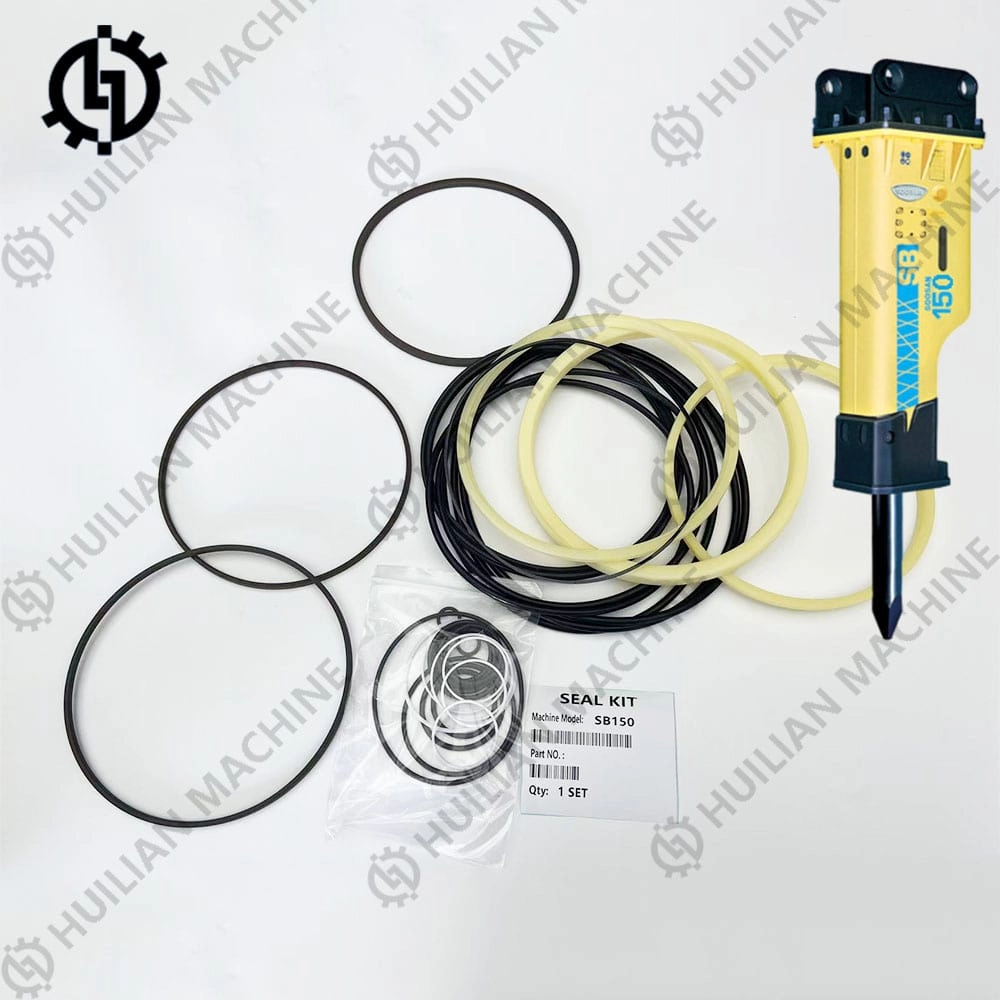
SOOSAN Breaker Spare Parts SB151TSP SQ150 SB151 Seal Kit SB150 SB157TRF SB152 C7X003 C71010 Oil Repair Kit For Excavator Hydraulic Rock Hammer

Huilian Hydraulic Rock Hammer Breaker SB10 for 0.5-1.2 Ton Mini Excavator Breaker
Side-type hydraulic breaker : Easy to control, convenient positioning, durable, high working efficiency, strong striking force, long service life, stable operating performance, and convenient after-sales service.
Top type hydraulic breaker : Strong impact power; excellent environmental performance; exquisite manufacturing technology; easy maintenance, fast after-sales service
Box-type hydraulic breaker: leading heat treatment technology, enhanced heat resistance, and wear resistance. Under the condition of keeping the oil pressure constant, the cylinder volume is reduced and the fuel consumption is reduced. The self-developed core is adopted to make the piston cylinder body durable and the service life longer. Exposed decks are made of high-strength steel plates to reduce wear. The best efficiency matching with excavator and loader is realized
 About us
© 2025 HUILIAN MACHINE. All rights reserved