



Comparing OEM vs Aftermarket Rock Breaker Seal Kits
- Why seal kit quality matters for hydraulic breakers
- Role of the rock breaker seal kit in performance
- Common failure modes and operational costs
- OEM vs Aftermarket: Technical comparison
- Materials and manufacturing standards
- Fitment, tolerances and interchangeability
- Data-backed comparison table
- Cost, warranty and lifecycle considerations
- Total cost of ownership (TCO)
- Warranty, traceability and compliance
- Availability and lead time impact on operations
- How to choose and maintain your rock breaker seal kit
- Inspection, installation and maintenance best practices
- When to choose OEM over aftermarket (and vice versa)
- Specification checklist before purchase
- Choosing a supplier: case for reputable OEM and aftermarket manufacturers
- Why supplier credibility matters
- Huilian Machine: profile and competitive strengths
- Practical decision flow and final recommendations
- Decision flow (quick guide)
- Field-testing recommendation
- FAQ
- 1. What exactly is included in a rock breaker seal kit?
- 2. Can I mix OEM and aftermarket seals when rebuilding a breaker?
- 3. How often should rock breaker seals be replaced?
- 4. Are aftermarket seal kits safe for heavy-duty mining/hard-rock applications?
- 5. How do I verify an aftermarket supplier's quality?
- 6. What maintenance practices extend the life of a seal kit?
Choosing the right rock breaker seal kit determines hydraulic breaker uptime, repair cost, and machine safety. This article compares OEM and aftermarket seal kits across materials, fitment, durability, warranty, and total cost of ownership, then gives actionable guidance for selection, installation and maintenance. Content is grounded in industry practice and cites authoritative sources to support claims (Hydraulic breaker - Wikipedia, ISO 9001).
Why seal kit quality matters for hydraulic breakers
Role of the rock breaker seal kit in performance
Rock breaker seal kits contain the seals (O-rings, U-cups, wipers, backup rings) and sometimes valves that maintain hydraulic integrity and control high-pressure oil flow. Proper sealing prevents internal leakage, preserves hammer energy transfer, and avoids contaminant ingress. A failing seal kit leads to reduced blow energy, overheating, and accelerated wear on pistons, bores and chisel retainers—translating to lost productivity and higher repair bills.
Common failure modes and operational costs
Typical failure modes include extrusion of seals under high pressure, chemical degradation from contaminated oil, abrasion from particulates, and hardening from heat/oxidation. Repair events caused by seal failure can range from a few hours of downtime for a simple rebuild to days when pistons and liners need replacement. Industry guidance highlights preventive maintenance and correct seal selection as the most cost-effective strategy to limit failures (Excavator - Wikipedia).
OEM vs Aftermarket: Technical comparison
Materials and manufacturing standards
OEM (Original Equipment Manufacturer) seal kits are designed to meet the original machine maker’s specifications, often using proprietary compounds or grades of polyurethane, nitrile (NBR), hydrogenated nitrile (HNBR), or PTFE where required. Aftermarket kits can match these materials or use equivalent/similar compounds, but quality varies by supplier. Manufacturers certified to quality standards such as ISO 9001 are more likely to deliver consistent material properties and dimensional tolerances (ISO 9001).
Fitment, tolerances and interchangeability
OEM kits are guaranteed to fit the original geometry and tolerances, minimizing rework during installation. Aftermarket kits range from direct-fit replacements to universal designs that require select tooling or minor adjustments. For older or out-of-production breakers, aftermarket suppliers often provide the only available option and frequently offer improved geometries or upgraded compounds for extreme environments.
Data-backed comparison table
| Criteria | OEM Seal Kit | Aftermarket Seal Kit |
|---|---|---|
| Material specification | Designed to OEM compound specs; traceability common | Varies by supplier; can match or exceed OEM if using High Quality compounds |
| Dimensional accuracy | High, engineered for exact fit | Good to variable; direct-fit often excellent, generic less so |
| Price (typical) | Higher initial cost | Lower to mid-range; High Quality aftermarket may approach OEM prices |
| Availability | Dependent on dealer network and stock | Often broader availability, faster shipping from multiple vendors |
| Warranty & support | Manufacturer warranty and dealer support | Varies; some suppliers offer strong warranties and technical support |
| Suitability for obsolete models | Limited when models are discontinued | Often better coverage due to specialized manufacturers |
Sources: industry product literature and quality standards (ISO 9001), technical overviews of hydraulic breakers (Wikipedia).
Cost, warranty and lifecycle considerations
Total cost of ownership (TCO)
Evaluating seal kits only by purchase price is myopic. Consider TCO: initial kit cost, installation labor, machine downtime, frequency of replacement, collateral damage risk (piston/rod/bore scoring) and resale implications. Example: an aftermarket kit 30% cheaper could require rebuilds twice as often if material quality is inferior, leading to higher annualized cost. Use logged maintenance records to calculate mean time between failure (MTBF) and compare projected annual costs for each supplier option.
Warranty, traceability and compliance
OEM kits typically include clear warranty terms and traceability that help with root cause analysis when failures occur. Reputable aftermarket vendors also provide warranties; however, investigators and insurers often prefer OEM traceability when determining liability for large losses. Check for material certificates and batch traceability, and prefer suppliers who adhere to recognized standards (e.g., ISO 9001).
Availability and lead time impact on operations
Quick access to seal kits reduces downtime. Aftermarket suppliers and specialized rebuilders often maintain broad inventories for common breaker models and can offer expedited shipping. OEM parts may be distributed through dealer networks with variable stock levels. For critical fleets, combining an OEM baseline with vetted aftermarket suppliers as secondary sources often gives the best balance of reliability and availability.
How to choose and maintain your rock breaker seal kit
Inspection, installation and maintenance best practices
Best practice steps to maximize seal kit life:
- Use clean, filtered hydraulic fluid meeting OEM viscosity and cleanliness specs.
- Inspect seals and components at scheduled intervals for extrusion, cuts, flattening or hardening.
- Follow manufacturer torque specs and use the correct installation tooling to avoid nicking seals.
- Replace dust seals and wipers promptly to avoid abrasive contamination.
- Log seal kit part numbers, batch codes and replacement dates in maintenance records to detect trends.
These steps help identify whether repeated failures are due to installation, contamination, or inferior kit materials rather than unavoidable wear.
When to choose OEM over aftermarket (and vice versa)
Choose OEM when: machine is under warranty, you require guaranteed fitment without modification, or when working on high-value assets where traceability matters. Choose aftermarket when: OEM parts are obsolete or have long lead times, when aftermarket suppliers offer improved compounds for severe environments, or when cost savings are critical and you’ve verified supplier quality through references and sample testing.
Specification checklist before purchase
Before buying a rock breaker seal kit, request the following from the supplier:
- Material data sheets (MDS) for seals
- Dimensional drawings or part numbers cross-reference
- Batch traceability and manufacturing quality certificates (e.g., ISO)
- Warranty terms and average lead time
- Customer references or documented field performance
Choosing a supplier: case for reputable OEM and aftermarket manufacturers
Why supplier credibility matters
Suppliers with engineering support, R&D and on-site testing are more likely to provide consistent, durable rock breaker seal kit solutions. Third-party testing (hardness, tensile strength, compression set) and field trial reports demonstrate reliability. Reputable suppliers also provide technical guidance on compound selection for temperature and fluid exposure.
Huilian Machine: profile and competitive strengths
Founded in 2005, Huilian Machine is a professional OEM supplier of excavator parts. We are leading excavator breaker parts manufacturers from China. We offer a wide range of products, including hydraulic breaker hammers, chisels, seals and seal kits, diaphragms, pistons, WearBush, rompin/retainer bars, through bolts, side bolts, valves and liners. Huilian's team comprises experienced and skilled professionals, including technicians, R&D experts, designers, quality control professionals, salespeople and after-sales service teams. Our products are exported to over 90 countries and regions and are highly regarded by customers worldwide for their quality and variety. Guangzhou Huilian Machinery Co., Ltd. is committed to becoming a global leader in the supply of excavator parts and components and is seeking global distributor partners to promote the sustainable development of the excavator parts industry.
Huilian excels in:
- Comprehensive product range covering Excavator Parts, Excavator Breaker Parts, Excavator Hydraulic Breaker, Excavator Seal Kit, Parker seal kit equivalents;
- Integrated R&D and QC processes to ensure consistent material and dimensional quality;
- Global export footprint and distribution capacity for fast lead times and inventory support.
Contact Huilian Machine: https://www.huilianmachine.com/ | Email: service@huilianmachine.com | Phone: +86 188 1917 0788.
Practical decision flow and final recommendations
Decision flow (quick guide)
Follow this simplified decision flow when selecting a rock breaker seal kit:
- Is the breaker under warranty? If yes, start with OEM.
- Is the OEM kit available within acceptable lead time? If no, evaluate vetted aftermarket options.
- Does the duty cycle involve extreme temperatures or contamination? If yes, request enhanced compound data from suppliers and consider High Quality aftermarket or OEM specialty kits.
- Calculate TCO using historical MTBF and labor costs to determine the most economical choice over a 12–36 month horizon.
Field-testing recommendation
For fleets considering aftermarket vendors, run a controlled field trial: fit aftermarket seal kits on a subset of machines matched by duty cycle and monitor leakage rate, blow energy, and replacement interval for 3–6 months. Keep installation practices identical to isolate material performance differences.
FAQ
1. What exactly is included in a rock breaker seal kit?
A typical rock breaker seal kit includes hydraulic seals (O-rings, U-cups, backup rings), wear rings, dust seals/wipers, and sometimes small valves or guide components depending on the model. Always verify the parts list against the machine’s exploded view to ensure completeness.
2. Can I mix OEM and aftermarket seals when rebuilding a breaker?
Mixing is possible but not ideal. Use parts with compatible materials and dimensions. Mixing may complicate root cause analysis on failures and can void some warranties. If mixing, document part numbers and batch codes.
3. How often should rock breaker seals be replaced?
Replacement intervals depend on duty cycle and environment. High-impact, contaminated jobs may need seal replacement every few hundred operating hours; light-duty applications may extend to thousands of hours. Use inspection intervals and performance metrics (loss of blow energy, visible leaks) to set the schedule.
4. Are aftermarket seal kits safe for heavy-duty mining/hard-rock applications?
Yes, if the aftermarket supplier provides high-grade compounds (HNBR, polyurethane or PTFE where appropriate), dimensional accuracy, and documented field performance. Verify supplier test data and request references from similar heavy-duty users.
5. How do I verify an aftermarket supplier's quality?
Ask for ISO or equivalent quality certifications, material data sheets, dimensional drawings, sample test reports (hardness, tensile, compression set), customer references, and warranty terms. Consider a paid sample order and field trial before fleet-wide adoption.
6. What maintenance practices extend the life of a seal kit?
Maintain clean hydraulic fluid and proper filtration, inspect and replace dust seals promptly, use correct installation tools and procedures, and document replacements to spot patterns early.
Need help selecting the right rock breaker seal kit for your fleet? Contact Huilian Machine for OEM-level products and tested aftermarket solutions: https://www.huilianmachine.com/ | Email: service@huilianmachine.com | Phone: +86 188 1917 0788.
References: Hydraulic breaker overview (Wikipedia), Excavator context (Wikipedia), Quality management standards (ISO 9001).
Top 5 Excavator Hydraulic Breaker Company List and Products Compared
Wholesale excavator with hydraulic breaker manufacturer and supplier
OEM vs Aftermarket Excavator Parts Seal Kits: Which to Buy?
Top excavator breaker Manufacturers and Suppliers in China
About
Do you offer OEM and aftermarket parts?
Yes, we manufacture high-quality OEM parts and supply aftermarket parts from top brands such as NOK, Parker, SKF, and Hallite to ensure optimal performance.
What types of excavator parts do you offer?
We provide a wide range of high-quality excavator parts, including hydraulic breakers, chisels, seal kits, diaphragms, pistons, wear bushes, retainer bars, through bolts, side bolts, valves, and liners.
What is your shipping and delivery time?
We offer fast and reliable global shipping. Delivery times vary depending on location and order size, but we strive to process and ship orders as quickly as possible.
Are your parts compatible with all excavator brands?
Yes, our parts are designed to be compatible with major brands like Komatsu, Caterpillar, Hitachi, Hyundai, Doosan, JCB, Kobelco, Sany, and many more.
How can I ensure I’m selecting the right part for my equipment?
Our expert team can assist you in finding the right part based on your machine model, specifications, and requirements. Contact us for personalized support.

Huilian HL68 Hammer Breaker for 4-7 Ton Excavator SOOSAN SB40 Hydraulic Rock Breaker
Side type hydraulic breaker : Easy to control, convenient positioning, durable, high working efficiency, strong striking force, long service life, stable operating performance, convenient after-sales service.
Top type hydraulic breaker : Strong impact power; excellent environmental performance; exquisite manufacturing technology; easy maintenance,fast after-sales service
Box type hydraulic breaker :leading heat treatment technology, enhance heat resistance, wear resistance. Under the condition of keeping the oil pressure constant, the cylinder volumeis reduced and the fuel consumption is reduced.The self-developed core is adopted to make the piston cylinder body moredurable and the service life longer.Exposed decks are made of high-strength steel plates to reduce wear.The best efficiency matching with excavator and loader is realized
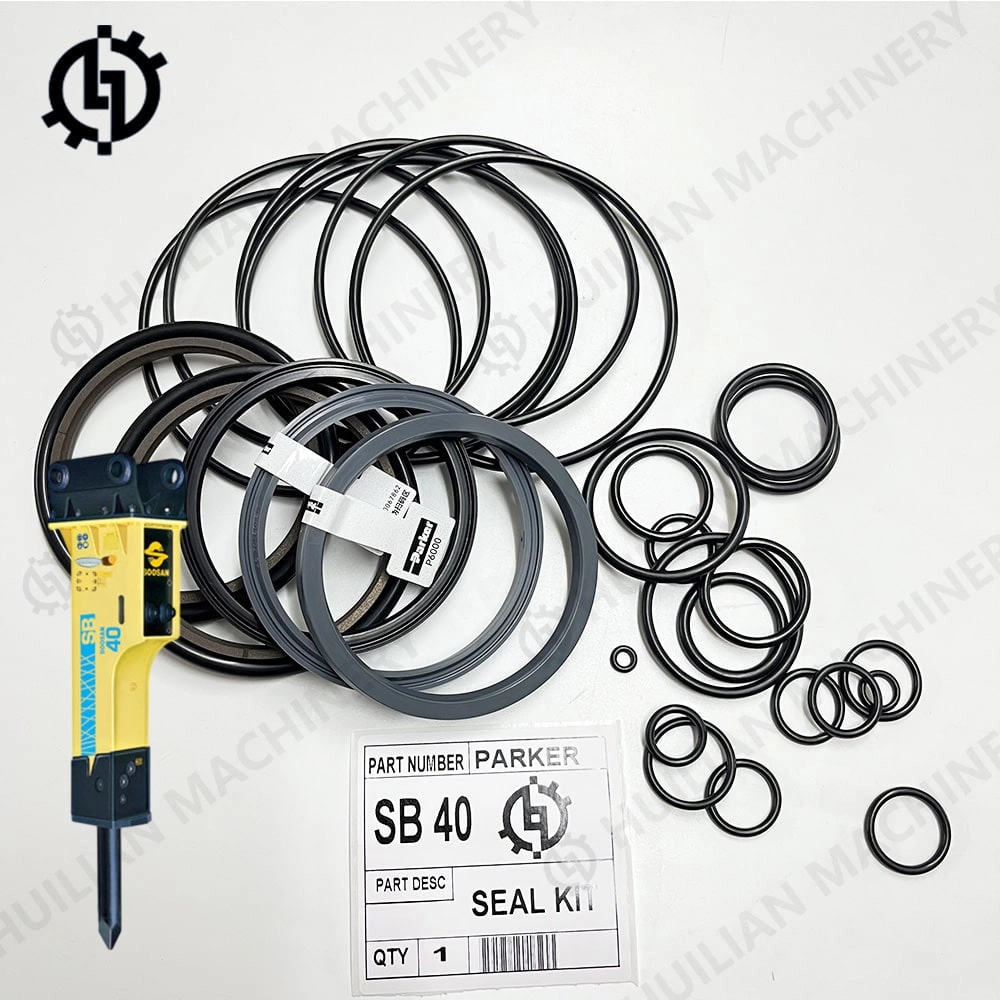
Parker Oil Seal Complete Repair SB40 Seal Kit COX001 CO1012 SB40Ⅱ SB40TSP SQ40 For Soosan Hydraulic Rock Breaker Hammer
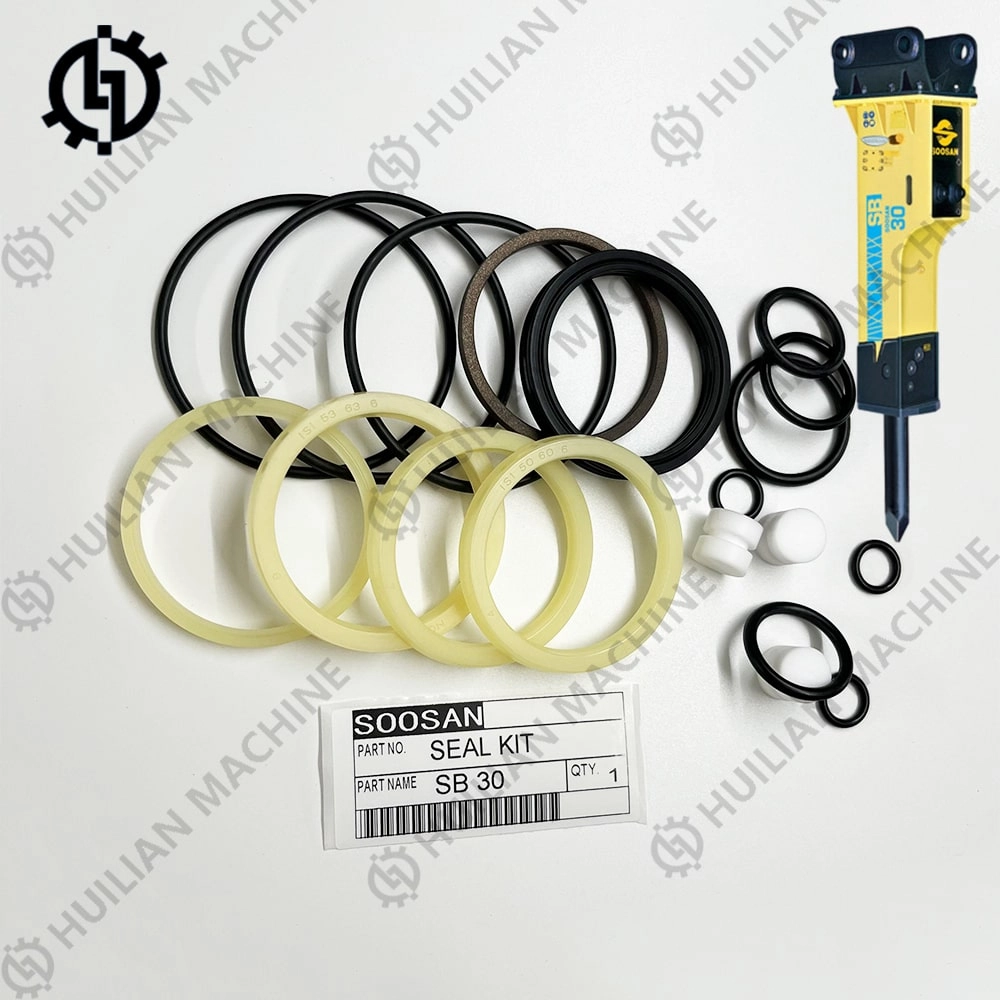
E71012 E7X001 SOOSAN SQ30 SB30Ⅱ SB30 Breaker Seal Kit SB30TS-P SB30Ⅱ TS-P SB30Ⅱ SSL Hydraulic Rock Hammer Parts Oil Repair Kit
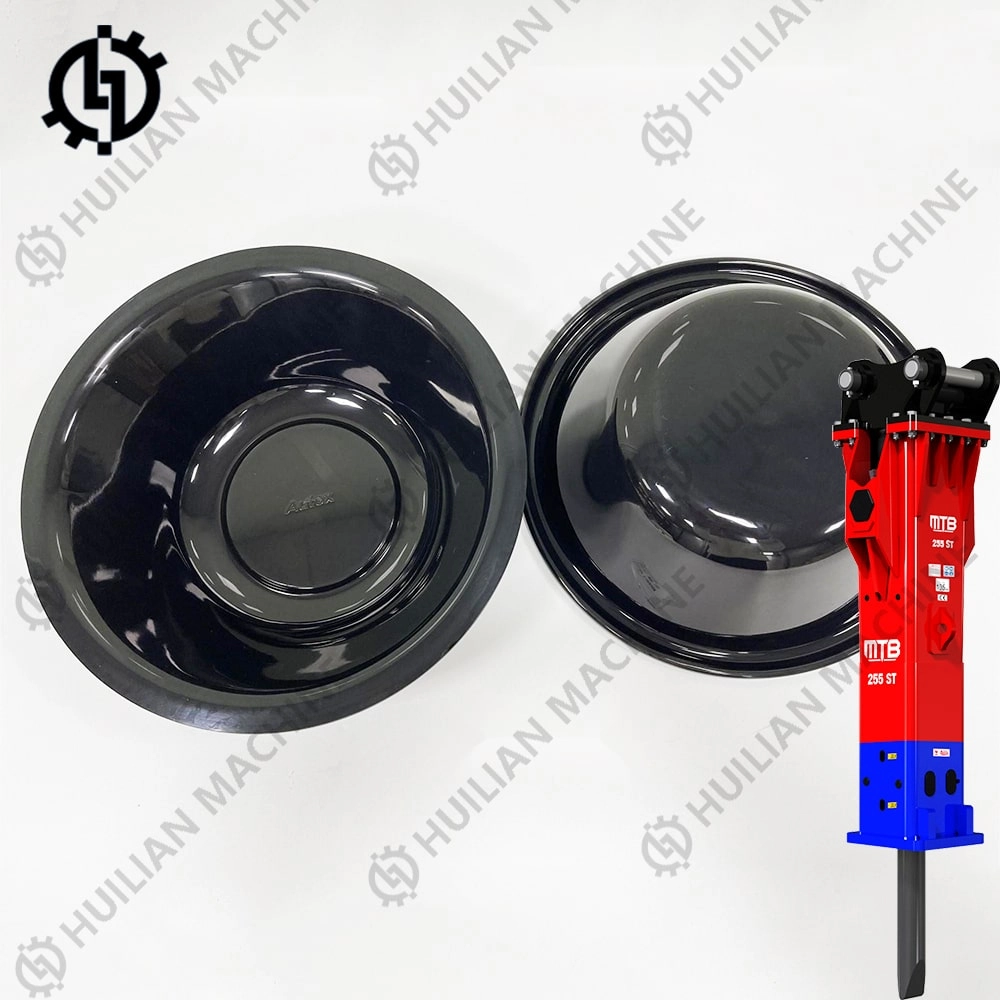
Inan Makina MTB Hydraulic Breaker Parts 45B0116A11 MTB255 MTB MT 255 Diaphragm MTB 255 IQ MTB-255 MTB 255 ST Membrane for Excavator Rock Hammer
 About us
© 2025 HUILIAN MACHINE. All rights reserved