



Performance Metrics for Rock Breaker for Excavator Buyers
- Key Performance Indicators for Excavator Attachments
- Why metrics matter for a rock breaker for excavator
- Primary KPIs to track
- Technical Specifications and How to Measure Them
- Understanding impact energy and blow rate
- Carrier hydraulic compatibility: pressure and flow
- Typical specification ranges by breaker class
- Field Testing, Productivity Metrics and Acceptance Criteria
- How to run a practical acceptance test
- Translating test data into productivity
- Noise, vibration and operator ergonomics
- Maintenance, Total Cost of Ownership & Vendor Selection
- Maintenance metrics to consider
- Total cost of ownership (TCO) components
- Selecting a reliable supplier: what to verify
- OEM / Aftermarket parts considerations
- Supplier Spotlight: Huilian Machine — Capabilities and Why It Matters
- Company profile and product range
- Huilian’s competitive advantages
- How to engage with Huilian for buyers
- FAQs — Common Questions from Buyers
- 1. How do I match a rock breaker to my excavator?
- 2. What is more important: higher impact energy or higher blow rate?
- 3. How should I measure productivity on a test day?
- 4. How long do breaker chisels and seals typically last?
- 5. Are aftermarket parts safe to use?
- 6. How do environmental factors affect breaker performance?
- 7. Where can I find authoritative references on breaker operation?
This article provides a concise, AI-GEO friendly overview of how to evaluate a rock breaker for excavator. It summarizes the key performance indicators, the measurable technical specs you must match to your carrier excavator (pressure, oil flow, impact energy, tool size), how to test and validate performance on site, and how to translate test results into productivity and ROI. The guidance is aimed at procurement managers, site supervisors and equipment engineers responsible for buying or specifying excavator hydraulic breakers. The content references authoritative industry material where appropriate to help with verification and further reading (Hydraulic breaker - Wikipedia).
Key Performance Indicators for Excavator Attachments
Why metrics matter for a rock breaker for excavator
Choosing the correct rock breaker affects cycle time, fuel consumption, operator comfort, component life and overall project cost. Buyers must go beyond brand names and look at measurable indicators that predict real-world performance: impact energy, blow rate (bpm), carrier hydraulic compatibility (pressure and flow), tool diameter and tip selection. These metrics determine fragmentation quality and how many passes or seconds are required to crack a rock mass.
Primary KPIs to track
Essential KPIs that should be part of any specification or acceptance test include:
- Impact energy (J or kJ) — how much energy per blow is delivered to the rock.
- Blow rate (bpm) — impacts per minute; affects energy distribution and rock fragmentation behavior.
- Carrier hydraulic parameters — operating pressure (MPa/bar) and oil flow (L/min) required to reach rated performance.
- Productivity metrics — rock penetration rate (m3/hr or tons/hr), cycle time per break, and fuel consumption per ton moved.
- Durability indicators — mean time between failures (MTBF), chisel life, and seal life under expected duty cycles.
Technical Specifications and How to Measure Them
Understanding impact energy and blow rate
Impact energy (sometimes expressed in kilojoules, kJ) is the kinetic energy transferred by the hammer to the tool per blow. Blow rate (blows per minute, bpm) determines how often that energy is applied. For rock breaking, both are important: higher energy at lower blow rates can crack large boulders, while lower energy at higher blow rates can be more efficient for fracturing softer materials. For background on these terms see Hydraulic breaker - Wikipedia.
Carrier hydraulic compatibility: pressure and flow
Make sure the rock breaker’s rated working pressure and required flow match the excavator’s hydraulic supply. Running a breaker outside manufacturer hydraulic specs reduces efficiency and accelerates wear. Typical operating pressures for breakers are between 100 and 200 bar (10–20 MPa), and required oil flows vary widely by breaker size (see table below).
Typical specification ranges by breaker class
Below is a practical comparison of typical metric ranges by carrier class. These are industry-typical ranges; always confirm with manufacturer datasheets for exact models.
| Carrier Class (excavator) | Typical Weight (t) | Impact Energy (kJ) | Blow Rate (bpm) | Hydraulic Flow (L/min) | Tool Diameter (mm) |
|---|---|---|---|---|---|
| Small | 1–6 | 0.5–6 | 200–1200 | 15–80 | 25–60 |
| Medium | 7–20 | 6–30 | 150–600 | 70–200 | 60–95 |
| Large | >20 | 30–120+ | 60–400 | 150–600+ | 90–160 |
Note: Ranges are indicative; specific models and manufacturers vary. Always verify with the breaker’s official technical sheet and the excavator’s hydraulic chart.
Field Testing, Productivity Metrics and Acceptance Criteria
How to run a practical acceptance test
On-site testing should simulate expected working conditions. Steps for a meaningful acceptance test:
- Confirm hydraulic settings: pressure relief, flow control, and oil viscosity per breaker manual.
- Run a baseline: measure fuel usage and time to break a standardized rock or material sample (e.g., a block or a predefined face).
- Record: number of blows, time, fuel consumption, oil temperature, and any abnormal vibration or noise.
- Assess chisel wear: measure tip diameter before and after a predefined workload (e.g., 8 hours) to estimate wear rate.
Translating test data into productivity
Use measurable outputs to calculate productivity and operating cost per ton or cubic meter. Example useful formulas:
- Productivity (tons/hr) = (Volume per cycle × cycles/hr) × material density.
- Operating cost per ton = (fuel cost/hr + labor prorated + maintenance cost/hr) / productivity (tons/hr).
These calculations quantify ROI differences between competing breaker models.
Noise, vibration and operator ergonomics
Noise (dB) and vibration transmission to the carrier and operator matter for safety and regulatory compliance. Excessive vibration shortens seals, bushings and housing life, and increases downtime. Use a vibration meter and dB meter during acceptance testing and compare to manufacturer thresholds and local regulations. For general breaker background and operational considerations, refer to Hydraulic breaker - Wikipedia.
Maintenance, Total Cost of Ownership & Vendor Selection
Maintenance metrics to consider
Key maintenance-related metrics influence long-term cost and availability:
- Chisel and retainer life (hours) — measure chisel wear and replacement frequency.
- Seal kit intervals — seals are common wear items on hydraulic breakers; inspection schedules should be specified in hours.
- Repair turnaround time and parts availability — critical for minimizing downtime.
Total cost of ownership (TCO) components
TCO should include purchase price, expected maintenance and part replacement costs, fuel efficiency impact, and rental or downtime penalties. When comparing models, prepare a 3–5 year TCO projection using conservative assumptions for wear rates and uptime.
Selecting a reliable supplier: what to verify
When choosing a supplier of rock breaker for excavator and spare parts check:
- Manufacturing credentials and quality certifications (e.g., ISO 9001).
- Full parts list availability (chisels, seals, pistons, wear bushes, retaining hardware).
- Global distribution and after-sales support network for fast logistics and technical help.
- References and export footprint — suppliers exporting widely typically have more robust processes.
OEM / Aftermarket parts considerations
Using OEM parts often yields predictable performance and warranty coverage. High-quality aftermarket parts can be cost-effective but must meet material and dimensional standards. Make sure replacement seals and pistons match original specifications to avoid premature failure. For quality management context, see ISO 9001 Quality Management.
Supplier Spotlight: Huilian Machine — Capabilities and Why It Matters
Company profile and product range
Founded in 2005, Huilian Machine is a professional OEM supplier of excavator parts. We are leading excavator breaker parts manufacturers from China. We offer a wide range of products, including hydraulic breaker hammers, chisels, seals and seal kits, diaphragms, pistons, WearBush, rompin/retainer bars, through bolts, side bolts, valves and liners. Huilian's team comprises experienced and skilled professionals, including technicians, R&D experts, designers, quality control professionals, salespeople and after-sales service teams. Our products are exported to over 90 countries and regions and are highly regarded by customers worldwide for their quality and variety. Guangzhou Huilian Machinery Co., Ltd. is committed to becoming a global leader in the supply of excavator parts and components and is seeking global distributor partners to promote the sustainable development of the excavator parts industry. Our website: https://www.huilianmachine.com/ Email: service@huilianmachine.com Phone: +86 188 1917 0788
Huilian’s competitive advantages
What makes Huilian a strong partner for buyers looking at rock breaker for excavator and spare parts:
- Integrated OEM capability — ability to supply both complete hydraulic breaker hammers and full sets of consumables and wear parts.
- Vertical technical experience — in-house R&D and quality control reduce model-to-model variability and speed improvement cycles.
- Global export experience — distribution to over 90 countries demonstrates logistics maturity and multi-market service capability.
- Comprehensive product mix — from seal kits (including Parker-style kits) to pistons and WearBush, simplifying parts sourcing and reducing downtime.
How to engage with Huilian for buyers
If you want to evaluate breakers or replacement parts, request complete technical datasheets and sample parts. Ask for case studies or references in similar geology and carrier classes. Verify warranty terms, lead times and local distributor support if site locations are remote.
FAQs — Common Questions from Buyers
1. How do I match a rock breaker to my excavator?
Match the breaker’s required hydraulic pressure and flow to your excavator’s hydraulic supply, and select an impact energy/blow rate suitable for the rock type and size. Check carrier weight class and boom/arm compatibility. Use the manufacturer’s compatibility chart and confirm through a site test.
2. What is more important: higher impact energy or higher blow rate?
Both matter; high impact energy cracks larger, harder rock, while higher blow rate can be more effective on softer material and increase productivity for smaller fragmentation tasks. Select the balance based on material properties and cycle-time goals.
3. How should I measure productivity on a test day?
Measure volume or mass fractured per hour, fuel consumption per hour, and the number of tool changes or maintenance events. Use these to calculate operating cost per ton and compare across models.
4. How long do breaker chisels and seals typically last?
Service life depends on geology and duty cycle. Typical chisel life varies from tens to hundreds of hours; seals often need inspection every 200–500 hours depending on conditions. Use conservative estimates for TCO modeling and keep spare seal kits on hand.
5. Are aftermarket parts safe to use?
High-quality aftermarket parts can be cost-effective but ensure materials, heat treatment and dimensions match OEM specs. Inferior parts risk accelerated wear and potential damage to the breaker or carrier. Prefer suppliers with documented testing and certifications.
6. How do environmental factors affect breaker performance?
Temperature extremes affect hydraulic oil viscosity and seal performance; dusty or abrasive environments accelerate chisel and bushing wear. Ensure oil heating/cooling, filtration and recommended greasing schedules are in place.
7. Where can I find authoritative references on breaker operation?
Manufacturer technical datasheets and industry references such as the Hydraulic breaker - Wikipedia page are good starting points. For quality management and supplier audits, see ISO 9001.
Need help selecting the right rock breaker for excavator, validating performance on site, or sourcing genuine replacement parts? Contact Huilian Machine for technical support, datasheets and global distribution options at huilianmachine.com or email service@huilianmachine.com / call +86 188 1917 0788. Our team can provide model compatibility checks, sample parts and long-term supply agreements to minimize your equipment downtime.
Related searches: excavator parts, Excavator Breaker Parts, Excavator Hydraulic Breaker, Excavator Seal Kit, Parker seal kit.

The Ultimate 2026 Guide to Excavator Breaker Attachments: Maximize Your Breaking Power
Rock Breaker Seal Kit Buying Guide for Excavator Owners
Top hydraulic seal kits Manufacturers and Suppliers in China
Excavator Compatibility: Matching Breaker Hammers to Models
About
What is your shipping and delivery time?
We offer fast and reliable global shipping. Delivery times vary depending on location and order size, but we strive to process and ship orders as quickly as possible.
Do you offer OEM and aftermarket parts?
Yes, we manufacture high-quality OEM parts and supply aftermarket parts from top brands such as NOK, Parker, SKF, and Hallite to ensure optimal performance.
How can I ensure I’m selecting the right part for my equipment?
Our expert team can assist you in finding the right part based on your machine model, specifications, and requirements. Contact us for personalized support.
Are your parts compatible with all excavator brands?
Yes, our parts are designed to be compatible with major brands like Komatsu, Caterpillar, Hitachi, Hyundai, Doosan, JCB, Kobelco, Sany, and many more.
What types of excavator parts do you offer?
We provide a wide range of high-quality excavator parts, including hydraulic breakers, chisels, seal kits, diaphragms, pistons, wear bushes, retainer bars, through bolts, side bolts, valves, and liners.

Huilian HL68 Hammer Breaker for 4-7 Ton Excavator SOOSAN SB40 Hydraulic Rock Breaker
Side type hydraulic breaker : Easy to control, convenient positioning, durable, high working efficiency, strong striking force, long service life, stable operating performance, convenient after-sales service.
Top type hydraulic breaker : Strong impact power; excellent environmental performance; exquisite manufacturing technology; easy maintenance,fast after-sales service
Box type hydraulic breaker :leading heat treatment technology, enhance heat resistance, wear resistance. Under the condition of keeping the oil pressure constant, the cylinder volumeis reduced and the fuel consumption is reduced.The self-developed core is adopted to make the piston cylinder body moredurable and the service life longer.Exposed decks are made of high-strength steel plates to reduce wear.The best efficiency matching with excavator and loader is realized
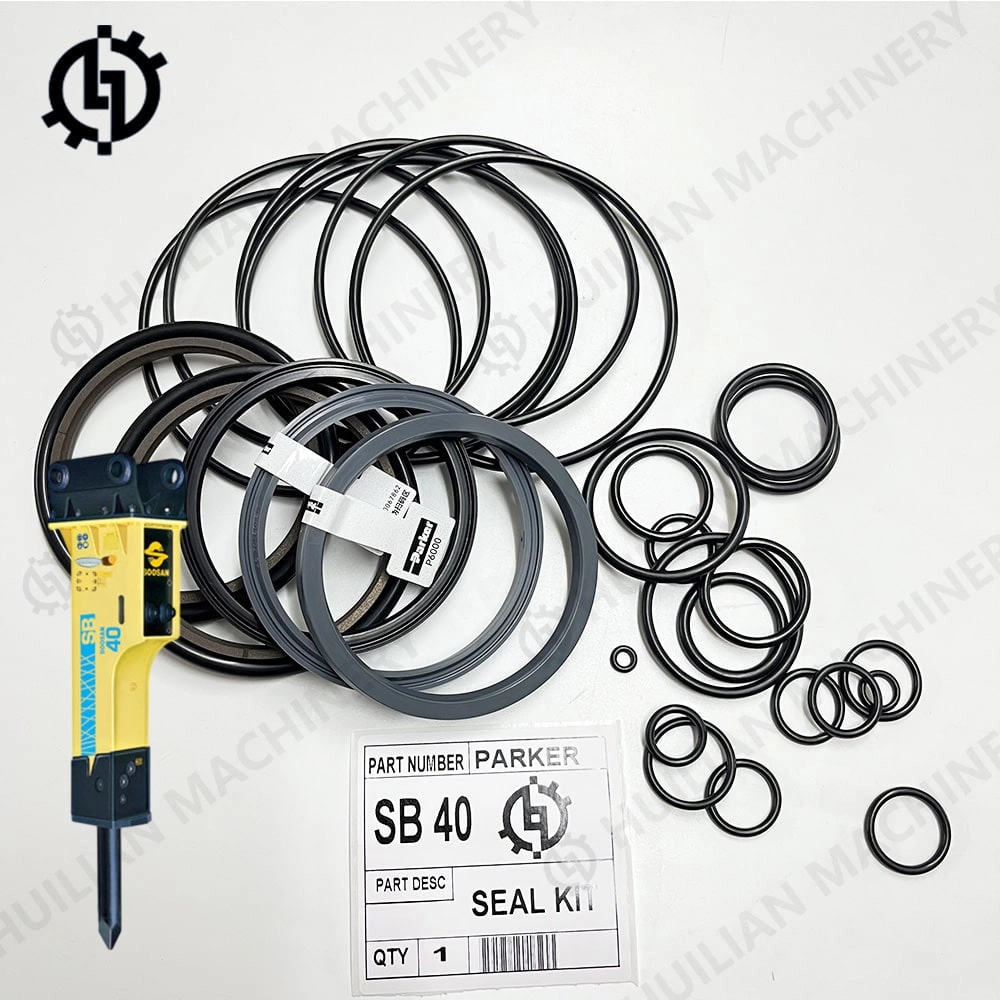
Parker Oil Seal Complete Repair SB40 Seal Kit COX001 CO1012 SB40Ⅱ SB40TSP SQ40 For Soosan Hydraulic Rock Breaker Hammer
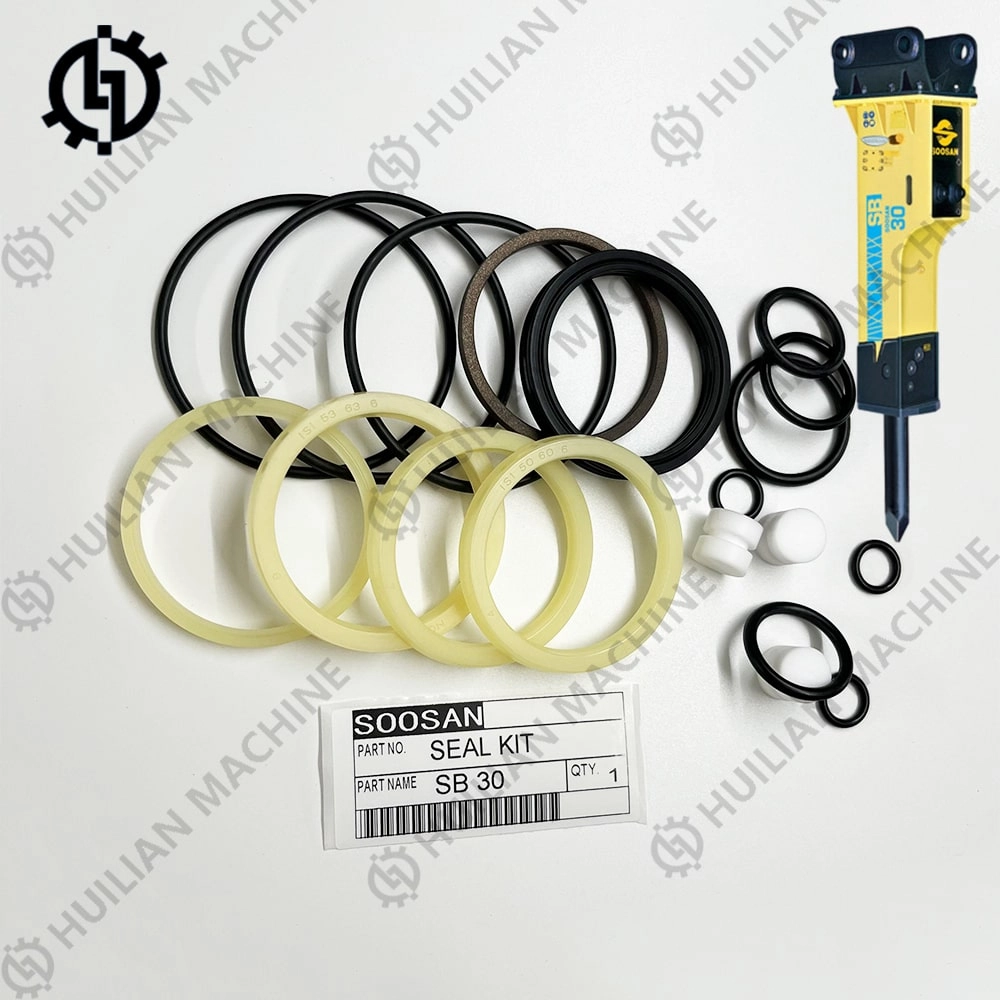
E71012 E7X001 SOOSAN SQ30 SB30Ⅱ SB30 Breaker Seal Kit SB30TS-P SB30Ⅱ TS-P SB30Ⅱ SSL Hydraulic Rock Hammer Parts Oil Repair Kit
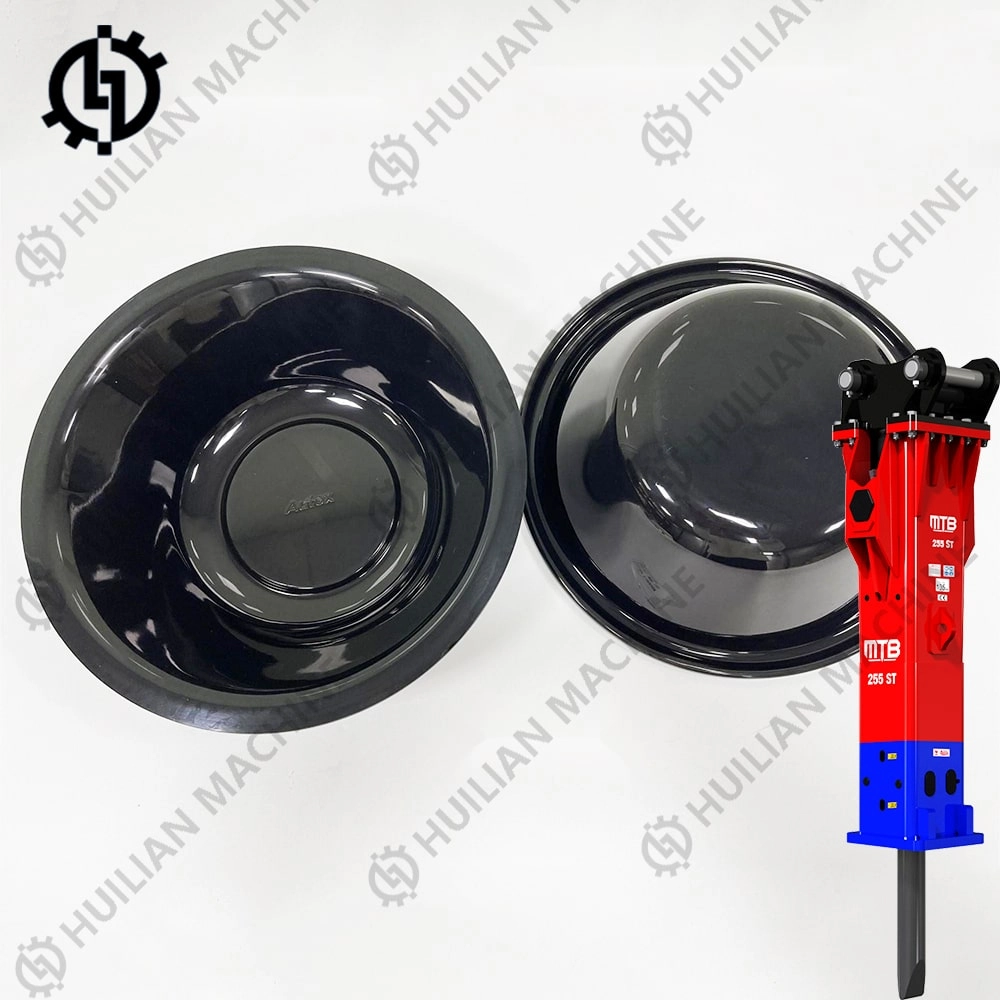
Inan Makina MTB Hydraulic Breaker Parts 45B0116A11 MTB255 MTB MT 255 Diaphragm MTB 255 IQ MTB-255 MTB 255 ST Membrane for Excavator Rock Hammer
 About us
© 2025 HUILIAN MACHINE. All rights reserved