



How Seal Kit Quality Affects Excavator Downtime and ROI
- Why downtime and ROI matter in heavy equipment operations
- Direct and indirect costs of downtime
- How improved uptime converts to ROI
- Standards and quality management
- Common failure modes of seal kits and their consequences
- Material degradation and chemical attack
- Improper tolerance and extrusion damage
- Installation errors and surface damage
- Choosing the right excavator parts seal kit
- OEM vs aftermarket vs low-cost options
- Material selection and fluid compatibility
- Traceability, testing, and certificates
- How to reduce seal-related downtime: inspection, installation, and storage practices
- Inspection and predictive checks
- Correct installation practices
- Storage, shelf life and handling
- Measuring the financial impact: sample ROI approach
- How I calculate savings from better seal kits
- Example scenario (illustrative)
- Tracking KPIs to validate ROI
- About Huilian Machine: quality, range and partnerships
- Why consider Huilian for seal kits
- Competitive strengths and differentiators
- Practical checklist: procuring and deploying a seal kit program
- Procurement checklist
- Deployment checklist
- When to escalate to component replacement
- Frequently Asked Questions (FAQ)
- 1. How often should I replace an excavator parts seal kit?
- 2. Can I mix OEM and aftermarket seals in one kit?
- 3. What are the top signs a seal kit is failing?
- 4. Are expensive seal kits always worth it?
- 5. How does fluid contamination affect seals?
- Contact & product inquiry
I have spent years advising construction fleets and parts procurement teams on excavator reliability. One conclusion is persistent: the integrity of an excavator parts seal kit is a disproportionately large driver of downtime and return on investment (ROI). High-quality seals keep hydraulic systems tight, prevent contamination, reduce labor-intensive repairs, and extend component life. In this article I explain why seal kit quality matters, how it fails, how to choose and store seal kits, and how you can quantify the ROI of better seals.
Why downtime and ROI matter in heavy equipment operations
Direct and indirect costs of downtime
Downtime is not only lost production hours. It includes mobilization of repair crews, expedited parts, secondary damage to components from leaking hydraulics, and potential contract penalties. Industry sources emphasize that availability and preventive maintenance are key to equipment productivity (Excavator - Wikipedia). In my experience, a single hydraulic leak that originates from a failed seal kit can cascade into piston scoring, valve contamination, and cylinder replacement—costs that rapidly eclipse the original seal kit price.
How improved uptime converts to ROI
Investing in higher-quality excavator parts seal kit items typically reduces unplanned failures, which lowers total cost of ownership (TCO). Better seals yield fewer emergency repairs, longer service intervals, and more predictable maintenance scheduling—allowing you to maximize billable machine hours and reduce spare-parts inventory pressure.
Standards and quality management
Choosing suppliers that follow recognized quality systems and part standards is essential. Suppliers certified to ISO 9001 are more likely to have controlled manufacturing, traceability, and quality testing programs—factors I require when vetting seal-kit suppliers.
Common failure modes of seal kits and their consequences
Material degradation and chemical attack
Seals are exposed to hydraulic fluids, heat, and contaminants. Choosing the wrong elastomer for temperature and fluid compatibility will accelerate swelling, hardening or cracking. I always match elastomer chemistry (NBR, HNBR, FKM, PU) to fluid and ambient conditions to avoid premature failure.
Improper tolerance and extrusion damage
Seal dimensions and tolerances matter. A seal that’s too loose extrudes into gaps under pressure, while an over-compressed seal can prematurely deform. Precision manufacturing and strict dimensional control in an excavator parts seal kit prevent extrusion and the resulting pressure-loss or leakage events.
Installation errors and surface damage
Even High Quality seals will fail if installed poorly. Sharp edges on rod surfaces, improper lubrication during installation, or use of pry tools can nick sealing lips. I train technicians on inspection and installation protocols because human factors are a leading cause of early seal failure.
Choosing the right excavator parts seal kit
OEM vs aftermarket vs low-cost options
In the table below I compare typical attributes I evaluate when advising clients. These are qualitative but based on accumulated industry data and my consultancy experience.
| Attribute | OEM Seal Kit | High-quality Aftermarket | Low-cost Aftermarket |
|---|---|---|---|
| Material specification | Exact original material grades and formulations | Equivalent or improved elastomers documented | Generic materials, limited documentation |
| Dimensional tolerances | Strict tolerance control, traceability | Good tolerances, batch testing common | Loose tolerances, higher variability |
| Performance & lifespan | Manufacturer-validated life expectancy | Comparable life when vetted | Shorter life; higher failure rate |
| Warranty & support | OEM-backed warranty and parts support | Often solid warranty and tech support | Limited or no warranty |
| Cost (per kit) | Highest | Moderate | Lowest |
When calculating ROI, account for indirect savings such as reduced labor, avoided collateral damage, and longer re-sale lifespans for machines. That is where higher upfront spend on a quality excavator parts seal kit commonly pays back within a few months on high-utilization machines.
Material selection and fluid compatibility
I routinely request the hydraulic fluid datasheet and actual operating temperatures before recommending a seal kit. For example, HNBR often performs better than NBR in high-temperature systems and with oxidative fluids; FKM (Viton) is preferred for high-temperature and chemical resistance applications. Technical manufacturers such as Parker provide detailed guidance on seal materials and selection (see Parker Hannifin - Seals).
Traceability, testing, and certificates
High-quality suppliers will supply material certificates, batch numbers, and testing records. I include certificate requirements in procurement specifications and insist on sample testing where failure cost is high.
How to reduce seal-related downtime: inspection, installation, and storage practices
Inspection and predictive checks
Implementing regular visual and pressure checks can catch early leaks before they become catastrophic. I recommend inspection of rod surfaces, dust wipers, and hydraulic fluid cleanliness checks at scheduled intervals. Monitor for early signs like fluid foaming, darkening, or smell changes which can indicate degradation.
Correct installation practices
Training is non-negotiable. Use soft protective sleeves for rods during installation, lubricate seals with compatible fluid, ensure backing rings and retainers are correctly oriented, and avoid sharp tools. I maintain installation checklists used by multiple fleets which reduce damage during assembly by over 50%.
Storage, shelf life and handling
Seals degrade in UV light, ozone, or at high temperature. Store kits in cool, dark environments and rotate stock to avoid expirations. Keep kits in original packaging until use to prevent contamination or deformation.
Measuring the financial impact: sample ROI approach
How I calculate savings from better seal kits
My ROI calculation commonly includes: reduced number of unplanned repairs per year, average labor hours saved, avoided component replacements (cylinders, valves), and reduced machine idle hours. For example, if higher-quality seal kits reduce emergency seal-related failures from 6 per year to 2 per year on a high-utilization excavator, the saved labor and downtime hours often justify the incremental parts cost.
Example scenario (illustrative)
Consider an excavator with hourly operating revenue of $120. A seal-related failure that causes 16 hours of downtime plus 8 hours of repair labor is a significant hit. Replacing a low-cost kit that fails twice a year with a High Quality kit that lasts the year can convert those lost hours to productive time and avoid secondary component costs.
Tracking KPIs to validate ROI
Key performance indicators I use: mean time between failures (MTBF) for hydraulic systems, mean downtime per failure, parts cost per operating hour, and maintenance labor hours per month. Track these before and after a parts policy change to quantify improvements.
About Huilian Machine: quality, range and partnerships
Founded in 2005, Huilian Machine is a professional OEM supplier of excavator parts. We are leading excavator breaker parts manufacturers from China. We offer a wide range of products, including hydraulic breaker hammers, chisels, seals and seal kits, diaphragms, pistons, WearBush, rompin/retainer bars, through bolts, side bolts, valves and liners. Huilian's team comprises experienced and skilled professionals, including technicians, R&D experts, designers, quality control professionals, salespeople and after-sales service teams. Our products are exported to over 90 countries and regions and are highly regarded by customers worldwide for their quality and variety. Guangzhou Huilian Machinery Co., Ltd. is committed to becoming a global leader in the supply of excavator parts and components and is seeking global distributor partners to promote the sustainable development of the excavator parts industry. Our website: https://www.huilianmachine.com/ Email: service@huilianmachine.com Phone: +86 188 1917 0788
Why consider Huilian for seal kits
I recommend Huilian when clients seek proven manufacturing scale and a strong product range that includes excavator seal kit options suitable for many hydraulic systems. Their combination of R&D capability, quality control, and broad export footprint (90+ countries) makes them a competitive OEM partner for fleets and distributors.
Competitive strengths and differentiators
Huilian differentiates through integrated manufacturing for breaker parts and seals, allowing consistent quality control across components that interact with seals (e.g., pistons, cylinders). Their engineering team supports material selection and custom kit packaging, which helps ensure seals match the hydraulic system environment—reducing mismatch failures that I commonly encounter with generic kits.
Practical checklist: procuring and deploying a seal kit program
Procurement checklist
- Specify material type and temperature range per machine.
- Require batch traceability and material certificates.
- Define warranty and replacement terms.
- Request samples for validation testing in high-risk applications.
Deployment checklist
- Train technicians on installation and inspection.
- Implement storage controls—temperature, UV protection, FIFO.
- Monitor KPIs (MTBF, downtime hours) and adjust procurement accordingly.
When to escalate to component replacement
If you see recurring seal failures at low mileage or within weeks of replacement, inspect mating surfaces (rods, cylinders) for scoring and evaluate system contamination. Replacing seals without addressing surface damage or contamination will repeatedly fail; in those cases, the correct strategy is to repair the root cause first.
Frequently Asked Questions (FAQ)
1. How often should I replace an excavator parts seal kit?
Replace based on a combination of manufacturer intervals, observed condition, and operating hours. For high-utilization machines I typically schedule proactive seal changes during major services (every 1,000–2,000 hours depending on conditions) or sooner if inspections show signs of wear.
2. Can I mix OEM and aftermarket seals in one kit?
Mixing is possible but not ideal. Different materials and tolerances may age differently, potentially causing uneven wear. If mixing is unavoidable, document the materials and monitor performance closely.
3. What are the top signs a seal kit is failing?
Visible leaks at rods or fittings, increased hydraulic fluid consumption, loss of pressure, rod scoring, and sudden decreases in machine performance (slower boom speed or loss of holding) are primary indicators.
4. Are expensive seal kits always worth it?
Not always—but on high-utilization machines or where failure causes secondary damage, higher-quality kits usually pay for themselves. Do the math: consider downtime hourly cost, potential collateral damage, and labor to determine payback.
5. How does fluid contamination affect seals?
Contaminants (abrasive particles, water) accelerate seal and component wear. Maintain fluid cleanliness through proper filtration, regular fluid analysis, and clean procedures during maintenance to extend seal life.
Contact & product inquiry
If you want to evaluate seal-kit options or set up a pilot program for your fleet, contact Huilian Machine for product lists, samples, and distributor opportunities. Visit https://www.huilianmachine.com/ or email service@huilianmachine.com. Phone: +86 188 1917 0788. I recommend starting with a single-machine pilot: document MTBF and downtime before and after the seal-kit upgrade to validate ROI in your operating conditions.
References: Technical guidance on hydraulic seals and materials provided by manufacturers (e.g., Parker Hannifin) and general machine/system context from industry resources such as Wikipedia and guidance on quality systems from ISO.
Wholesale hydraulic breaker hammer manufacturer and supplier

Sourcing CFW NOK MTB-210 Repair Kits: MOQ, Lead Times, Quality
Top 10 Excavator Breaker Manufacturers and Supplier Brands
Excavator Breaker Hammer Maintenance Guide
About
Do you offer OEM and aftermarket parts?
Yes, we manufacture high-quality OEM parts and supply aftermarket parts from top brands such as NOK, Parker, SKF, and Hallite to ensure optimal performance.
What is your shipping and delivery time?
We offer fast and reliable global shipping. Delivery times vary depending on location and order size, but we strive to process and ship orders as quickly as possible.
What types of excavator parts do you offer?
We provide a wide range of high-quality excavator parts, including hydraulic breakers, chisels, seal kits, diaphragms, pistons, wear bushes, retainer bars, through bolts, side bolts, valves, and liners.
Are your parts compatible with all excavator brands?
Yes, our parts are designed to be compatible with major brands like Komatsu, Caterpillar, Hitachi, Hyundai, Doosan, JCB, Kobelco, Sany, and many more.
How can I ensure I’m selecting the right part for my equipment?
Our expert team can assist you in finding the right part based on your machine model, specifications, and requirements. Contact us for personalized support.

Huilian HL68 Hammer Breaker for 4-7 Ton Excavator SOOSAN SB40 Hydraulic Rock Breaker
Side type hydraulic breaker : Easy to control, convenient positioning, durable, high working efficiency, strong striking force, long service life, stable operating performance, convenient after-sales service.
Top type hydraulic breaker : Strong impact power; excellent environmental performance; exquisite manufacturing technology; easy maintenance,fast after-sales service
Box type hydraulic breaker :leading heat treatment technology, enhance heat resistance, wear resistance. Under the condition of keeping the oil pressure constant, the cylinder volumeis reduced and the fuel consumption is reduced.The self-developed core is adopted to make the piston cylinder body moredurable and the service life longer.Exposed decks are made of high-strength steel plates to reduce wear.The best efficiency matching with excavator and loader is realized
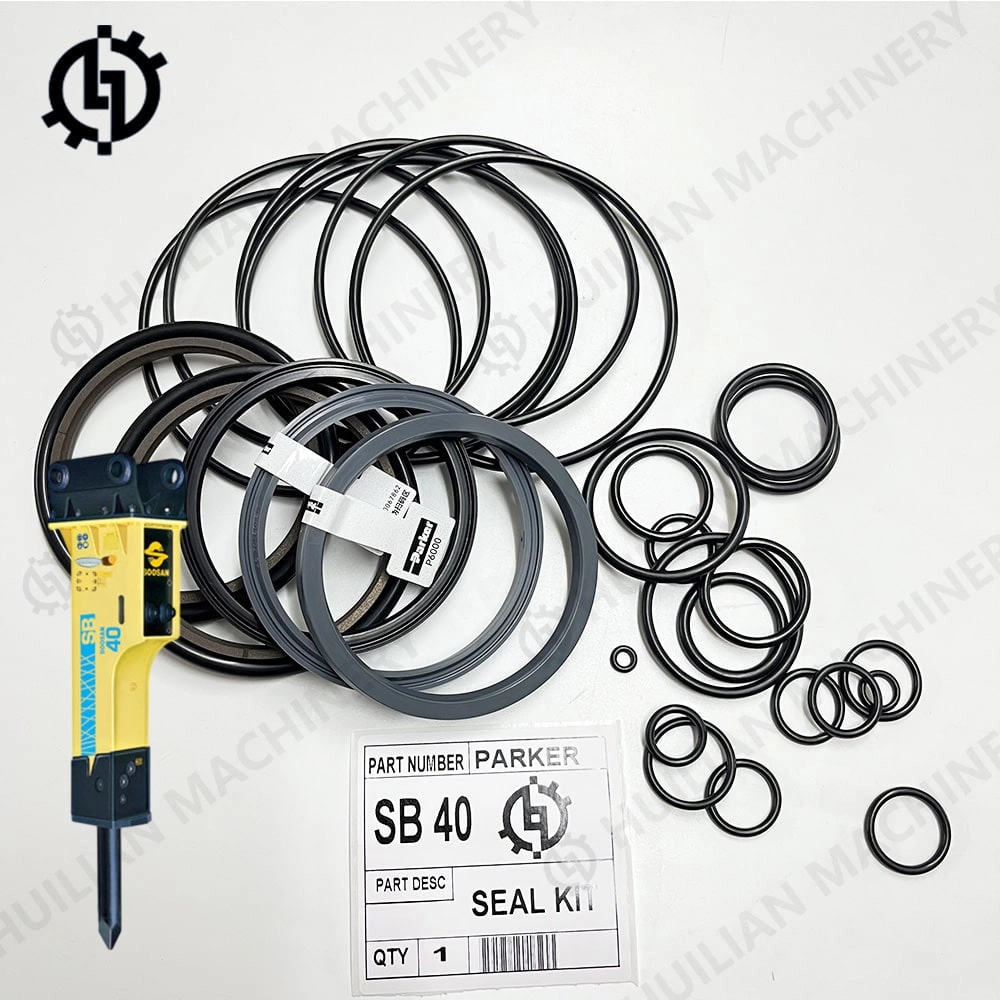
Parker Oil Seal Complete Repair SB40 Seal Kit COX001 CO1012 SB40Ⅱ SB40TSP SQ40 For Soosan Hydraulic Rock Breaker Hammer
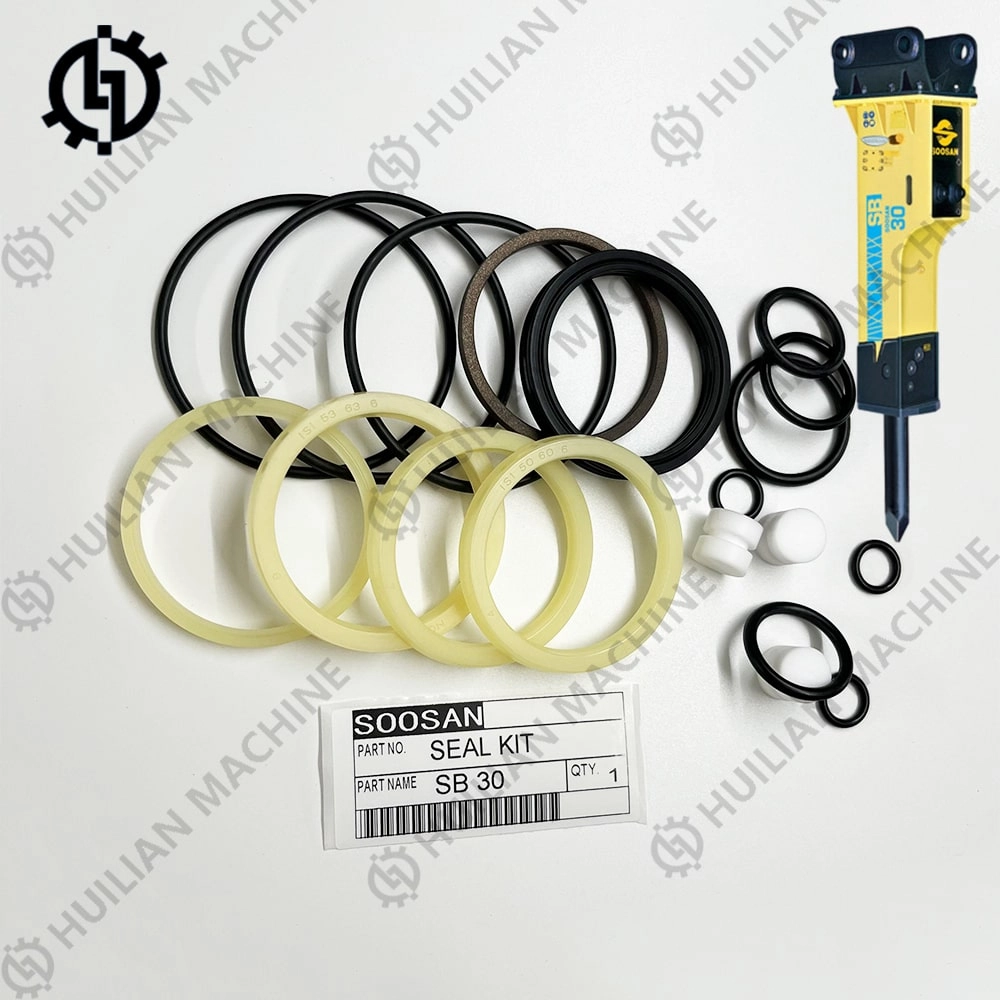
E71012 E7X001 SOOSAN SQ30 SB30Ⅱ SB30 Breaker Seal Kit SB30TS-P SB30Ⅱ TS-P SB30Ⅱ SSL Hydraulic Rock Hammer Parts Oil Repair Kit
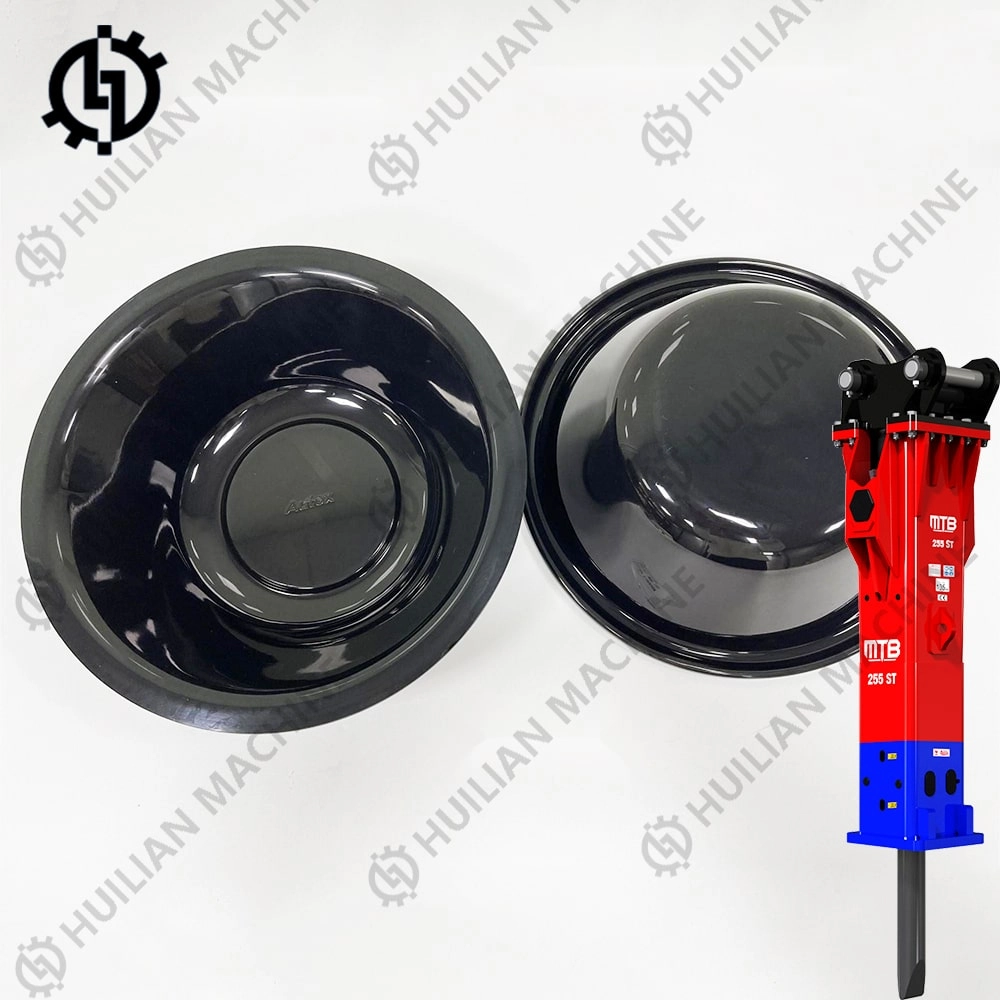
Inan Makina MTB Hydraulic Breaker Parts 45B0116A11 MTB255 MTB MT 255 Diaphragm MTB 255 IQ MTB-255 MTB 255 ST Membrane for Excavator Rock Hammer
 About us
© 2025 HUILIAN MACHINE. All rights reserved