



Customizing Breaker Tools: Tips for Different Rock Types
- Understanding Rock Mechanics for Breaker Selection
- Why rock properties matter
- Key mechanical metrics I check
- Linking metrics to breaker parameters
- Matching Tool Geometry and Materials to Rock Type
- Point vs moil vs chisel — how shape drives fragmentation
- Material selection and heat treatment
- Coatings and advanced alloys
- Operational Settings: Matching Hammer Parameters to Rock
- Choosing hammer class and impact energy
- Hydraulic pressure, flow and accumulator tuning
- Try-it-and-measure approach
- Practical Recommendations by Rock Type
- Soft sedimentary rocks (e.g., shale, soft limestone)
- Medium-hard rocks (e.g., sandstone, weathered basalt)
- Hard, massive rocks (e.g., granite, quartzite)
- Table: Rock types, typical UCS ranges, and recommended breaker tool setups
- Maintenance, Wear Management and Lifecycle Costs
- Monitoring wear and scheduling replacements
- Seal kits, valves and routine servicing
- Recordkeeping and parts availability
- Case Studies and Field Examples
- Quarry conversion: sandstone to engineered aggregate
- Urban demolition with mixed debris
- Hard rock road-cut project
- Choosing a Reliable Parts Supplier and OEM Support
- Why OEM quality matters
- About Huilian Machine — OEM supplier profile
- Huilian advantages and product focus
- FAQ
- 1. How do I choose the right hammer rock breaker for excavator loader for my quarry?
- 2. How often should I replace chisels and seal kits?
- 3. Is it worth using carbide or special alloys for chisels?
- 4. Can I tune any breaker to any rock type by changing chisels alone?
- 5. Where can I find reliable specifications for parts and maintenance?
- 6. How does hammer sizing affect excavator loader compatibility?
As someone who has worked with excavator breaker fleets across quarries, infrastructure projects and demolition sites, I know that success with a hammer rock breaker for excavator loader depends less on brute force and more on matching tool design, operating parameters and maintenance to the rock you’re breaking. Below I summarize actionable techniques for optimizing chisels, hammers, and settings for different rock types, backed by standards and geological references and presented so you can apply them directly on site.
Understanding Rock Mechanics for Breaker Selection
Why rock properties matter
Different rocks behave differently under impact. Compressive strength, tensile strength, grain size, bedding and discontinuities all influence how energy from a hydraulic breaker is transmitted and dissipated. For basic rock definitions and mechanical property ranges see resources like the US Geological Survey and general rock references (Wikipedia: Rock (geology), Geology.com: Rock Types).
Key mechanical metrics I check
In practice I focus on three measurable or estimable metrics before selecting a tool: uniaxial compressive strength (UCS), rock abrasivity (e.g., via Mohs hardness or quartz content), and fracture pattern/discontinuity spacing. UCS influences required impact energy; hardness/abrasivity dictates chisel material and heat treatment; and fracture spacing often determines whether pre-splitting or undercutting is necessary.
Linking metrics to breaker parameters
From those metrics I choose hammer class (impact energy and frequency), tool geometry (point, moil, blunt, spade), and operating parameters like hydraulic pressure, flow rate and blow rate. For an overview of hydraulic breakers and their components, see Hydraulic breaker (Wikipedia).
Matching Tool Geometry and Materials to Rock Type
Point vs moil vs chisel — how shape drives fragmentation
Tool geometry governs stress concentration at the impact face. A pointed or moil tool concentrates stress in a small area and is effective on medium-hard to very hard, massive rock (e.g., granite). A chisel or flat tool distributes energy for controlled spalling on layered or brittle rocks (e.g., slate, shale). For highly abrasive rock, blunt tools that transfer compressive stress rather than cutting are often longer lasting.
Material selection and heat treatment
Tool steel selection matters. I prefer Cr-Mo alloy steels with surface hardening or induction hardening for chisels operating in abrasive conditions. Tool tip hardness should balance toughness and wear resistance; typical case hardness values are in the HRC 55–62 range for high-wear tips. For background on hardness as a material property see Hardness (materials).
Coatings and advanced alloys
For extreme abrasive environments (high silica sandstone, quartzites) consider tungsten-alloyed tips or carbide inserts where feasible, and ensure proper heat-treatment to prevent brittleness. I always weigh replacement cost against downtime and choose solutions that minimize total cost of ownership.
Operational Settings: Matching Hammer Parameters to Rock
Choosing hammer class and impact energy
Breakers are rated by impact energy (kJ) and blow frequency (blows/min). For soft rock (UCS < 50 MPa) higher blow rates with lower impact per blow give better productivity; for hard rock (UCS > 150 MPa) higher impact energy per blow at lower frequency is usually better. Manufacturer specifications and empirical charts are helpful; confirm settings with a short test program on site.
Hydraulic pressure, flow and accumulator tuning
Optimizing the hydraulic supply is crucial—insufficient flow or pressure reduces effective impact energy; excessive pressure risks damage. Modern breakers use accumulators to tune blow energy and frequency. I record supply pressure, flow, and breaker recommended ranges and adjust nitrogen pre-charge and valve timing to match target energy curves specified by the manufacturer.
Try-it-and-measure approach
On a new rock type I run timed, instrumented trials: pieces produced per hour, chisel wear rate, and hydraulic oil temperature. Small data sets guide whether to swap tool geometry, change hammer settings, or reposition the machine. Reliable practice uses iterative tuning rather than one-time guesses.
Practical Recommendations by Rock Type
Soft sedimentary rocks (e.g., shale, soft limestone)
Characteristics: low UCS (<50 MPa), layered, may delaminate. Recommendations: use chisel or moil with moderate tip hardness to reduce over-penetration and avoid shattering useful material. Higher blow rate, lower impact energy helps produce controlled fragmentation. Keep hydraulic pressure in the lower end of breaker spec to avoid excessive penetration.
Medium-hard rocks (e.g., sandstone, weathered basalt)
Characteristics: UCS ~50–150 MPa, variable abrasivity. Recommendations: point/steil (short moil) for fracturing, with Cr-Mo tool steel and induction-hardened tips. Balance blow energy and frequency—start mid-range and adjust toward higher energy if progress stalls. Check for silica content to select wear-resistant tips.
Hard, massive rocks (e.g., granite, quartzite)
Characteristics: UCS >150 MPa, high toughness and abrasivity. Recommendations: high-impact, low-frequency hammer settings with pointed/long moil tools to concentrate stress. Use the hardest practical chisel tip materials (properly heat treated) and plan for accelerated wear—ensure spare tips and chisels are on site. When possible, pre-sawing or pre-splitting reduces breaker cycle time and wear.
Table: Rock types, typical UCS ranges, and recommended breaker tool setups
| Rock Type | Typical UCS (MPa) | Recommended Tool Geometry | Hammer Setting | Tool Material Notes |
|---|---|---|---|---|
| Soft sedimentary (shale, soft limestone) | <50 | Chisel / flat | High blow rate, low impact | Moderate hardness; good toughness to avoid brittle failure |
| Medium rock (sandstone, weathered basalt) | 50–150 | Point / short moil | Mid blow rate and energy | Cr-Mo with induction-hardened tip |
| Hard massive (granite, quartzite) | >150 | Pointed / long moil | Low frequency, high impact | High hardness (HRC 58–62), consider carbide inserts |
Notes: UCS ranges are approximate; verify with laboratory or in-situ tests. For background on rock mechanics consult Rock mechanics (Wikipedia) or textbooks.
Maintenance, Wear Management and Lifecycle Costs
Monitoring wear and scheduling replacements
Wear rate is the primary lifecycle cost driver. I track chisel mass and tip profile monthly in high-use operations. Photographic records and simple caliper measurements reveal wear trends. Replace or rotate tools before catastrophic failure (e.g., spalling of tempering zone) to avoid damaging bushings and through bolts.
Seal kits, valves and routine servicing
Hydraulic systems require regular seal checks—contaminated oil or worn seals reduce performance and increase blow-to-blow variability. Follow manufacturer schedules for seal kits and valve servicing. ISO 9001 standards on quality systems can help structure preventative maintenance (ISO 9001).
Recordkeeping and parts availability
Keep records of part numbers, lot numbers, and operating hours. Quick access to replacement parts—chisels, seal kits, pistons, WearBush, retainer bars and bolts—minimizes downtime. I always source parts from trusted OEMs or reputable aftermarket suppliers with clear material specs.
Case Studies and Field Examples
Quarry conversion: sandstone to engineered aggregate
At a mid-sized quarry producing aggregate from brittle sandstone (UCS ~80 MPa), we increased production 18% by switching from blunt chisels to short moil tips and raising blow rate by 10% while monitoring wear. Savings came from better fragmentation and reduced re-handling. The test protocol used measured cube production over fixed time and tip life tracking.
Urban demolition with mixed debris
In demolition, encountering reinforced concrete, brick and hard inclusions is common. I kept a mixed tool set on the loader: point for concrete, chisel for brick/blocks. Frequent stops to check for hidden rebar reduced tool-tip failures and protected hammers from shock loads.
Hard rock road-cut project
On a road cut through granite (UCS >200 MPa) we optimized by running a high-impact breaker class on low frequency with carbide-tipped tools for the hardest lenses. We also used pre-drilling for undercutting in specific sections. Productivity improved once we controlled blow energy and tool shape.
Choosing a Reliable Parts Supplier and OEM Support
Why OEM quality matters
Replacement parts quality—especially pistons, diaphragms, seals and bushings—directly affects performance. Inferior parts lead to variability in blow energy and faster wear. I look for suppliers with consistent metallurgy data, QC processes, and clear warranty policies.
About Huilian Machine — OEM supplier profile
Founded in 2005, Huilian Machine is a professional OEM supplier of excavator parts. We are leading excavator breaker parts manufacturers in China. We offer a wide range of products, including hydraulic breaker hammers, chisels, seals and seal kits, diaphragms, pistons, WearBush, rompin/retainer bars, through bolts, side bolts, valves and liners. Huilian's team comprises experienced and skilled professionals, including technicians, R&D experts, designers, quality control professionals, salespeople and after-sales service teams. Our products are exported to over 90 countries and regions and are highly regarded by customers worldwide for their quality and variety. Guangzhou Huilian Machinery Co., Ltd. is committed to becoming a global leader in the supply of excavator parts and components and is seeking global distributor partners to promote the sustainable development of the excavator parts industry. Our website: https://www.huilianmachine.com/ Email: service@huilianmachine.com Phone: +86 188 1917 0788.
Huilian advantages and product focus
- Competitive advantage: integrated OEM production chain for consistent material specs and shorter lead times.
- Technical strength: in-house R&D and experienced technicians for custom tool designs and heat-treatment profiles.
- Industry reputation: customers in over 90 countries and established quality control processes.
- Main products: excavator parts, Excavator Breaker Parts, Excavator Hydraulic Breaker, Excavator Seal Kit, Parker seal kit.
FAQ
1. How do I choose the right hammer rock breaker for excavator loader for my quarry?
Start by determining the rock’s approximate UCS, abrasivity and fracture pattern. Select a breaker class and tool geometry that match those properties—high energy/low frequency for hard, massive rock; higher frequency/lower energy for soft, layered rock. Test a small area, measure productivity and wear, then iterate.
2. How often should I replace chisels and seal kits?
Replacement intervals depend on usage and rock abrasivity. Monitor wear visually and by simple dimensional checks. For high-abrasion environments check tips every 50–200 operating hours; seals should be inspected at manufacturer-recommended intervals or whenever hydraulic performance degrades. Keep spare seal kits on hand to avoid long downtime.
3. Is it worth using carbide or special alloys for chisels?
Carbide or alloyed tips can greatly extend life in very abrasive rocks (high quartz content), but they are costlier and sometimes more brittle. Evaluate total cost of ownership: if tip replacements and downtime costs exceed the High Quality for alloyed tips, invest in the higher-end material.
4. Can I tune any breaker to any rock type by changing chisels alone?
No. Chisels are a major factor, but hydraulic settings (pressure, flow, accumulator charge), hammer class and mounting/stiffness of the excavator/loader all matter. A combined approach—tooling, settings and operator technique—produces the best results.
5. Where can I find reliable specifications for parts and maintenance?
Use OEM manuals and reputable standards like ISO for quality systems. For rock and material properties consult geological references such as Rock mechanics and geological databases. For suppliers, choose those that provide material certificates and clear QC documentation.
6. How does hammer sizing affect excavator loader compatibility?
Hammer size must match the carrier’s hydraulic capacity and weight class. Oversized breakers overtax hydraulic systems and structural mounts; undersized units reduce productivity. Always consult carrier and breaker manufacturer compatibility charts and verify hydraulic flow and pressure capability before installation.
If you need hands-on guidance for selecting or customizing hammer rock breaker for excavator loader, or you want OEM parts that reduce downtime and improve tool life, contact us. For quality OEM parts and technical support, visit Huilian Machine or email service@huilianmachine.com. Phone: +86 188 1917 0788.
Top 10 Excavator Hydraulic Breaker Manufacturers and Supplier Brands
Matching a Rock Breaker for Excavator to Your Machine Size
Cost, Lifecycle and ROI of a Rock Breaker for Excavator
Replacement Parts & Wear Tools for Excavator Breaker Attachment
About
What types of excavator parts do you offer?
We provide a wide range of high-quality excavator parts, including hydraulic breakers, chisels, seal kits, diaphragms, pistons, wear bushes, retainer bars, through bolts, side bolts, valves, and liners.
Are your parts compatible with all excavator brands?
Yes, our parts are designed to be compatible with major brands like Komatsu, Caterpillar, Hitachi, Hyundai, Doosan, JCB, Kobelco, Sany, and many more.
What is your shipping and delivery time?
We offer fast and reliable global shipping. Delivery times vary depending on location and order size, but we strive to process and ship orders as quickly as possible.
Do you offer OEM and aftermarket parts?
Yes, we manufacture high-quality OEM parts and supply aftermarket parts from top brands such as NOK, Parker, SKF, and Hallite to ensure optimal performance.
How can I ensure I’m selecting the right part for my equipment?
Our expert team can assist you in finding the right part based on your machine model, specifications, and requirements. Contact us for personalized support.
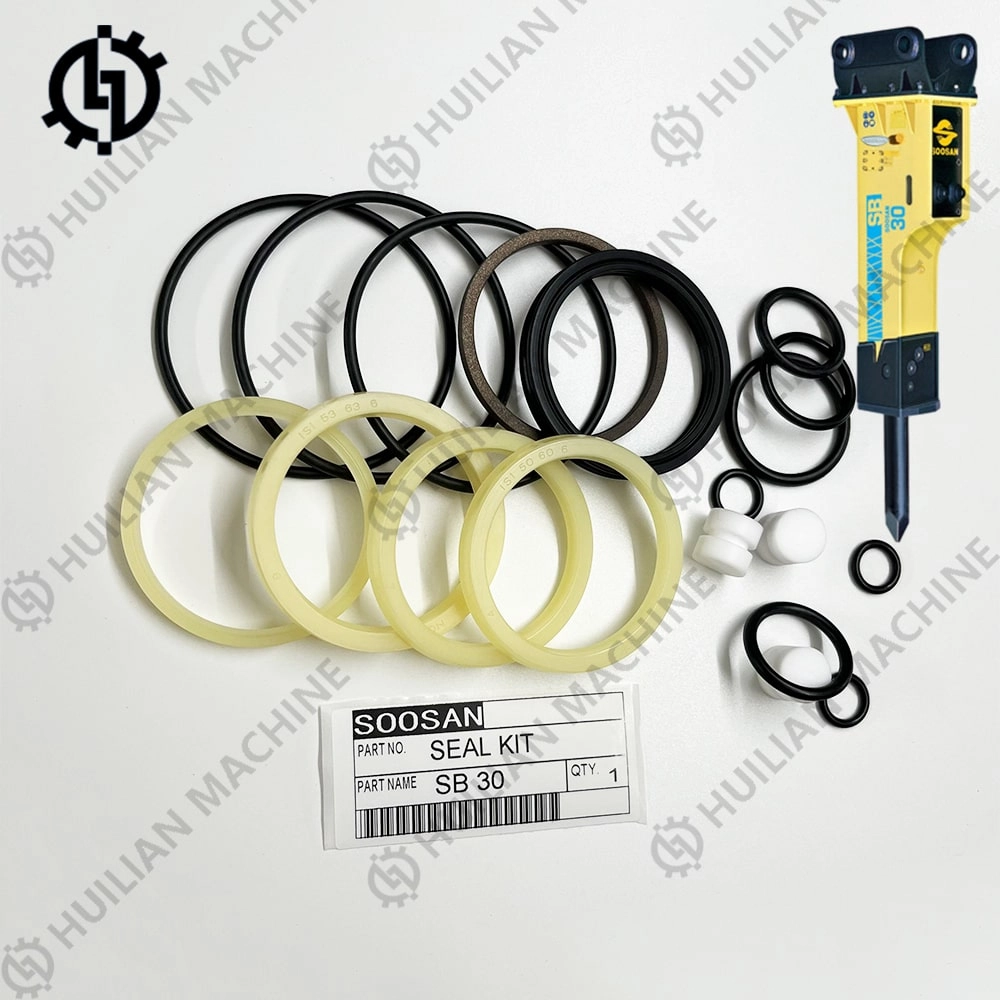
E71012 E7X001 SOOSAN SQ30 SB30Ⅱ SB30 Breaker Seal Kit SB30TS-P SB30Ⅱ TS-P SB30Ⅱ SSL Hydraulic Rock Hammer Parts Oil Repair Kit
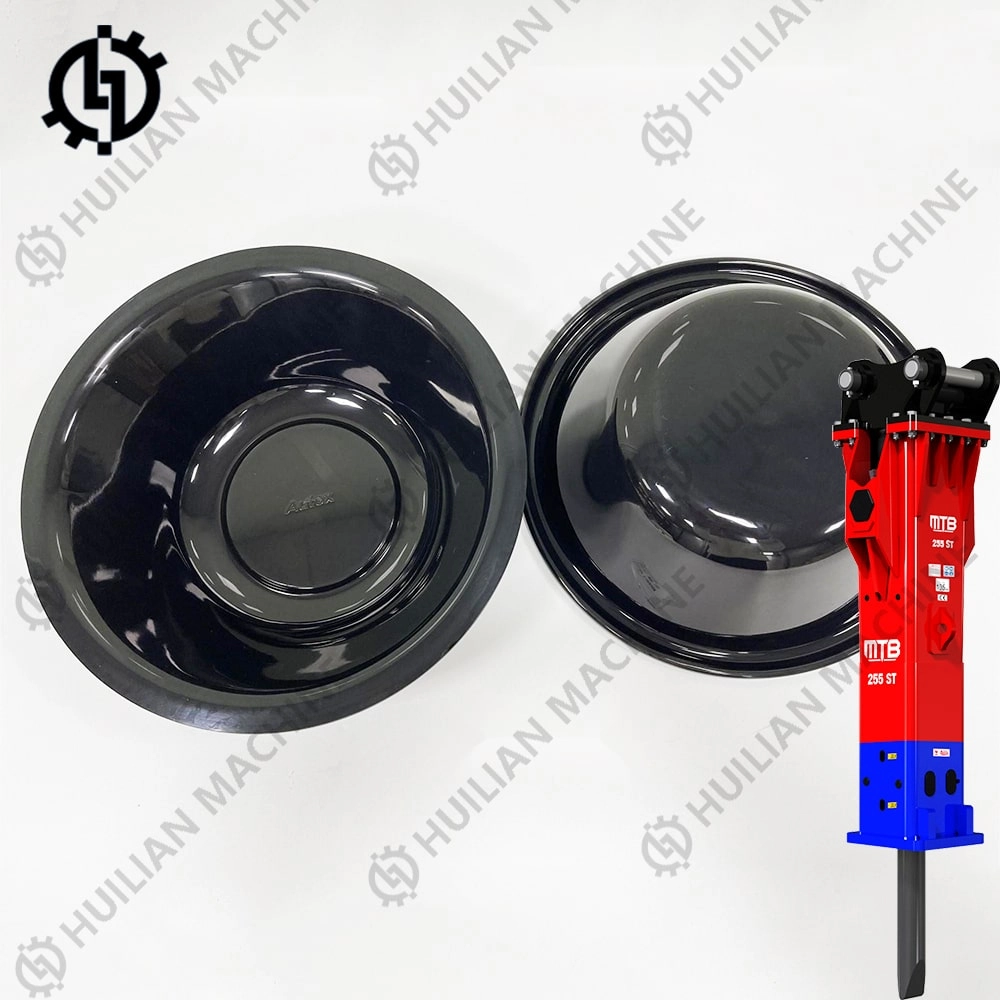
Inan Makina MTB Hydraulic Breaker Parts 45B0116A11 MTB255 MTB MT 255 Diaphragm MTB 255 IQ MTB-255 MTB 255 ST Membrane for Excavator Rock Hammer

Huilian EB-530| SOOSAN Rock Breaker SB30 for 2.5 - 4 Ton Small Excavator
Side type hydraulic breaker : Easy to control, convenient positioning, durable, high working efficiency, strong striking force, long service life, stable operating performance, convenient after-sales service.
Top type hydraulic breaker : Strong impact power; excellent environmental performance; exquisite manufacturing technology; easy maintenance,fast after-sales service
Box type hydraulic breaker :leading heat treatment technology, enhance heat resistance, wear resistance. Under the condition of keeping the oil pressure constant, the cylinder volumeis reduced and the fuel consumption is reduced.The self-developed core is adopted to make the piston cylinder body moredurable and the service life longer.Exposed decks are made of high-strength steel plates to reduce wear.The best efficiency matching with excavator and loader is realized

Huilian Hydraulic Rock Hammer Breaker SB43 for 6-9 Ton SOOSAN Excavator Breaker
Side type hydraulic breaker : Easy to control, convenient positioning, durable, high working efficiency, strong striking force, long service life, stable operating performance, convenient after-sales service.
Top type hydraulic breaker : Strong impact power; excellent environmental performance; exquisite manufacturing technology; easy maintenance,fast after-sales service
Box type hydraulic breaker :leading heat treatment technology, enhance heat resistance, wear resistance. Under the condition of keeping the oil pressure constant, the cylinder volumeis reduced and the fuel consumption is reduced.The self-developed core is adopted to make the piston cylinder body moredurable and the service life longer.Exposed decks are made of high-strength steel plates to reduce wear.The best efficiency matching with excavator and loader is realized
 About us
© 2025 HUILIAN MACHINE. All rights reserved