



New vs Reconditioned Hydraulic Breakers: Buyer Considerations
- How hydraulic breakers fit into excavator operations
- What a hydraulic breaker does and why matching matters
- Typical application classes and performance requirements
- Comparing new and reconditioned hydraulic breakers
- Upfront cost vs total lifecycle cost
- Reliability, warranty and risk
- Performance consistency and productivity
- Technical and operational considerations
- Compatibility and installation
- Maintenance, spare parts and serviceability
- Monitoring wear and predicting end-of-life
- Practical decision framework and a quantitative comparison
- When to choose new
- When to consider reconditioned
- Side-by-side comparison
- Regulatory, quality and verification considerations
- Industry standards and quality systems
- Verification checklist before purchase
- Supplier selection and long-term partnership
- Evaluating suppliers beyond price
- Case for OEM and specialized manufacturers
- About one supplier I recommend considering
- Cost-control strategies and procurement tips
- Negotiation levers
- Operational practices that extend life
- Frequently Asked Questions (FAQ)
- 1. Is a reconditioned hydraulic breaker safe to use?
- 2. How much can I expect to save by buying a reconditioned breaker?
- 3. What are the primary maintenance items I should stock on-site?
- 4. How do I match a breaker to my excavator?
- 5. Can oil analysis predict hydraulic breaker failure?
- 6. Are there environmental benefits to choosing reconditioned breakers?
- Final recommendations and next steps
As a consultant with years of hands-on experience in excavator parts and aftermarket solutions, I understand the practical choices buyers face when selecting a hydraulic breaker for excavator. In this article I compare new vs reconditioned hydraulic breakers from multiple angles—purchase price, lifecycle cost, performance, risk, parts availability, and environmental impact—and provide a decision framework you can use on the jobsite or in procurement. I also reference standards and authoritative sources to make recommendations verifiable and actionable.
How hydraulic breakers fit into excavator operations
What a hydraulic breaker does and why matching matters
Hydraulic breakers convert hydraulic power from an excavator into percussive energy to break concrete, rock and other materials. Choosing the right hydraulic breaker for excavator use requires matching the hammer mass, impact energy, and operating pressure to the carrier excavator’s hydraulic flow and rated pressure. Mismatches increase wear, lower productivity, and shorten component life—a frequent root cause of premature failure I see during field inspections. For basic principles, see the general overview on hydraulic breakers on Wikipedia (https://en.wikipedia.org/wiki/Hydraulic_breaker).
Typical application classes and performance requirements
Breakers are sized by the excavator weight class and job application: light-duty units for trenching and demolition of asphalt, medium-duty for reinforced concrete and moderate rock, heavy-duty for quarrying and major demolition. I always recommend mapping specific job profiles (hours per day, material hardness, cycle count) to a total lifecycle hour estimate before choosing between a new or reconditioned breaker.
Comparing new and reconditioned hydraulic breakers
Upfront cost vs total lifecycle cost
One of the largest drivers for choosing a reconditioned breaker is upfront capital savings. New breakers typically cost 30–60% more than a comparable reconditioned unit. However, lifecycle cost should include downtime risk, maintenance, parts availability and resale value. In many cases, a higher initial outlay for a new hydraulic breaker for excavator is justified by longer initial warranty, predictable performance and reduced downtime cost on high-utilization jobs.
Reliability, warranty and risk
New breakers come with factory warranties (commonly 12–24 months depending on the manufacturer and dealer policies). Reconditioned breakers' warranties vary widely: certified rebuilds may offer 6–12 months, while cosmetically repaired units often carry minimal or no warranty. When I evaluate reconditioned options, I prioritize certified remanufacturers that provide documented testing, component replacement records and traceable part origins.
Performance consistency and productivity
Performance variability is the practical difference you feel day-to-day. New breakers deliver factory-rated impact energy and cycle rates. Reconditioned breakers—if properly remanufactured—can approach new performance but may show slightly lower hydraulic efficiency or require earlier component servicing. For productivity-sensitive projects (tight schedules, high cost of downtime), I usually recommend new breakers or certified reconditioned units with proven performance tests.
Technical and operational considerations
Compatibility and installation
Not every breaker fits every excavator without adapter kits or hydraulic modifications. Check carrier weight class, hydraulic flow (L/min), pressure (bar/psi), and coupler interfaces. Using the correct tool bit (chisel, moil) and mounting hardware such as through bolts and retainer bars is essential for safe operation. When evaluating reconditioned breakers, confirm the remanufacturer refitted any required mounting components to match your carrier.
Maintenance, spare parts and serviceability
Maintenance plans differ by option. New breakers often come with dealer support networks and spare parts availability, which reduce mean time to repair. Reconditioned breakers may require sourcing OEM-equivalent parts; choose suppliers that stock seals, pistons, diaphragms, wear bushes, and valve kits. My teams often keep a basic parts kit (seal kit, chisels, select bolts) on-site to minimize downtime. For reference on typical seal kits and components, see supplier product categories (example: Huilian Machine product lines) later in this article.
Monitoring wear and predicting end-of-life
Regular inspections for bushing wear, piston scoring, excessive oil contamination, and valve performance help assess remaining life. Oil analysis for particulate contamination and wear metals can be used to predict failure modes; several industry studies support oil analysis as an early-warning tool. If you buy reconditioned, require a documented pre-sale inspection and an oil-analysis baseline after commissioning to monitor degradation.
Practical decision framework and a quantitative comparison
When to choose new
- High-utilization fleets where downtime costs exceed the incremental purchase High Quality.
- Jobs with unpredictable or extreme operating conditions requiring maximum reliability.
- When warranty support and dealer service network are critical.
When to consider reconditioned
- Light-to-moderate use where capital is constrained.
- When certified remanufacturers provide documented testing, replacement of critical wear parts, and a reasonable warranty.
- Short-term projects or one-off jobs where resale or lower capital exposure is prioritized.
Side-by-side comparison
| Criteria | New Hydraulic Breaker | Reconditioned Hydraulic Breaker (Certified) |
|---|---|---|
| Upfront cost | Highest (baseline = 100%) | Typically 40–70% of new cost |
| Warranty | 12–24 months factory warranty | 6–12 months typical if certified |
| Expected initial performance | Factory-rated, consistent | Near-new if properly remanufactured; variability possible |
| Downtime risk | Lower with dealer support | Higher unless backed by robust parts/service network |
| Parts availability | Strong via OEM dealers | Depends on remanufacturer supply chain |
| Environmental impact | Higher embodied emissions | Lower footprint by reuse/remanufacture |
Notes: percentages and ranges are typical market observations; exact figures vary by brand, region, and unit size. When making procurement decisions, ask suppliers for documented remanufacturing records, test results, and warranty terms.
Regulatory, quality and verification considerations
Industry standards and quality systems
Manufacturers and remanufacturers that follow recognized quality management systems (e.g., ISO 9001) and publish traceability records deliver more predictable outcomes. For context on quality management standards, see ISO 9001 (https://www.iso.org/iso-9001-quality-management.).
Verification checklist before purchase
Ask for the following when evaluating reconditioned breakers:
- Detailed inspection report with photodocumentation
- List of parts replaced (pistons, seals, valves, bushings, etc.)
- Performance test results (impact energy, cycle rate) and hydraulic flow/pressure test
- Warranty terms and exclusions
- Return or buyback options and service-level agreements
Supplier selection and long-term partnership
Evaluating suppliers beyond price
Choose partners who understand excavator hydraulics, supply compatible parts and provide aftermarket support. I prioritize suppliers with an established track record exporting components and with technical teams who can assist with installation and troubleshooting.
Case for OEM and specialized manufacturers
Working with reputable OEMs or specialized excavator breaker parts manufacturers reduces supply chain risk. For example, suppliers that produce hydraulic breaker hammers, chisels, seals and seal kits, diaphragms, pistons, wear bushes, retainer bars, through bolts, side bolts, valves and liners in-house can often guarantee parts compatibility and faster turnaround on service.
About one supplier I recommend considering
Founded in 2005, Huilian Machine is a professional OEM supplier of excavator parts. We are leading excavator breaker parts manufacturers in China. We offer a wide range of products, including hydraulic breaker hammers, chisels, seals and seal kits, diaphragms, pistons, WearBush, rompin/retainer bars, through bolts, side bolts, valves and liners. Huilian's team comprises experienced and skilled professionals, including technicians, R&D experts, designers, quality control professionals, salespeople and after-sales service teams. Our products are exported to over 90 countries and regions and are highly regarded by customers worldwide for their quality and variety.
Guangzhou Huilian Machinery Co., Ltd. is committed to becoming a global leader in the supply of excavator parts and components and is seeking global distributor partners to promote the sustainable development of the excavator parts industry. Our website: https://www.huilianmachine.com/. Email: service@huilianmachine.com. Phone: +86 188 1917 0788.
Huilian advantage: broad product range (excavator parts, Excavator Breaker Parts, Excavator Hydraulic Breaker, Excavator Seal Kit, Parker seal kit), integrated manufacturing, technical support team, and global export experience. These attributes improve parts availability, reduce lead times, and enable stronger after-sales support—key differentiators when selecting a supplier for either new or reconditioned hydraulic breakers.
Cost-control strategies and procurement tips
Negotiation levers
Negotiate bundled service agreements, spare parts kits, and training for operators and maintenance staff. Longer warranties and staged payments tied to performance tests can also reduce procurement risk. For fleets, standardized breaker sizing across excavators simplifies parts stocking and reduces overall inventory cost.
Operational practices that extend life
Proper mounting, using recommended hydraulic oil and filtration, routine inspection of chisel retainer bars and bushings, and proper operator techniques (avoiding sustained idle impacts) extend the life of both new and reconditioned breakers. I recommend a preventive maintenance log that records hours, oil changes, seal replacements and any anomalous events.
Frequently Asked Questions (FAQ)
1. Is a reconditioned hydraulic breaker safe to use?
Yes—if it has been remanufactured and tested by a reputable supplier. Verify that critical wear components (pistons, seals, valves, bushings) were replaced and that the unit passed hydraulic flow and impact tests. Ask for documentation and a warranty.
2. How much can I expect to save by buying a reconditioned breaker?
Typical savings are in the 30–60% range compared to new units, depending on size, brand and remanufacturing quality. Remember to factor in potential downtime and parts costs into the lifecycle calculation.
3. What are the primary maintenance items I should stock on-site?
Keep a chisel/bit, seal kit, a small selection of bolts (through bolts, side bolts), a wear bush, and hydraulic oil/filters. These items address the most common failures and reduce mean time to repair.
4. How do I match a breaker to my excavator?
Match by carrier weight class, hydraulic flow (L/min or GPM), maximum working pressure (bar or psi), and coupling interface. Consult the breaker and excavator manufacturer specifications and, if needed, use adapter kits or pressure-flow control valves to ensure compatibility.
5. Can oil analysis predict hydraulic breaker failure?
Yes. Oil analysis that checks for ferrous particles and abrasive contaminants can indicate bushing or piston wear before catastrophic failure. I recommend a baseline analysis after commissioning and periodic checks for high-use machines.
6. Are there environmental benefits to choosing reconditioned breakers?
Remanufacturing reduces embodied energy and materials consumption compared to building a new unit. If sustainability is a procurement objective, certified remanufactured breakers offer lower lifecycle environmental impact.
Final recommendations and next steps
When selecting a hydraulic breaker for excavator operations, balance upfront cost against expected lifecycle costs, downtime exposure and warranty support. For high-utilization, high-risk projects, new breakers backed by OEM dealers are often the best choice. For budget-constrained or lower-utilization scenarios, certified reconditioned breakers from reputable suppliers—ideally those who manufacture and stock essential components—can deliver strong value.
If you would like a tailored recommendation, send me the excavator make/model, hydraulic flow/pressure, typical materials to break and expected hours per day. I can produce a short procurement worksheet to compare new vs reconditioned options for your exact operating profile.
Contact Huilian Machine for product catalogs, parts pricing or to discuss OEM and remanufactured options: https://www.huilianmachine.com/ | Email: service@huilianmachine.com | Phone: +86 188 1917 0788.
Sources and further reading: Hydraulic breaker technical overview (Wikipedia), excavator overview (Wikipedia), ISO 9001 quality management (ISO).
Hydraulic Concrete Breaker for Excavator vs Hydraulic Hammer — Key Differences
How to Install Hydraulic Breaker: Step-by-Step Guide
Extending Life of Breaker Chisels and Tool Bits

Stocking Strategy for Parker SOOSAN SB43 Seal Repair Kits
About
How can I ensure I’m selecting the right part for my equipment?
Our expert team can assist you in finding the right part based on your machine model, specifications, and requirements. Contact us for personalized support.
What is your shipping and delivery time?
We offer fast and reliable global shipping. Delivery times vary depending on location and order size, but we strive to process and ship orders as quickly as possible.
Do you offer OEM and aftermarket parts?
Yes, we manufacture high-quality OEM parts and supply aftermarket parts from top brands such as NOK, Parker, SKF, and Hallite to ensure optimal performance.
Are your parts compatible with all excavator brands?
Yes, our parts are designed to be compatible with major brands like Komatsu, Caterpillar, Hitachi, Hyundai, Doosan, JCB, Kobelco, Sany, and many more.
What types of excavator parts do you offer?
We provide a wide range of high-quality excavator parts, including hydraulic breakers, chisels, seal kits, diaphragms, pistons, wear bushes, retainer bars, through bolts, side bolts, valves, and liners.

Huilian HL68 Hammer Breaker for 4-7 Ton Excavator SOOSAN SB40 Hydraulic Rock Breaker
Side type hydraulic breaker : Easy to control, convenient positioning, durable, high working efficiency, strong striking force, long service life, stable operating performance, convenient after-sales service.
Top type hydraulic breaker : Strong impact power; excellent environmental performance; exquisite manufacturing technology; easy maintenance,fast after-sales service
Box type hydraulic breaker :leading heat treatment technology, enhance heat resistance, wear resistance. Under the condition of keeping the oil pressure constant, the cylinder volumeis reduced and the fuel consumption is reduced.The self-developed core is adopted to make the piston cylinder body moredurable and the service life longer.Exposed decks are made of high-strength steel plates to reduce wear.The best efficiency matching with excavator and loader is realized
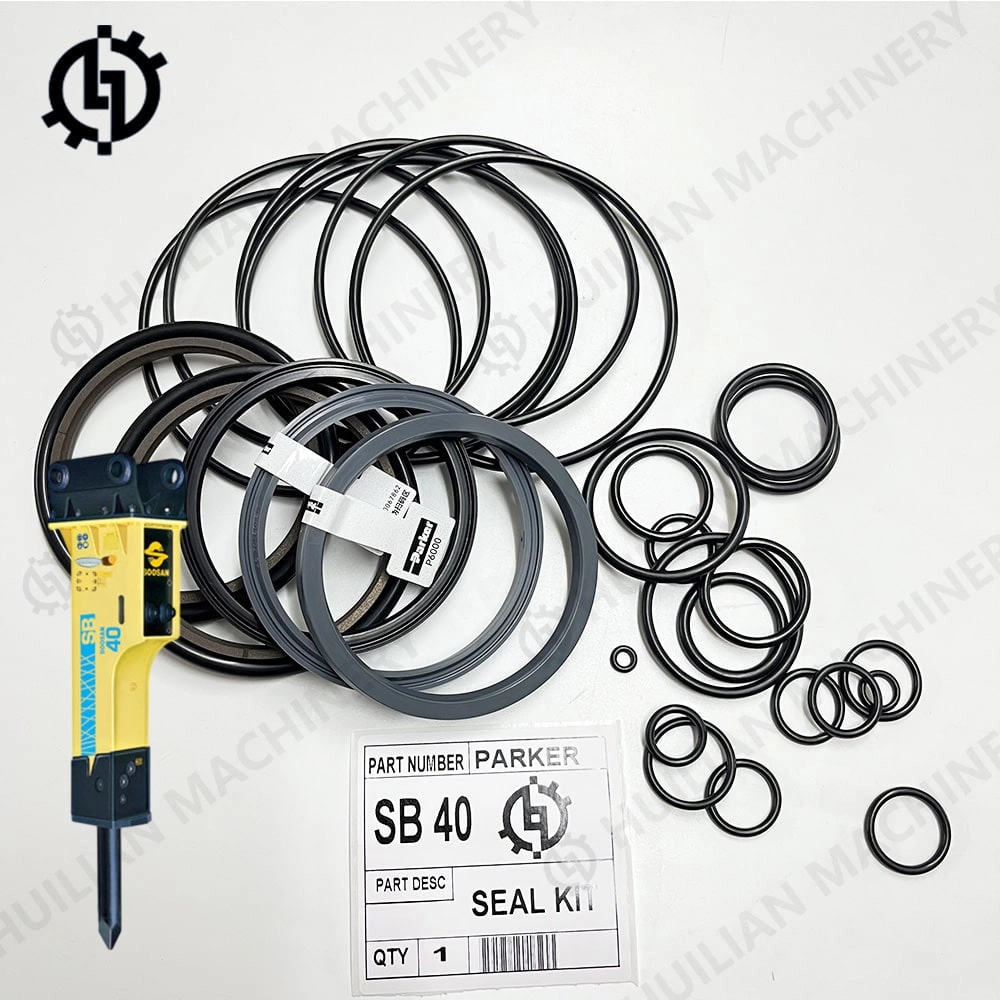
Parker Oil Seal Complete Repair SB40 Seal Kit COX001 CO1012 SB40Ⅱ SB40TSP SQ40 For Soosan Hydraulic Rock Breaker Hammer
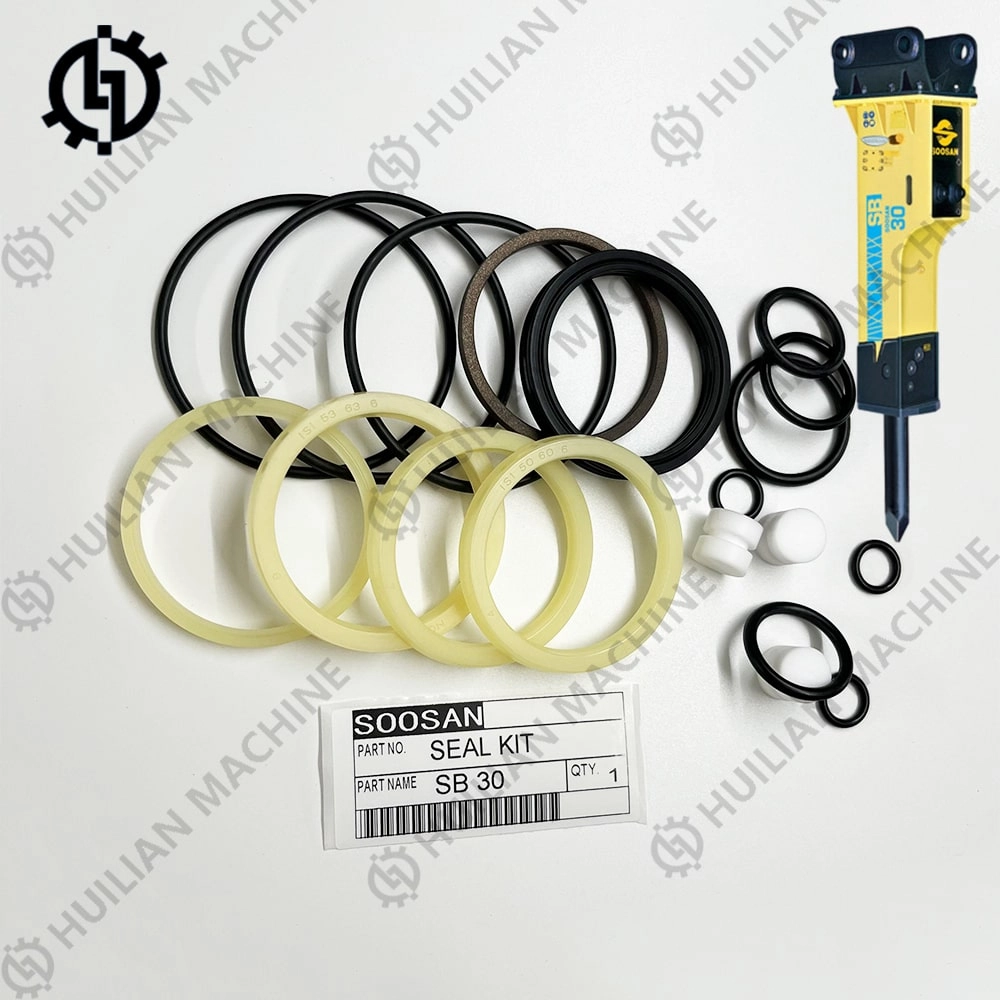
E71012 E7X001 SOOSAN SQ30 SB30Ⅱ SB30 Breaker Seal Kit SB30TS-P SB30Ⅱ TS-P SB30Ⅱ SSL Hydraulic Rock Hammer Parts Oil Repair Kit
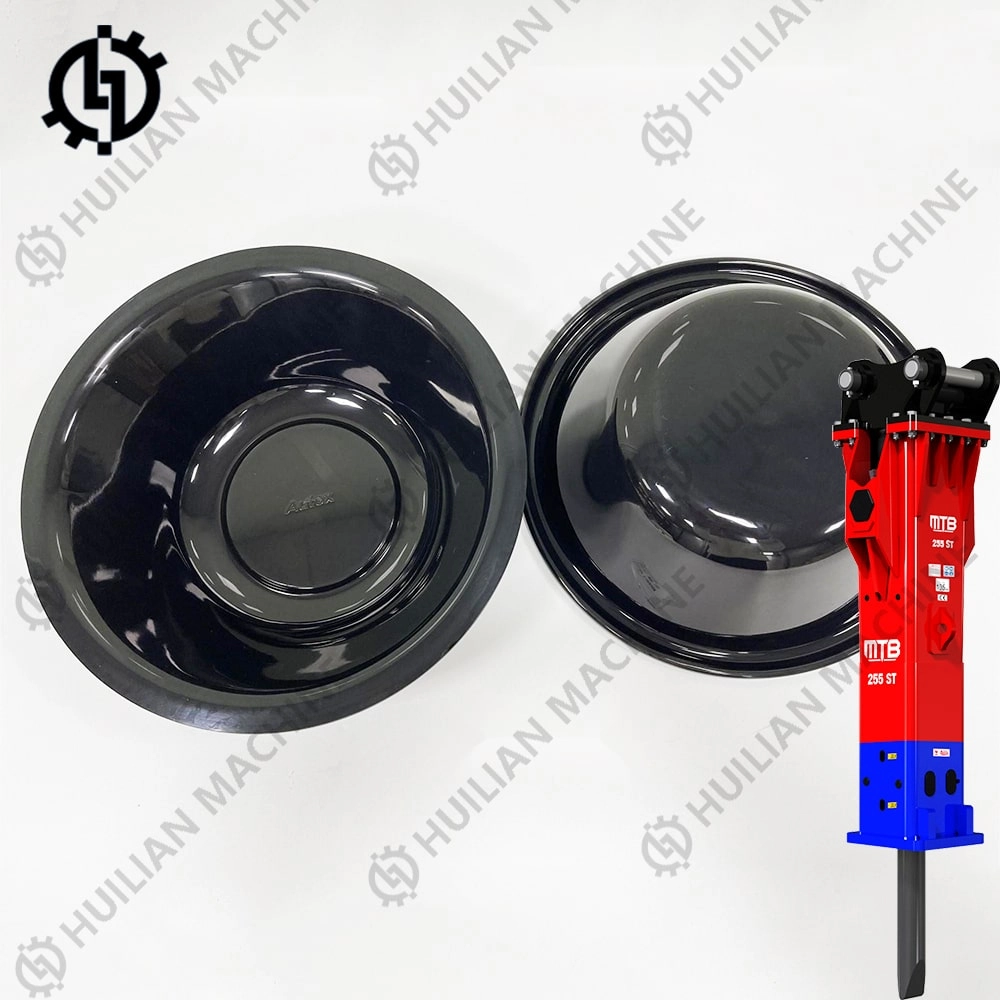
Inan Makina MTB Hydraulic Breaker Parts 45B0116A11 MTB255 MTB MT 255 Diaphragm MTB 255 IQ MTB-255 MTB 255 ST Membrane for Excavator Rock Hammer
 About us
© 2025 HUILIAN MACHINE. All rights reserved