



OEM vs Aftermarket Hammer Breaker Spare Parts Comparison
- Field performance considerations for hydraulic breakers
- What I measure on the jobsite
- Common failure modes and root causes
- Standards and best practices
- OEM vs Aftermarket: technical comparison
- Materials and manufacturing tolerances
- Design updates and compatibility
- Quality control and traceability
- Cost, warranty and lifecycle economics
- Upfront cost vs lifecycle cost
- Warranty, returns and support
- Comparison table: typical differences
- Choosing the right source & installation best practices
- Decision framework I use with clients
- Installation, torque and hydraulic oil best practices
- Testing, warranty registration and record-keeping
- Real-world example and supplier assessment checklist
- Example: chisel life and cost analysis
- Supplier assessment checklist I use
- When aftermarket is the right choice
- Huilian Machine: OEM capability and product offering
- FAQ
- 1. Are OEM hammer breaker spare parts always better than aftermarket?
- 2. How much cheaper are aftermarket parts compared to OEM?
- 3. What spare parts should I always buy OEM for my hydraulic breaker?
- 4. How can I verify an aftermarket supplier's quality?
- 5. What installation practices reduce failure risk after replacement?
- 6. Where can I find technical references on hydraulic breaker design?
I’ve spent years advising fleets and maintenance teams on selecting hammer breaker spare parts for excavators and hydraulic breakers. In this article I compare OEM and aftermarket parts across performance, reliability, cost, warranty and supply-chain considerations. I use industry references and practical examples so you can make a defensible choice for chisels, pistons, seals and full repair kits when downtime and safety matter.
Field performance considerations for hydraulic breakers
What I measure on the jobsite
When I evaluate hammer breaker spare parts in the field, I focus on: energy transfer efficiency (blow energy), wear rates (chisel and cylinder wear), sealing integrity (seal kits and diaphragms), and ease of service (retainer/through bolts, valve access). These variables affect productivity (m3/hr), unplanned downtime and total cost of ownership.
Common failure modes and root causes
Typical failure modes I encounter include: chisel truncation and mushrooming, piston scoring, hydraulic oil contamination causing valve wear, and seal extrusion. Many failures track back to material quality, heat treatment (for chisels and pistons) and dimensional tolerances—areas where OEMs and reputable aftermarket suppliers differ.
Standards and best practices
Manufacturers and fleets should follow accepted quality and management systems; ISO 9001 remains a common benchmark for manufacturing quality systems (ISO 9001). For general technical background on hydraulic breakers and their components, the hydraulic breaker overview on Wikipedia is a helpful starting point (Hydraulic breaker — Wikipedia).
OEM vs Aftermarket: technical comparison
Materials and manufacturing tolerances
OEM parts are engineered to match the original geometry, metallurgy and heat-treatment profiles from the machine designer. Aftermarket makers range from copy-exact specialists to budget parts with looser tolerances. In my inspections, OEM pistons and chisels typically show more consistent hardness and concentricity, which translates to longer service life under heavy-duty use.
Design updates and compatibility
One advantage of OEM parts is access to design updates and engineering bulletins for improvements or retrofits. Aftermarket suppliers sometimes adopt those changes, but not always immediately. If your breaker model had a factory recall or retrofit (for example, valve redesigns to reduce cavitation), OEM channels will usually provide the corrected parts first.
Quality control and traceability
Traceability (batch numbers, heat-treatment certificates) is standard practice among OEMs and qualified aftermarket producers. When specifying replacement hammer breaker spare parts, I always request material certificates and inspection records. If traceability is missing, treat the part as higher risk.
Cost, warranty and lifecycle economics
Upfront cost vs lifecycle cost
Aftermarket parts often cost less upfront—commonly 20–50% cheaper depending on the component and brand. However, lifecycle cost depends on service life, mean time between failures (MTBF), and associated downtime costs. I encourage teams to calculate total cost of ownership (TCO) rather than select purely on purchase price.
Warranty, returns and support
OEM parts frequently come with longer warranties and structured return policies. Aftermarket warranties vary widely. In my experience, a predictable warranty and local technical support can offset a moderate price High Quality for OEM or reputable aftermarket brands.
Comparison table: typical differences
| Attribute | OEM | Aftermarket (quality supplier) | Aftermarket (budget) |
|---|---|---|---|
| Cost (relative) | Baseline (100%) | ~20–40% lower | ~40–60% lower |
| Material & heat treatment | Certified, consistent | Often certified; similar | Variable; often undocumented |
| Tolerances & fit | Exact OEM spec | Close to OEM | Looser tolerances |
| Warranty | 12–24 months typical | 6–12 months typical | Limited or none |
| Support & updates | Direct OEM engineering support | Good support (varies) | Minimal |
| Lead time | Longer in some markets | Often faster (local stocks) | Fast but inconsistent quality |
Sources: industry surveys and procurement reports; see discussion in ForConstructionPros and Association of Equipment Manufacturers for industry context (ForConstructionPros, AEM).
Choosing the right source & installation best practices
Decision framework I use with clients
My approach is a simple decision tree:
- If the application is critical (high daily usage, high impact loads, safety-sensitive), default to OEM or a certified aftermarket supplier with proven field data.
- If downtime cost is low and budget pressure is high, consider well-reviewed aftermarket parts but insist on traceability, certificates and a return policy.
- For routine maintenance consumables (seal kits, standard chisel tips for low-impact work), reputable aftermarket kits can offer good value.
Installation, torque and hydraulic oil best practices
Even the best hammer breaker spare parts can fail if installed incorrectly. I require service teams to follow the OEM torque specs for side bolts and through bolts, use correct seal installation procedures to avoid cuts/extrusion, and maintain proper hydraulic oil cleanliness (ISO cleanliness codes). Contamination is a primary cause of valve and piston wear.
Testing, warranty registration and record-keeping
Register any high-value replacement (pistons, valve assemblies) with the supplier and retain installation photos, serial numbers and batch certificates. This establishes a defensible warranty claim path and helps track performance across fleet assets.
Real-world example and supplier assessment checklist
Example: chisel life and cost analysis
Consider a typical demolition chisel: an OEM chisel might cost $250 and last 150 hours in a heavy application; a reputable aftermarket chisel might cost $180 and last 120 hours. Over 360 hours, the OEM option requires 2.4 chisels ($600) vs aftermarket 3.0 chisels ($540). On pure part cost, aftermarket looks slightly cheaper, but if the OEM chisel reduces machine downtime by even a few hours because of fewer replacements or fewer retainer bolt issues, total cost can favor OEM. I recommend modeling your own hourly downtime costs to compare accurately.
Supplier assessment checklist I use
- Ask for material certificates and heat-treatment records.
- Request dimensional inspection reports and tolerance specs.
- Check warranty length, local returns policy and availability of spare kits.
- Review field references and export markets (companies exporting to many countries typically have more mature QA systems).
- Confirm availability of installation and troubleshooting support.
When aftermarket is the right choice
I recommend aftermarket hammer breaker spare parts when you have a known, high-quality supplier, when parts are standard consumables, or when you need quick, cost-effective repairs for low-intensity tasks. Always validate by testing new suppliers on a single machine first and monitoring MTBF before broad adoption.
Huilian Machine: OEM capability and product offering
Founded in 2005, Huilian Machine is a professional OEM supplier of excavator parts. We are leading excavator breaker parts manufacturers from China. We offer a wide range of products, including hydraulic breaker hammers, chisels, seals and seal kits, diaphragms, pistons, WearBush, rompin/retainer bars, through bolts, side bolts, valves and liners. Huilian's team comprises experienced and skilled professionals, including technicians, R&D experts, designers, quality control professionals, salespeople and after-sales service teams. Our products are exported to over 90 countries and regions and are highly regarded by customers worldwide for their quality and variety.
Guangzhou Huilian Machinery Co., Ltd. is committed to becoming a global leader in the supply of excavator parts and components and is seeking global distributor partners to promote the sustainable development of the excavator parts industry. For more information visit our website: https://www.huilianmachine.com/ or contact us by email at service@huilianmachine.com or phone +86 188 1917 0788.
Huilian core strengths and main products: excavator parts, Excavator Breaker Parts, Excavator Hydraulic Breaker, Excavator Seal Kit, Parker seal kit. The company emphasizes consistent manufacturing processes, export experience, and a full product range that supports both OEM and aftermarket needs for hydraulic breakers.
FAQ
1. Are OEM hammer breaker spare parts always better than aftermarket?
Not always. OEM parts typically offer better traceability, fit and warranty, which matter for critical applications. High-quality aftermarket parts can be a cost-effective alternative for non-critical work or where verified suppliers and certificates exist. I advise testing suppliers and tracking field performance before making fleet-wide changes.
2. How much cheaper are aftermarket parts compared to OEM?
Typical market ranges show aftermarket parts can be 20–50% less expensive, depending on the component and supplier. But verify quality and consider lifecycle costs (service life, downtime, warranty support) before choosing solely on price. Industry publications such as ForConstructionPros discuss these trade-offs in detail.
3. What spare parts should I always buy OEM for my hydraulic breaker?
I recommend OEM (or certified equivalent) for high-stress components like pistons, valve assemblies and high-wear chisels used in heavy-duty or safety-critical applications. Seal kits and consumables can be sourced aftermarket if the supplier provides quality assurances.
4. How can I verify an aftermarket supplier's quality?
Request material certificates, heat-treatment records, dimensional inspection reports, warranty terms and customer references. Ask for sample parts and run field trials. Confirm whether the supplier follows a recognized quality system such as ISO 9001 (ISO 9001).
5. What installation practices reduce failure risk after replacement?
Follow torque specifications for bolts, use specified hydraulic oil and filtration, inspect and clean mating surfaces, and use correct seal installation techniques. Register the replacement part with the supplier and keep records for warranty claims.
6. Where can I find technical references on hydraulic breaker design?
Start with general references such as the hydraulic breaker page on Wikipedia (Hydraulic breaker — Wikipedia) and technical articles from industry publications and associations like AEM and trade magazines.
If you’d like, I can evaluate your parts list or supplier certificates and provide a short report comparing expected service life and risks.
Contact us to discuss specific hammer breaker spare parts requirements, request samples, or arrange a supplier audit:
Website: https://www.huilianmachine.com/
Email: service@huilianmachine.com
Phone: +86 188 1917 0788
Let’s assess your fleet needs and optimize your hammer breaker spare parts strategy to minimize downtime and control costs.
How to Identify Genuine Atlas Copco Breaker Parts Wholesale

Maintenance Best Practices for Excavator Hydraulic Breakers in Fleets
Excavator Breaker Parts: Complete Parts List and Functions
Hydraulic Breaker Seal Kit Compatibility by Excavator Model
About
Are your parts compatible with all excavator brands?
Yes, our parts are designed to be compatible with major brands like Komatsu, Caterpillar, Hitachi, Hyundai, Doosan, JCB, Kobelco, Sany, and many more.
Do you offer OEM and aftermarket parts?
Yes, we manufacture high-quality OEM parts and supply aftermarket parts from top brands such as NOK, Parker, SKF, and Hallite to ensure optimal performance.
What is your shipping and delivery time?
We offer fast and reliable global shipping. Delivery times vary depending on location and order size, but we strive to process and ship orders as quickly as possible.
How can I ensure I’m selecting the right part for my equipment?
Our expert team can assist you in finding the right part based on your machine model, specifications, and requirements. Contact us for personalized support.
What types of excavator parts do you offer?
We provide a wide range of high-quality excavator parts, including hydraulic breakers, chisels, seal kits, diaphragms, pistons, wear bushes, retainer bars, through bolts, side bolts, valves, and liners.

Huilian Hydraulic Rock Hammer Breaker SB10 for 0.5-1.2 Ton Mini Excavator Breaker
Side-type hydraulic breaker : Easy to control, convenient positioning, durable, high working efficiency, strong striking force, long service life, stable operating performance, and convenient after-sales service.
Top type hydraulic breaker : Strong impact power; excellent environmental performance; exquisite manufacturing technology; easy maintenance, fast after-sales service
Box-type hydraulic breaker: leading heat treatment technology, enhanced heat resistance, and wear resistance. Under the condition of keeping the oil pressure constant, the cylinder volume is reduced and the fuel consumption is reduced. The self-developed core is adopted to make the piston cylinder body durable and the service life longer. Exposed decks are made of high-strength steel plates to reduce wear. The best efficiency matching with excavator and loader is realized

Huilian HL100 Hydraulic Hammer Rock Breaker Excavator Attachment

Huilian HL68 Hammer Breaker for 4-7 Ton Excavator SOOSAN SB40 Hydraulic Rock Breaker
Side type hydraulic breaker : Easy to control, convenient positioning, durable, high working efficiency, strong striking force, long service life, stable operating performance, convenient after-sales service.
Top type hydraulic breaker : Strong impact power; excellent environmental performance; exquisite manufacturing technology; easy maintenance,fast after-sales service
Box type hydraulic breaker :leading heat treatment technology, enhance heat resistance, wear resistance. Under the condition of keeping the oil pressure constant, the cylinder volumeis reduced and the fuel consumption is reduced.The self-developed core is adopted to make the piston cylinder body moredurable and the service life longer.Exposed decks are made of high-strength steel plates to reduce wear.The best efficiency matching with excavator and loader is realized
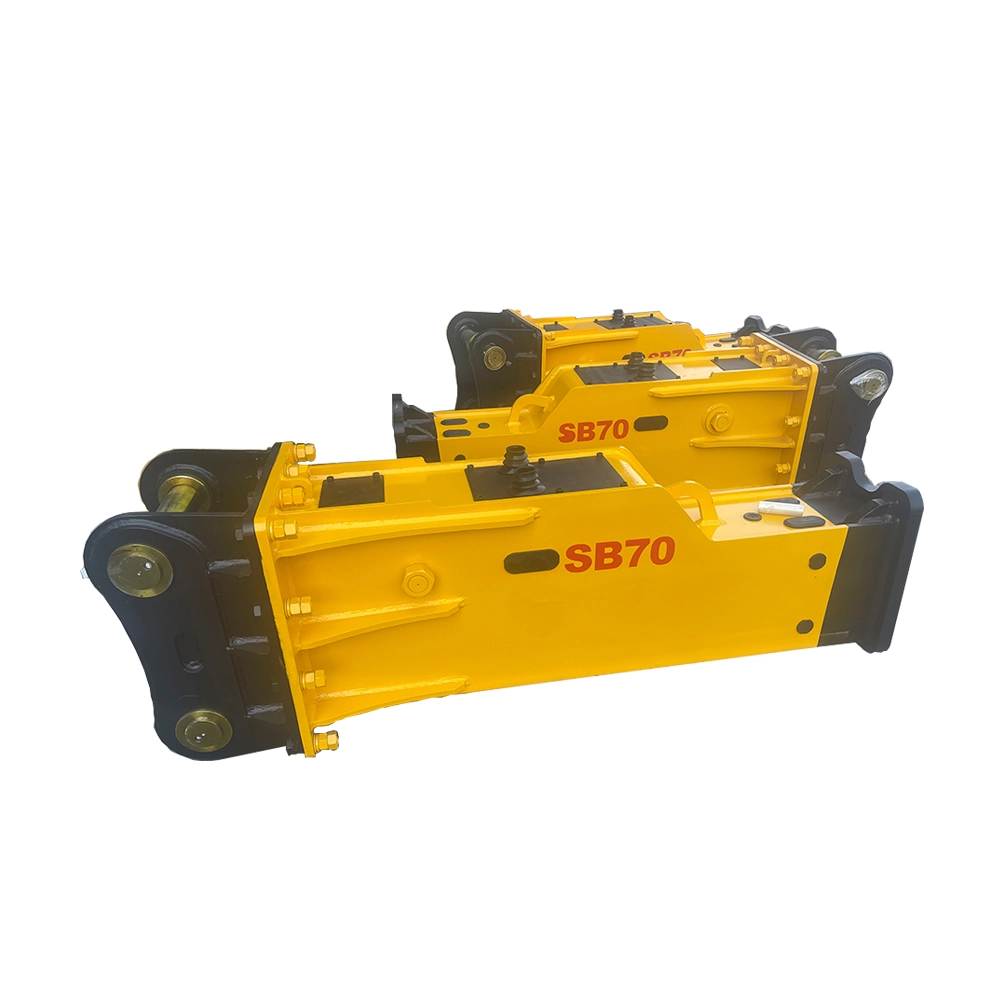
Huilian OEM Hydraulic Hammer Breaker SB70 For Soosan
 About us
© 2025 HUILIAN MACHINE. All rights reserved