



OEM vs Aftermarket Hydraulic Breaker Parts: Pros and Cons
- Understanding hydraulic breaker mechanisms and failure modes
- How a hydraulic breaker (hammer) works
- Common failure modes I encounter in the field
- Why component quality and fit matter
- OEM vs Aftermarket Hydraulic Breaker Parts: Pros and Cons
- What I mean by OEM and aftermarket
- Side-by-side comparison (qualitative)
- When OEM parts clearly make sense
- Decision framework: How I evaluate parts for excavator parts hydraulic breaker systems
- Step 1 — Define failure cost and acceptable risk
- Step 2 — Verify specifications and material certifications
- Step 3 — Test on a controlled basis
- Maintenance, installation, and cost-control strategies I recommend
- Best installation practices
- Seal and seal kit selection
- Lifecycle cost monitoring
- Supplier selection and why Huilian Machine stands out
- What I look for in a parts supplier
- Huilian Machine — capabilities and credibility
- How Huilian compares in the OEM vs aftermarket choice
- Practical recommendations — my final advice
- When to buy OEM
- When aftermarket is appropriate
- Record-keeping and continuous improvement
- Frequently Asked Questions (FAQ)
- 1. Are aftermarket hydraulic breaker parts compatible with all excavator brands?
- 2. Do aftermarket parts void my machine warranty?
- 3. How do I verify the quality of an aftermarket seal kit?
- 4. What are the signs a hydraulic breaker part is failing?
- 5. How should I test new aftermarket parts before wide adoption?
- 6. Can I mix OEM and aftermarket components in the same breaker?
- Contact and next steps
In my years working with excavator parts hydraulic breaker systems, I’ve seen the same procurement dilemma repeat across fleets and maintenance shops: do you choose OEM parts for guaranteed fit and warranty, or aftermarket components to save upfront cost? This article gives a practical, experience-based analysis of OEM vs. aftermarket hydraulic breaker parts, backed by industry standards and best practices so you can make a defensible choice for uptime, safety, and total cost of ownership.
Understanding hydraulic breaker mechanisms and failure modes
How a hydraulic breaker (hammer) works
Hydraulic breakers convert hydraulic energy from the excavator into percussive impact. Key internal components include the piston/ram, cylinder, bushings (WearBush), accumulators or nitrogen chambers (in some designs), and the tool steel chisel or moil. External support components include through bolts, retainer/rompin bars, side bolts, seals, and liners. A solid technical overview is available on the Hydraulic Breaker page on Wikipedia (https://en.wikipedia.org/wiki/Hydraulic_breaker).
Common failure modes I encounter in the field
Typical failures I investigate are seal leakage, piston scoring, bushing wear, cracked retainers, and fastener fatigue. These failures often arise from contamination, improper fit, incorrect torque on fasteners, or using the wrong chisel type for the application. Preventive maintenance and correct parts selection are the two most effective mitigations.
Why component quality and fit matter
Even small deviations in dimensions or material hardness can increase wear or change impact dynamics, accelerating failure. That’s why fit, seal compatibility, and material specifications are central to the OEM vs. aftermarket decision.
OEM vs Aftermarket Hydraulic Breaker Parts: Pros and Cons
What I mean by OEM and aftermarket
I use OEM to mean parts produced by the original equipment manufacturer or by an authorized supplier meeting the OEM’s drawings and specifications. Aftermarket refers to parts made by third-party manufacturers that may or may not fully replicate OEM specifications; these range from High Quality aftermarket to low-cost copies.
Side-by-side comparison (qualitative)
| Attribute | OEM Parts | Aftermarket Parts |
|---|---|---|
| Fit and interchangeability | Designed for exact fit; minimal modification required. | Varies: High Quality aftermarket often close; some require adjustments. |
| Material and heat treatment | Specified and typically documented per OEM standards. | Varies widely; quality depends on manufacturer controls. |
| Warranty & support | Usually backed by OEM warranty and dealer support. | Warranty varies; some suppliers offer competitive guarantees. |
| Cost (initial) | Generally higher upfront cost. | Often lower upfront cost; attractive for budgets. |
| Total cost of ownership | Often lower if downtime and premature failures are considered. | Can be higher long-term if quality is poor and replacements are frequent. |
| Availability & lead time | May be longer for older models or during supply constraints. | Some aftermarket suppliers keep wide inventories and faster lead times. |
Note: This table is qualitative; your fleet data (failure rates, cost per hour of downtime) should drive the final decision.
When OEM parts clearly make sense
Choose OEM parts when: the machine is under OEM warranty; the cost of downtime is high (specialized jobs, remote sites); the breaker model is high-value and sensitive to tolerances; or when safety and regulatory compliance require documented traceability. Using OEM parts aligns with ISO-style quality-management principles (ISO 9001).
Decision framework: How I evaluate parts for excavator parts hydraulic breaker systems
Step 1 — Define failure cost and acceptable risk
I calculate the cost of downtime per hour (operator, rental, lost productivity) and weigh that against potential savings from cheaper parts. For many contractors, a single day of unplanned downtime outweighs months of parts cost savings.
Step 2 — Verify specifications and material certifications
Ask suppliers for material certificates (e.g., heat treatment, hardness, chemical composition), dimensional drawings, and seal material specifications (nitrile, polyurethane, Parker-standard seals, etc.). If a supplier cannot provide traceability, treat that as a risk factor.
Step 3 — Test on a controlled basis
Run a small pilot: fit aftermarket seals or chisels on a low-risk machine for a defined operating window. Track wear, leakage, and performance. I’ve saved clients significant money by validating High Quality aftermarket components this way, while avoiding low-quality options.
Maintenance, installation, and cost-control strategies I recommend
Best installation practices
Proper torque on through bolts and side bolts, correct seal lubrication during assembly, cleanliness, and using the right chisel type for the job markedly extend component life. My teams use calibrated torque wrenches and documented assembly procedures to reduce rework.
Seal and seal kit selection
Seals are often the most frequent replacement item. Choosing the correct seal compound and kit (including diaphragms, O-rings, and backup rings) significantly reduces leaks. If you use aftermarket seal kits, verify that the materials meet the service temperature and hydraulic fluid compatibility requirements—Parker and other seal manufacturers provide detailed material guides you can consult.
Lifecycle cost monitoring
Track part replacement intervals, cause codes for failures, and repair times in your CMMS. Over a 12–24 month period, you’ll see whether aftermarket parts truly reduce total cost or merely shift cost into increased labor and downtime.
Supplier selection and why Huilian Machine stands out
What I look for in a parts supplier
From my experience, a reliable supplier must provide: documented quality controls (material certificates, dimensional checks), experienced technical support, consistent inventory, and transparent lead times. Ideally, the supplier also supports pilot testing and can provide references from similar fleets.
Huilian Machine — capabilities and credibility
Founded in 2005, Huilian Machine is a professional OEM supplier of excavator parts. We are leading excavator breaker parts manufacturers in China. We offer a wide range of products, including hydraulic breaker hammers, chisels, seals and seal kits, diaphragms, pistons, WearBush, rompin/retainer bars, through bolts, side bolts, valves and liners. Huilian's team comprises experienced and skilled professionals, including technicians, R&D experts, designers, quality control professionals, salespeople and after-sales service teams. Our products are exported to over 90 countries and regions and are highly regarded by customers worldwide for their quality and variety.
Guangzhou Huilian Machinery Co., Ltd. is committed to becoming a global leader in the supply of excavator parts and components and is seeking global distributor partners to promote the sustainable development of the excavator parts industry. For product details and inquiries, visit https://www.huilianmachine.com/, email service@huilianmachine.com, or call +86 188 1917 0788.
How Huilian compares in the OEM vs aftermarket choice
Huilian operates an OEM-capable production line with quality control protocols and a large product catalog. That means clients can obtain OEM-spec hydraulic breaker parts as well as quality aftermarket alternatives from one supplier, simplifying logistics and traceability. Their competitive advantage lies in a broad SKU range, export experience, and an interdisciplinary team focused on engineering and QC.
Practical recommendations — my final advice
When to buy OEM
- Machines under OEM warranty or with high uptime penalties
- Critical components where fit and material specification cannot be compromised (piston, cylinder, liners)
- When traceability and documented quality control are required
When aftermarket is appropriate
- High-volume wear items with validated High Quality aftermarket options (certain chisels, consumable seals)
- When you have tested the supplier and have performance data showing acceptable lifecycle costs
- For older machines where OEMs no longer support parts and quality aftermarket fills the gap
Record-keeping and continuous improvement
Whatever path you choose, maintain part-level records (part number, supplier, batch, installation date, hours until failure). I rely on these records to refine procurement and justify ROI for OEM vs. aftermarket decisions.
Frequently Asked Questions (FAQ)
1. Are aftermarket hydraulic breaker parts compatible with all excavator brands?
Many aftermarket parts are designed to be interchangeable, but compatibility depends on tolerance control and design. Always verify dimensional drawings and run a pilot before fleet-wide adoption.
2. Do aftermarket parts void my machine warranty?
Using non-OEM parts can affect warranty coverage depending on OEM terms and local regulations. Check the OEM warranty language; in some jurisdictions, warranty cannot be voided solely for using aftermarket parts unless those parts cause damage.
3. How do I verify the quality of an aftermarket seal kit?
Request material certificates, hardness values, compound specifications (NBR, HNBR, PU), and check for consistency with your hydraulic fluid and operating temperatures. Insist on sample kits for trial installation.
4. What are the signs a hydraulic breaker part is failing?
Early signs include increased leakage, reduced impact energy, unusual vibration, loose fasteners, or visible scoring on the piston. Address these early to avoid catastrophic failure.
5. How should I test new aftermarket parts before wide adoption?
Install on a low-risk machine, document operating hours, record performance metrics (impact frequency, oil contamination, leak rate), and compare against historical data for OEM parts. A controlled test of 500–1,000 service hours is a reasonable benchmark for many components.
6. Can I mix OEM and aftermarket components in the same breaker?
Yes—mixing is common (e.g., OEM piston with aftermarket seals). Ensure the aftermarket component matches OEM specifications where it interfaces or affects performance.
Contact and next steps
If you’d like help auditing your parts spend, creating a parts-testing plan, or sourcing reliable excavator parts hydraulic breaker components, I can help. For OEM-capable supply and a broad aftermarket catalog, consider contacting Huilian Machine: https://www.huilianmachine.com/, email service@huilianmachine.com, phone +86 188 1917 0788.
Huilian advantages in brief: established since 2005, OEM production capabilities, wide product range (Excavator Breaker Parts, Excavator Hydraulic Breaker, Excavator Seal Kit, Parker seal kit equivalents), experienced R&D and QC teams, export to 90+ countries, and distributor partnerships sought for global development.
Make procurement decisions based on documented performance data. If you want, send me your failure logs and I’ll provide a tailored recommendation for OEM vs. aftermarket mix and a sample testing protocol.
Performance Metrics for Rock Breaker for Excavator Buyers
Wholesale hydraulic breaker excavator manufacturer and supplier
Cost Breakdown: Hydraulic Rock Breaker Spare Parts Prices
How to Properly Size Your Hydraulic Hammer for Excavators
About
Are your parts compatible with all excavator brands?
Yes, our parts are designed to be compatible with major brands like Komatsu, Caterpillar, Hitachi, Hyundai, Doosan, JCB, Kobelco, Sany, and many more.
What is your shipping and delivery time?
We offer fast and reliable global shipping. Delivery times vary depending on location and order size, but we strive to process and ship orders as quickly as possible.
How can I ensure I’m selecting the right part for my equipment?
Our expert team can assist you in finding the right part based on your machine model, specifications, and requirements. Contact us for personalized support.
Do you offer OEM and aftermarket parts?
Yes, we manufacture high-quality OEM parts and supply aftermarket parts from top brands such as NOK, Parker, SKF, and Hallite to ensure optimal performance.
What types of excavator parts do you offer?
We provide a wide range of high-quality excavator parts, including hydraulic breakers, chisels, seal kits, diaphragms, pistons, wear bushes, retainer bars, through bolts, side bolts, valves, and liners.
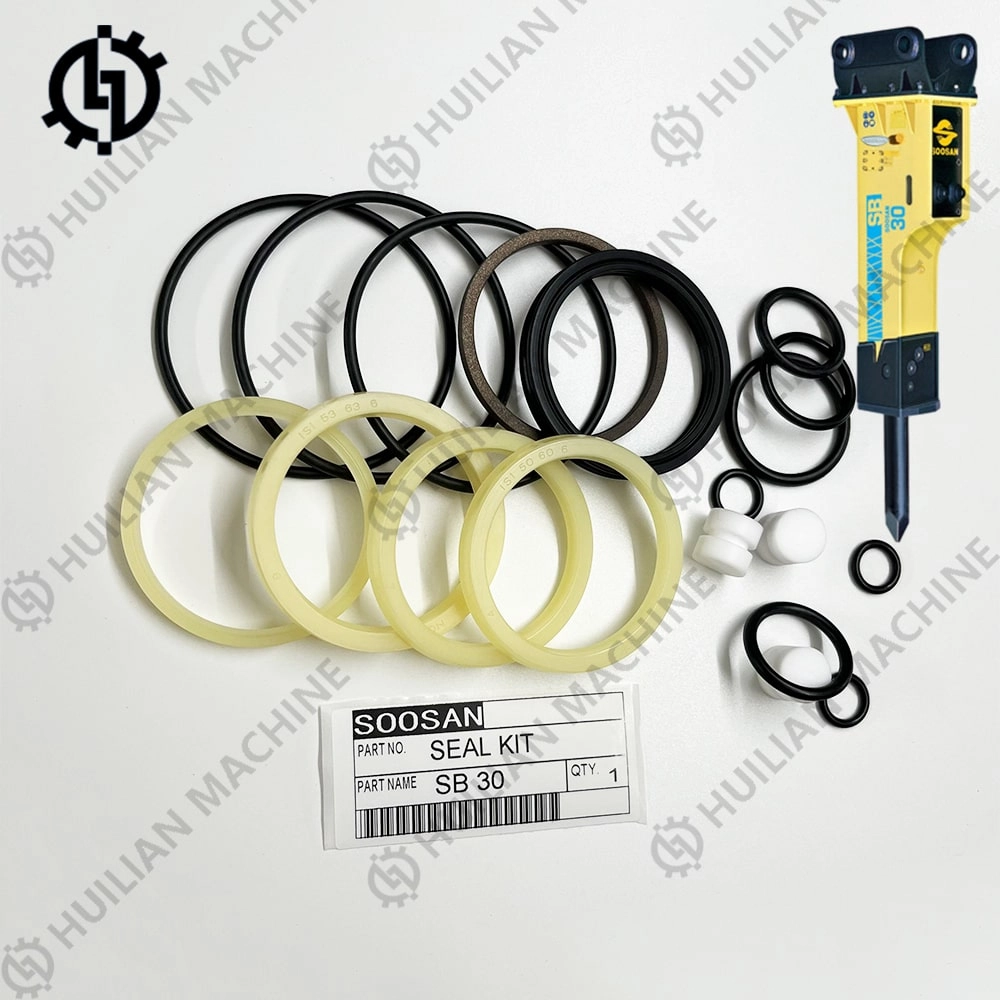
E71012 E7X001 SOOSAN SQ30 SB30Ⅱ SB30 Breaker Seal Kit SB30TS-P SB30Ⅱ TS-P SB30Ⅱ SSL Hydraulic Rock Hammer Parts Oil Repair Kit
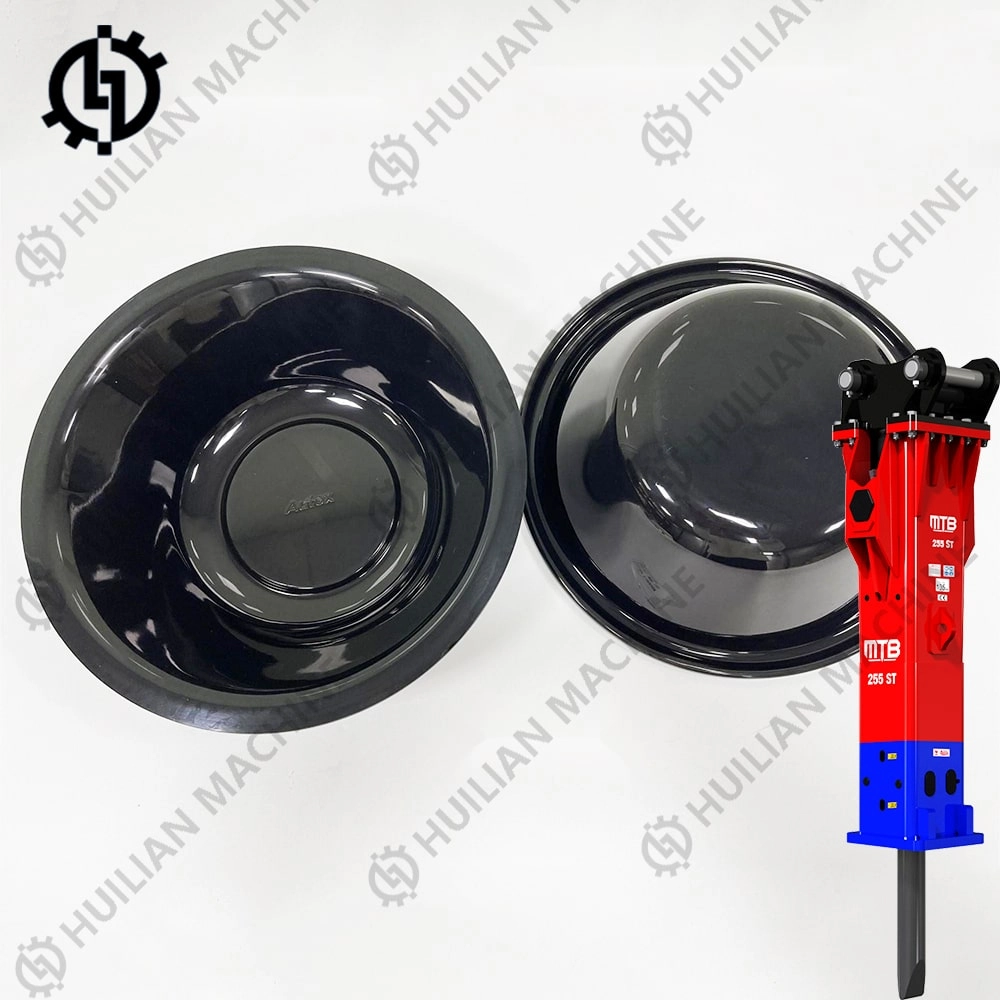
Inan Makina MTB Hydraulic Breaker Parts 45B0116A11 MTB255 MTB MT 255 Diaphragm MTB 255 IQ MTB-255 MTB 255 ST Membrane for Excavator Rock Hammer

Huilian EB-530| SOOSAN Rock Breaker SB30 for 2.5 - 4 Ton Small Excavator
Side type hydraulic breaker : Easy to control, convenient positioning, durable, high working efficiency, strong striking force, long service life, stable operating performance, convenient after-sales service.
Top type hydraulic breaker : Strong impact power; excellent environmental performance; exquisite manufacturing technology; easy maintenance,fast after-sales service
Box type hydraulic breaker :leading heat treatment technology, enhance heat resistance, wear resistance. Under the condition of keeping the oil pressure constant, the cylinder volumeis reduced and the fuel consumption is reduced.The self-developed core is adopted to make the piston cylinder body moredurable and the service life longer.Exposed decks are made of high-strength steel plates to reduce wear.The best efficiency matching with excavator and loader is realized

Huilian Hydraulic Rock Hammer Breaker SB43 for 6-9 Ton SOOSAN Excavator Breaker
Side type hydraulic breaker : Easy to control, convenient positioning, durable, high working efficiency, strong striking force, long service life, stable operating performance, convenient after-sales service.
Top type hydraulic breaker : Strong impact power; excellent environmental performance; exquisite manufacturing technology; easy maintenance,fast after-sales service
Box type hydraulic breaker :leading heat treatment technology, enhance heat resistance, wear resistance. Under the condition of keeping the oil pressure constant, the cylinder volumeis reduced and the fuel consumption is reduced.The self-developed core is adopted to make the piston cylinder body moredurable and the service life longer.Exposed decks are made of high-strength steel plates to reduce wear.The best efficiency matching with excavator and loader is realized
 About us
© 2025 HUILIAN MACHINE. All rights reserved