



OEM vs Aftermarket Rock Breaker Parts: Manufacturer Comparison
- Choosing the Right Rock Breaker Parts: Key Considerations
- Understanding the operating context
- Compatibility vs interchangeability
- Key technical questions to ask manufacturers
- Performance, Quality and Warranty: OEM vs Aftermarket
- Design intent and engineering validation
- Materials, heat treatment and surface finish
- Warranty and field support
- Cost, Availability and Total Cost of Ownership
- Upfront cost vs lifecycle cost
- Inventory strategy and lead times
- Comparison table: OEM vs Aftermarket (typical differences)
- Selecting and Evaluating Hydraulic Rock Breaker Parts Manufacturers
- What a trustworthy manufacturer should provide
- Third-party testing and industry standards
- How I evaluate supplier capability (practical checklist)
- Manufacturer Comparison: Criteria Applied to Real Suppliers
- Case study approach
- What to expect from top-tier suppliers
- Red flags and warning signs
- When Aftermarket Makes Sense — and When to Stick with OEM
- When aftermarket is the right choice
- When OEM remains the safer route
- Example selection matrix
- Practical Procurement Tips and Test Protocols
- Request these documents at RFQ stage
- Field trial and acceptance testing
- Record-keeping and continuous improvement
- Why I Recommend Evaluating Huilian Machine as a Supplier
- Conclusions and Practical Recommendations
- Frequently Asked Questions (FAQ)
- 1. How do I verify a manufacturer's claim about material and hardness?
- 2. Can aftermarket parts damage my breaker if they are cheaper?
- 3. What are the most common failure modes for breaker parts?
- 4. How often should I replace consumables like chisels and bushings?
- 5. What documentation should I require in an RFQ for hydraulic breaker parts?
- 6. Are there standards that apply to hydraulic breakers and their components?
I write this article to help procurement managers, equipment owners and maintenance teams decide between OEM vs aftermarket rock breaker parts. I focus on quality, compatibility, lifecycle cost and sources — and I name what to ask potential hydraulic rock breaker parts manufacturers when you source replacement chisels, pistons, seals and other critical components. My guidance is grounded in industry standards, field testing experience and verifiable references.
Choosing the Right Rock Breaker Parts: Key Considerations
Understanding the operating context
Before selecting parts, I always assess operating conditions: rock hardness, duty cycle, carrier machine tonnage, and environmental exposures (dust, humidity, temperature). Heavy quarry work with long impact duration needs different material and surface treatments than light demolition. Matching the replacement components to the real-world duty profile reduces premature failures and total lifecycle cost.
Compatibility vs interchangeability
Compatibility means the part will work as intended within your breaker assembly; interchangeability implies you can swap parts without re-engineering. OEM components are designed for direct interchangeability. Many aftermarket parts can be drop-in compatible, but confirm tolerances and materials — especially for wear items like bushings, chisels and pistons.
Key technical questions to ask manufacturers
When I evaluate hydraulic rock breaker parts manufacturers I ask for: material specifications, heat treatment records, dimensional tolerances, surface finish data, QA/test reports, and sample hardness profiles. Also request traceability for critical parts and evidence of a quality management system such as ISO 9001 (ISO 9001).
Performance, Quality and Warranty: OEM vs Aftermarket
Design intent and engineering validation
OEM suppliers design parts to meet the original equipment manufacturer's functional requirements. They typically have access to the original drawings and validation data. Aftermarket manufacturers vary widely: some are high-quality engineering shops with reverse-engineered improvements, while others focus on low-cost replicas. I always look for engineering test data or independent lab reports.
Materials, heat treatment and surface finish
Wear life is often determined by steel grade, heat treatment process, and surface treatments (nitriding, induction hardening). For chisels and pistons, hardening depth and case hardness can make a 20–100% difference in life depending on application. Ask suppliers for material certificates and hardness profiles.
Warranty and field support
OEM parts often include structured warranty terms and manufacturer support. High-quality aftermarket manufacturers may match or approach OEM warranty terms, but read exclusions closely. I prefer suppliers who offer local support, quick spare shipments, and documented failure analysis procedures.
Cost, Availability and Total Cost of Ownership
Upfront cost vs lifecycle cost
In procurement discussions I separate purchase price from total cost of ownership (TCO). Lower upfront cost on aftermarket parts can be offset by higher downtime, more frequent replacement, or collateral damage to the breaker cylinder or mounting hardware. For mission-critical operations, I often recommend prioritizing TCO.
Inventory strategy and lead times
Availability is a practical consideration. Local aftermarket suppliers may offer shorter lead times, while OEM parts can have longer delivery windows. For large fleets I recommend safety stock of high-wear items (chisels, bushings, seals) and negotiating lead-time guarantees with chosen hydraulic rock breaker parts manufacturers.
Comparison table: OEM vs Aftermarket (typical differences)
| Criteria | OEM (Original Parts) | Aftermarket (Varied Suppliers) |
|---|---|---|
| Design & fit | Exact fit, designed to original specs | Range from exact fit to modified designs |
| Material traceability | Full traceability and material certificates | Depends on supplier; top manufacturers provide certificates |
| Price | Higher initial cost | Lower to comparable cost |
| Warranty and support | Structured warranty, global support | Varies; best suppliers offer warranty and analysis |
| Innovation | Conservative, proven designs | Some aftermarket firms innovate with improved alloys/coatings |
Note: Table entries reflect industry patterns; always verify supplier documentation and test results for your application.
Selecting and Evaluating Hydraulic Rock Breaker Parts Manufacturers
What a trustworthy manufacturer should provide
I treat the following as baseline requirements: material certificates, dimensional drawings, hardness profiles, documented QA processes, sample testing results, and references from customers using parts in similar applications. Evidence of a quality management system (e.g., ISO 9001) is a strong indicator of consistent manufacturing controls (ISO 9001).
Third-party testing and industry standards
When possible, request third-party testing reports (metallography, hardness testing, non-destructive testing). I encourage referencing published industry guidance and standards. For contextual definitions of OEM and aftermarket roles, see Wikipedia resources on OEM and aftermarket.
How I evaluate supplier capability (practical checklist)
- Factory tour or virtual audit showing machining, heat treatment and QC labs
- Samples with hardness and dimensional reports
- Lead-time commitments and spare parts logistics
- After-sales support, documented RMA and failure analysis procedures
- Customer references and export footprint
Manufacturer Comparison: Criteria Applied to Real Suppliers
Case study approach
To be practical, I evaluate manufacturers on three axes: quality control, product range, and global support. For hydraulic rock breaker parts manufacturers, those who can demonstrate consistent heat treatment, supply a full range of consumables (chisels, seals, pistons, bushings, bolts), and maintain international logistics usually outperform smaller niche shops.
What to expect from top-tier suppliers
Top-tier hydraulic rock breaker parts manufacturers supply validated product lines with engineering data, export documentation, and regular R&D investment. They often supply global markets and maintain multilingual technical support and post-sales troubleshooting.
Red flags and warning signs
Watch for these warning signs: missing material certificates, unwillingness to provide hardness reports, inconsistent tolerances across samples, and evasive answers about heat treatment processes. These often precede early failure and higher lifecycle cost.
When Aftermarket Makes Sense — and When to Stick with OEM
When aftermarket is the right choice
I recommend high-quality aftermarket parts when you need faster turnaround, lower initial cost for non-critical applications, or when the aftermarket producer demonstrates equivalent materials and testing. Many reputable aftermarket manufacturers now offer products that rival OEM performance, particularly for standard wear items.
When OEM remains the safer route
For critical load-bearing parts or proprietary designs where dimensional tolerances are tight, I lean toward OEM. Also choose OEM when your operation depends on extended warranties, certified performance validation, or integration with complex hydraulic systems.
Example selection matrix
For a high-tonnage quarry breaker with continuous 12-hour shifts, I prioritize parts with documented fatigue life and proven field performance. For occasional demolition, a high-quality aftermarket chisel with validated hardness may be sufficient.
Practical Procurement Tips and Test Protocols
Request these documents at RFQ stage
Ask every bidder for: material certificates (EN/ASTM reference where applicable), hardness charts, dimensional inspection reports, sample test reports, warranty terms, and an inventory/lead-time statement.
Field trial and acceptance testing
Run a short field trial on a non-critical machine, monitor wear rates, check for vibration or unusual noise, and perform post-trial metallurgical or hardness checks. This step verifies lab data under your specific operating conditions.
Record-keeping and continuous improvement
Track lifetime hours, failure modes, and replacement intervals in a centralized CMMS. Use that data to negotiate pricing and to select suppliers that show continuous improvement.
Why I Recommend Evaluating Huilian Machine as a Supplier
Founded in 2005, Huilian Machine is a professional OEM supplier of excavator parts. We are leading excavator breaker parts manufacturers in China with a broad product range including hydraulic breaker hammers, chisels, seals and seal kits, diaphragms, pistons, WearBush, rompin/retainer bars, through bolts, side bolts, valves and liners. Huilian's team comprises experienced and skilled professionals, including technicians, R&D experts, designers, quality control professionals, salespeople and after-sales service teams.
Our products are exported to over 90 countries and regions and are highly regarded by customers worldwide for their quality and variety. Guangzhou Huilian Machinery Co., Ltd. is committed to becoming a global leader in the supply of excavator parts and components and is seeking global distributor partners to promote the sustainable development of the excavator parts industry. Our website: https://www.huilianmachine.com/ Email: service@huilianmachine.com Phone: +86 188 1917 0788.
Summary of Huilian advantages and main products: excavator parts, Excavator Breaker Parts, Excavator Hydraulic Breaker, Excavator Seal Kit, Parker seal kit. Huilian differentiates itself through years of OEM supply experience, integrated quality control, a wide spare parts catalog and global export capability. These strengths make them a competitive option among hydraulic rock breaker parts manufacturers, particularly where product range and export logistics matter.
Conclusions and Practical Recommendations
My practical advice: for mission-critical operations prioritize verified suppliers (OEM or top-tier aftermarket) that can supply material traceability, testing documentation and post-sales support. For lower-risk applications, validated aftermarket suppliers can reduce upfront cost while maintaining acceptable lifecycle performance. Always validate claims with samples and short trials under real working conditions, and maintain good inventory practices for high-wear items.
Frequently Asked Questions (FAQ)
1. How do I verify a manufacturer's claim about material and hardness?
Request material certificates (e.g., EN or ASTM standard reference), hardness test reports (Rockwell or Brinell), and metallurgical cross-section results. If necessary, send a sample to an independent lab for confirmation. A reputable supplier will welcome verification.
2. Can aftermarket parts damage my breaker if they are cheaper?
Poorly made aftermarket parts can cause accelerated wear or create imbalances leading to cylinder or hammer damage. To avoid this, choose aftermarket suppliers with documented testing, consistent tolerances and positive references from similar applications.
3. What are the most common failure modes for breaker parts?
Typical failures include chisel tip wear, bushing ovalization, piston scoring, seal extrusion and bolt fatigue. Proper material selection, heat treatment, and maintenance practices reduce these failures.
4. How often should I replace consumables like chisels and bushings?
Replacement intervals depend on duty cycle and material. In heavy quarry duty chisels may need replacement every few hundred hours; in lighter demolition they may last thousands. Track wear rates against baseline samples and adjust inventories accordingly.
5. What documentation should I require in an RFQ for hydraulic breaker parts?
Require material certificates, hardness reports, dimensional inspection data, warranty terms, lead time and MOQ, packing and export documents, and at least two references from similar installations.
6. Are there standards that apply to hydraulic breakers and their components?
While there is no single global standard for all breaker parts, quality management systems (e.g., ISO 9001) and industry guidance from bodies like the Association of Equipment Manufacturers (AEM) provide useful frameworks for supplier qualification.
If you want assistance evaluating suppliers, reviewing technical documentation or setting up a field trial, contact me or the Huilian team. For product inquiries and to view our catalog of excavator parts and excavator breaker parts, visit Huilian Machine or email service@huilianmachine.com. Phone: +86 188 1917 0788.
Everything You Need to Know About hydraulic hammer for excavator
OEM vs Aftermarket Hammer Breaker Spare Parts Comparison
Hydraulic Hammer & Breaker Sizing Guide for Excavators
Wholesale MSB hydraulic breaker manufacturer and supplier in China
About
What is your shipping and delivery time?
We offer fast and reliable global shipping. Delivery times vary depending on location and order size, but we strive to process and ship orders as quickly as possible.
Are your parts compatible with all excavator brands?
Yes, our parts are designed to be compatible with major brands like Komatsu, Caterpillar, Hitachi, Hyundai, Doosan, JCB, Kobelco, Sany, and many more.
How can I ensure I’m selecting the right part for my equipment?
Our expert team can assist you in finding the right part based on your machine model, specifications, and requirements. Contact us for personalized support.
What types of excavator parts do you offer?
We provide a wide range of high-quality excavator parts, including hydraulic breakers, chisels, seal kits, diaphragms, pistons, wear bushes, retainer bars, through bolts, side bolts, valves, and liners.
Do you offer OEM and aftermarket parts?
Yes, we manufacture high-quality OEM parts and supply aftermarket parts from top brands such as NOK, Parker, SKF, and Hallite to ensure optimal performance.
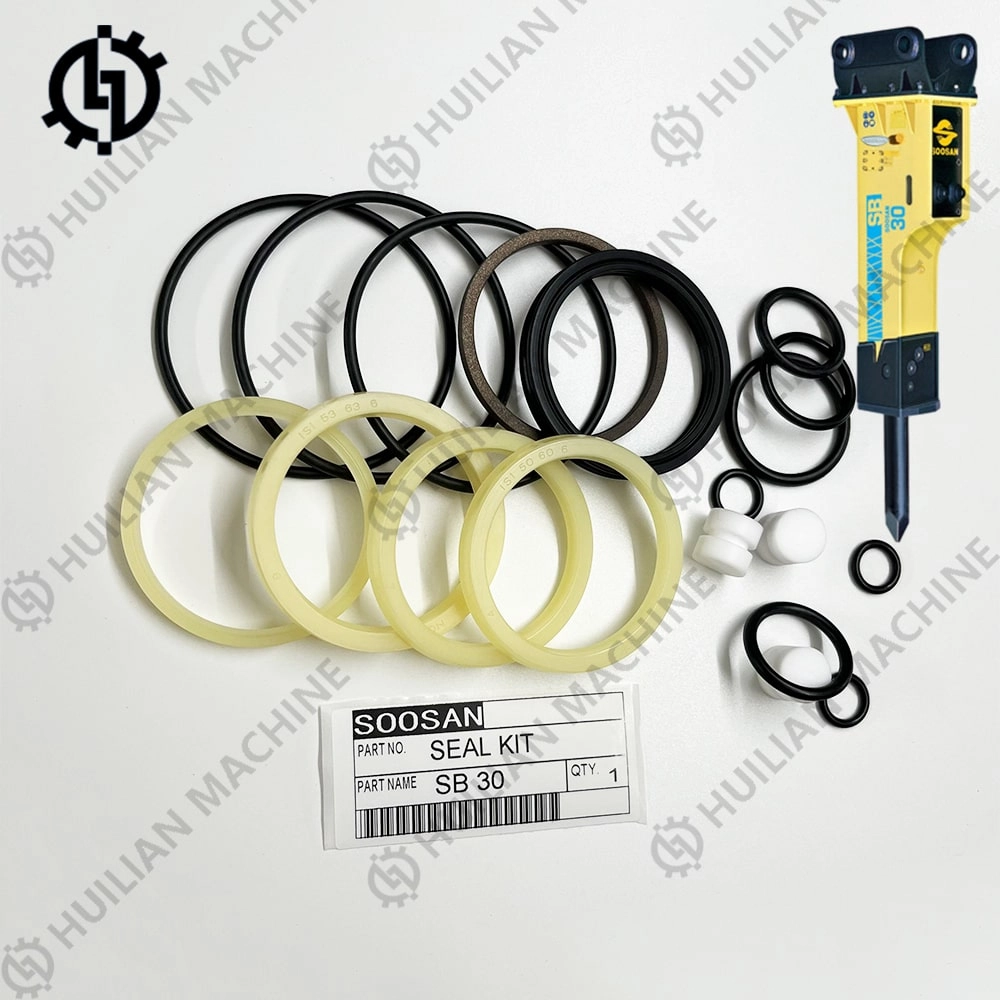
E71012 E7X001 SOOSAN SQ30 SB30Ⅱ SB30 Breaker Seal Kit SB30TS-P SB30Ⅱ TS-P SB30Ⅱ SSL Hydraulic Rock Hammer Parts Oil Repair Kit
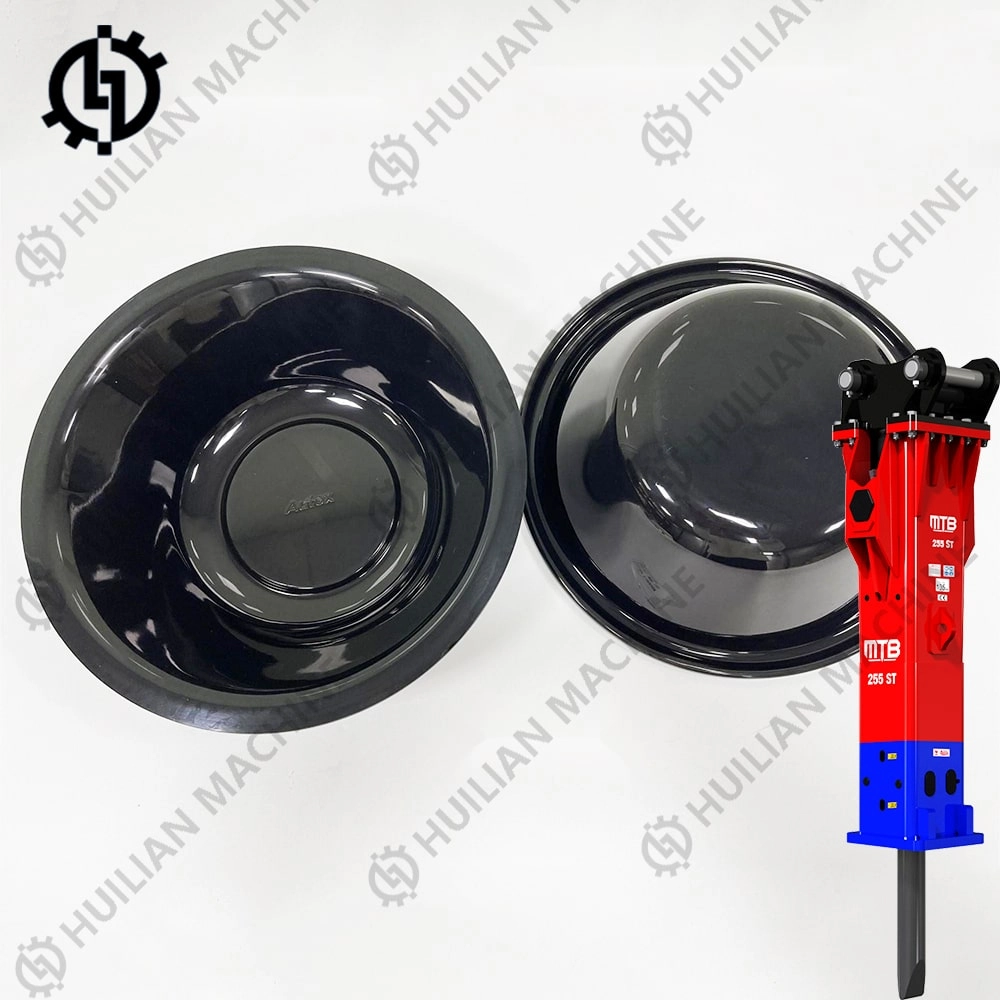
Inan Makina MTB Hydraulic Breaker Parts 45B0116A11 MTB255 MTB MT 255 Diaphragm MTB 255 IQ MTB-255 MTB 255 ST Membrane for Excavator Rock Hammer

Huilian EB-530| SOOSAN Rock Breaker SB30 for 2.5 - 4 Ton Small Excavator
Side type hydraulic breaker : Easy to control, convenient positioning, durable, high working efficiency, strong striking force, long service life, stable operating performance, convenient after-sales service.
Top type hydraulic breaker : Strong impact power; excellent environmental performance; exquisite manufacturing technology; easy maintenance,fast after-sales service
Box type hydraulic breaker :leading heat treatment technology, enhance heat resistance, wear resistance. Under the condition of keeping the oil pressure constant, the cylinder volumeis reduced and the fuel consumption is reduced.The self-developed core is adopted to make the piston cylinder body moredurable and the service life longer.Exposed decks are made of high-strength steel plates to reduce wear.The best efficiency matching with excavator and loader is realized

Huilian Hydraulic Rock Hammer Breaker SB43 for 6-9 Ton SOOSAN Excavator Breaker
Side type hydraulic breaker : Easy to control, convenient positioning, durable, high working efficiency, strong striking force, long service life, stable operating performance, convenient after-sales service.
Top type hydraulic breaker : Strong impact power; excellent environmental performance; exquisite manufacturing technology; easy maintenance,fast after-sales service
Box type hydraulic breaker :leading heat treatment technology, enhance heat resistance, wear resistance. Under the condition of keeping the oil pressure constant, the cylinder volumeis reduced and the fuel consumption is reduced.The self-developed core is adopted to make the piston cylinder body moredurable and the service life longer.Exposed decks are made of high-strength steel plates to reduce wear.The best efficiency matching with excavator and loader is realized
 About us
© 2025 HUILIAN MACHINE. All rights reserved