



Moil vs. Blunt vs. Wedge: How to Pick the Perfect Hydraulic Breaker Hammer Chisel for Any Job
- What is a Hydraulic Breaker Hammer Chisel?
- Quick Summary & Key Takeaways
- The Moil Point: The All-Rounder for General Demolition
- The Blunt Tool: Maximum Impact for Secondary Breaking
- Wedge and Chisel Points: Precision for Trenching
- Data Comparison Table: Moil vs. Blunt vs. Wedge
- Common Mistakes & Expert Tips for Extending Tool Life
- How Guangzhou Huilian Machines Co., Ltd Delivers Industry-Leading Hydraulic Breaker Solutions
- Conclusion & Call to Action
- Frequently Asked Questions
- How do I know when to replace my hydraulic breaker chisel?
- Can I use a moil point for trenching?
- What causes a hydraulic hammer bit to break prematurely?
- How often should I grease my hydraulic breaker hammer chisel?
- What is the difference between transverse and longitudinal wedge chisels?
- Does rock hardness dictate which hydraulic hammer tool I should use?
- What is 'blank firing' and why is it bad for my breaker tool?
- How does proper bushing clearance affect chisel lifespan?
What is a Hydraulic Breaker Hammer Chisel?
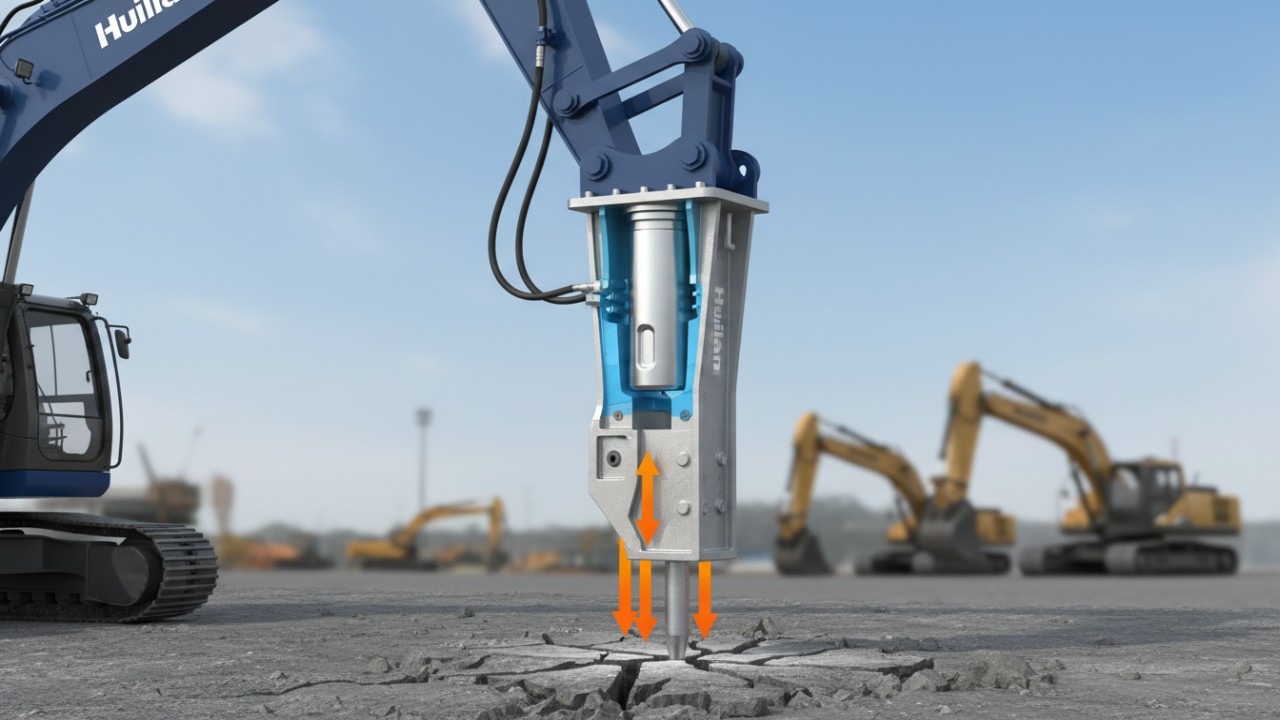
A hydraulic breaker hammer chisel is the heavy-duty, replaceable steel working tool attached to the lower end of an excavator's hydraulic hammer. It serves as the primary contact point, transferring immense kinetic energy from the breaker’s piston directly into the substrate.
The chisel acts as the primary interface between your multi-ton excavator and the rigid earth. Inside the hammer, a precision-machined piston accelerates downward, driven by highly pressurized hydraulic fluid and nitrogen gas. When this piston strikes the top of the chisel (the shank), it transfers a massive shockwave of kinetic energy. Selecting the correct geometry—such as moil, blunt, or wedge—determines exactly how this energy interacts with the rock or concrete. Using the wrong tool limits breaking efficiency, causes excessive recoil, and increases the risk of metallurgical failure (as detailed in metallurgical failure analysis, where repeated inappropriate cyclic stress causes metal fatigue and eventual snapping).
- Energy Transfer: Converts raw hydraulic fluid pressure into directional kinetic impact force.
- Material Penetration: Fractures dense materials through targeted stress points.
- Asset Protection: Absorbs and dissipates shock to protect the excavator boom and the hammer's internal components.
Quick Summary & Key Takeaways
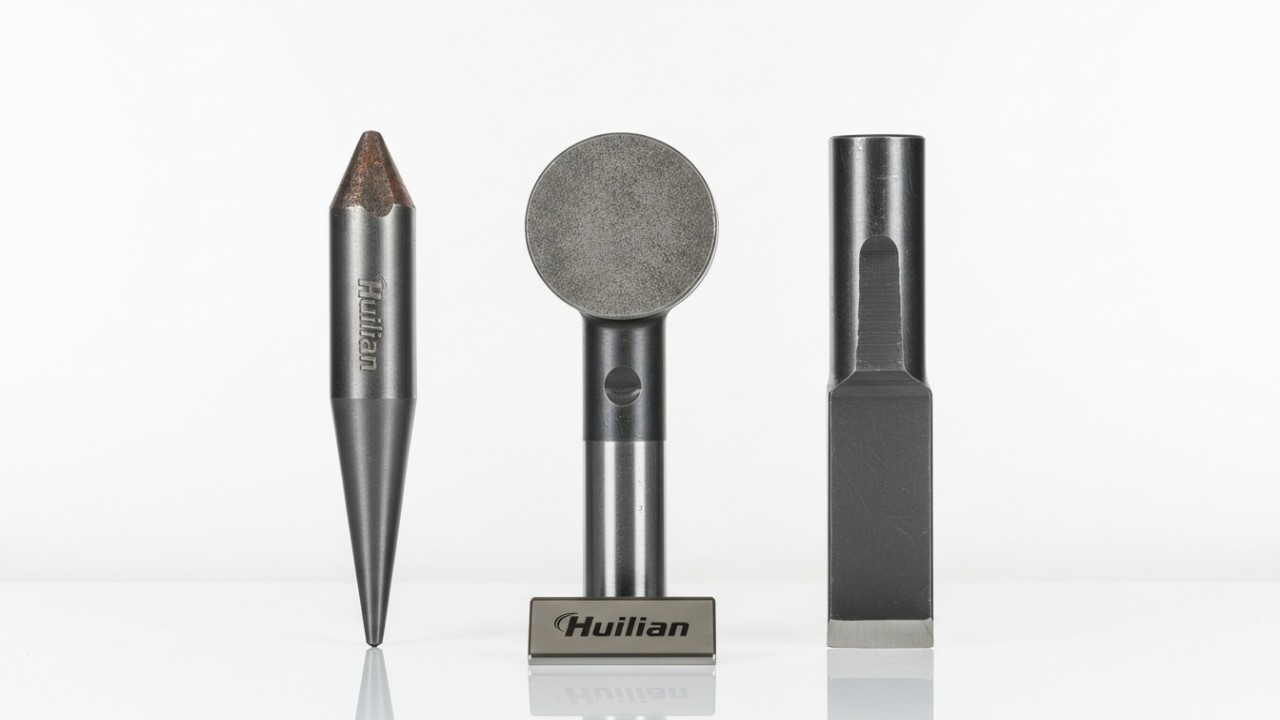
Selecting the correct tool maximizes productivity and prevents mechanical damage. Your choice depends entirely on the material's compressive strength and the specific job site requirements, directly impacting the overall longevity of your heavy construction equipment and internal breaker components.
Understanding the different hydraulic hammer bit types ensures you achieve the best return on investment for your heavy machinery attachments. Here are the core distinctions that operators must memorize:
- Moil Point: Best for general demolition, standard concrete, and materials needing deep, penetrating strikes.
- Blunt Tool: Ideal for secondary breaking, oversized boulders, and hard rock where surface shattering is required without piercing.
- Wedge/Chisel: Perfect for trenching, asphalt cutting, and sedimentary rock requiring directed, straight-line energy.
Proper tool selection drastically extends the lifespan of the breaker hammer chisel, as well as the internal wear bushings, reducing costly downtime.
The Moil Point: The All-Rounder for General Demolition
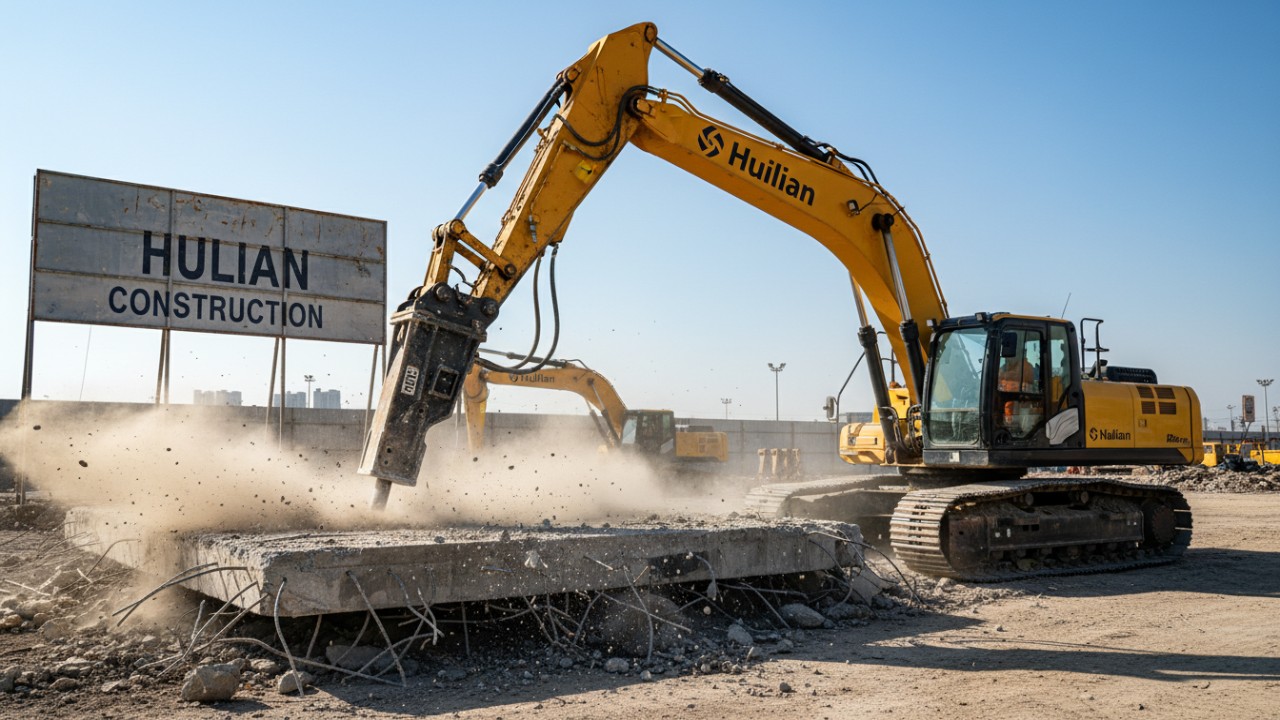
The moil point features a sharply tapered, conical tip designed to concentrate maximum impact force into a very small surface area. It works by driving a wedge effect directly into the material to split it from the inside out.
When evaluating the moil point vs chisel, the moil is widely considered the ultimate general-purpose tool on any construction site. It relies on pure penetration to accomplish its task.
- Primary Uses: Standard reinforced concrete demolition, highway road construction, foundation removal, and moderately hard rock excavation.
- Working Principle: The conical point acts exactly like a traditional hand wedge, exploiting microscopic cracks in the material and forcing them outward.
- Limitations and Risks: Because of its shape, the moil point can easily become embedded or stuck in highly elastic or soft materials. Inexperienced operators often make the critical error of using a stuck moil point as a pry bar to shift debris. This introduces extreme lateral force, which the steel is not designed to withstand, leading to immediate breakage.
The Blunt Tool: Maximum Impact for Secondary Breaking
A blunt tool features a completely flat face that distributes kinetic energy over a wide surface area rather than piercing the substrate. It functions through sheer impact shock and compressive stress to shatter brittle materials efficiently and safely.
When examining rock breaker blunt tool applications, operators rely on this flat, broad profile specifically to reduce oversized boulders in quarries and mines. Because the tool deliberately does not penetrate the rock, it significantly reduces the risk of side-loading and becoming trapped.
- Ideal Substrates: High-density igneous rock, granite, slag processing, and quarry secondary breaking.
- Physics of Impact: It sends massive, concussive shockwaves through the boulder, shattering it entirely from the surface without getting stuck.
- Reduced Wear: Because the blunt tool stays securely on the surface of the rock, it minimizes the risk of blank firing, thereby protecting the hydraulic hammer retaining pin from absorbing violent, unloaded recoil energy.
- Hardness Consideration: Geologists and mining engineers often reference the Mohs scale of mineral hardness to assess rock properties; blunt tools are specifically engineered for crystalline materials at the highest end of this scale where penetration is nearly impossible.
Wedge and Chisel Points: Precision for Trenching
Wedge and chisel points feature a flat, blade-like edge available in either transverse or longitudinal orientations. They provide highly directional breaking power, allowing heavy equipment operators to guide the fracture line along a specific, predictable dimensional path.
Wedges are the absolute best choice for trenching, dimensional excavation, and any application where the operator needs to control the exact line of the break.
- Transverse Orientation (Cross-Cut): The blade cuts parallel to the excavator's tracks. This is ideal for digging trenches directly in front of the machine, pulling the material toward the cab.
- Longitudinal Orientation (In-Line): The blade cuts perpendicular to the tracks. This is used when the machine drives alongside the trench line, breaking the wall down as it moves forward.
- Applications: Asphalt cutting, removing layered sedimentary rock, and precision foundation profiling.
- Warning: Using a wedge requires strict operator alignment. Improper angle of attack forces severe bending stress onto the bit, rapidly degrading both the tool and the internal bushing components.
Data Comparison Table: Moil vs. Blunt vs. Wedge
Comparing hydraulic tools side-by-side helps operators quickly match the chisel geometry to the specific substrate. This data-driven approach minimizes daily downtime, maximizes impact efficiency, and prevents catastrophic mechanical failures on demanding industrial construction and excavation job sites.
Use the following industry standard comparison matrix to guide your next attachment purchase and ensure you are using the right tool for the job:
| Tool Type | Primary Application | Working Principle | Ideal Substrate |
|---|---|---|---|
| Moil Point | General Demolition & Prep | Penetration / Internal Splitting | Concrete, Moderately Hard Rock |
| Blunt Tool | Secondary Breaking | Shockwave / Compressive Fracture | Oversized Boulders, Slag, Igneous Rock |
| Wedge/Chisel | Trenching & Profiling | Directional Splitting / Cutting | Asphalt, Sedimentary Rock, Trench Lines |
Common Mistakes & Expert Tips for Extending Tool Life
Proper maintenance and correct operating techniques are the only ways to guarantee maximum tool life. Neglecting routine lubrication or utilizing poor attacking angles causes rapid overheating, severe friction welding, and premature steel snapping during heavy daily operations.
Consistent hydraulic breaker tool maintenance ensures your investment remains profitable. Keep these expert strategies in mind to maximize your equipment's operational lifespan:
- Consistent Lubrication: Grease the tool shank every two hours of continuous use with high-temperature molybdenum grease. This prevents metal-on-metal friction welding between the shank and the bushing.
- Avoid the Pry Bar Mistake: Never use the chisel to pry or move heavy debris. This introduces extreme side-loading stress that ruins the tool and cracks the internal components.
- Prevent Blank Firing: Never fire the hammer unless the tool is pressed firmly against solid material. Blank firing shoots the piston’s immense kinetic energy directly into the hydraulic hammer retaining pin, destroying it rapidly.
- Dust Control Compliance: Breaking rock and concrete generates hazardous fine silica dust. Modern job sites must implement water suppression systems or sealed cabins to comply with the Occupational Safety and Health Administration (OSHA) regulations regarding respirable crystalline silica exposure.
How Guangzhou Huilian Machines Co., Ltd Delivers Industry-Leading Hydraulic Breaker Solutions
Since 2005, Guangzhou Huilian Machines Co., Ltd has stood as a premier OEM supplier of excavator parts, providing perfectly engineered hydraulic breaker hammer chisels that meet the most demanding global standards for quality, extreme durability, and peak performance.
Operating under our highly regarded brand, Huilian, our team comprises experienced R&D experts, technicians, and quality control professionals dedicated to solving the industry's toughest excavation challenges.
- Premium Metallurgy: Our chisels are forged from advanced alloys and undergo proprietary metallurgical heat treatments, resulting in maximum impact durability that resists cracking and fatigue.
- Comprehensive Product Catalog: We don't just supply the chisel. We offer a complete, wide range of products including excavator hydraulic breakers, Parker seal kits, diaphragms, pistons, WearBush units, rompin/retainer bars, through bolts, side bolts, valves, and liners.
- Global Reach: With our products exported to over 90 countries and regions, we have the field experience to match the exact tool geometry to your job site's specific rock hardness.
Guangzhou Huilian Machinery Co., Ltd. is committed to becoming a global leader in the supply of excavator parts, constantly seeking global distributor partners to promote the sustainable development of the industry.
Conclusion & Call to Action
Choosing between a moil, blunt, or wedge tool is the single most critical decision an operator makes before initiating a demolition or excavation project. Proper selection dictates heavy equipment efficiency, job site safety, and overall hydraulic breaker longevity.
Matching the correct chisel geometry to the substrate maximizes impact energy while significantly reducing equipment wear. Whether you are conducting general demolition with a moil point, shattering granite with a blunt tool, or cutting perfect trenches with a wedge, your choice defines your success. Remember to prioritize consistent greasing, avoid the dangers of blank firing, and enforce proper operator technique to get the highest ROI out of your attachments.
Contact Guangzhou Huilian Machines Co., Ltd today to discuss your specific needs.
Frequently Asked Questions
How do I know when to replace my hydraulic breaker chisel?
You should replace your chisel when the tip is severely blunted beyond its original geometry or if you notice deep cracks. Additionally, if the diameter of the shank has worn down and creates excessive play inside the bushing, it is time for a replacement.
Can I use a moil point for trenching?
While a moil point can break the material, it is highly inefficient for trenching because it fractures rock in a circular, outward pattern. A wedge or chisel point is much better suited for trenching because it directs the energy in a straight line, creating clean, predictable trench walls.
What causes a hydraulic hammer bit to break prematurely?
The most common causes of premature failure are blank firing, inadequate lubrication, and using the tool as a pry bar to move heavy debris. Operating in extreme cold without properly warming up the tool, or pushing the breaker continuously beyond its heat threshold, can also cause catastrophic metallurgical failure.
How often should I grease my hydraulic breaker hammer chisel?
Industry best practices dictate that you should manually grease the chisel every two hours of continuous operation using high-quality molybdenum paste. If your breaker is equipped with an auto-lube system, you should visually inspect the tool shank daily to ensure the system is dispensing grease properly.
What is the difference between transverse and longitudinal wedge chisels?
A transverse (cross-cut) wedge runs perpendicular to the excavator's boom, making it ideal for cutting trenches directly in front of the machine. A longitudinal (in-line) wedge runs parallel to the boom, which is generally used when the excavator is tracking and driving alongside the trench line.
Does rock hardness dictate which hydraulic hammer tool I should use?
Absolutely. Hard, brittle, and highly abrasive rock requires a blunt tool to create massive shockwaves that shatter the material from the surface. Softer, sedimentary rock or standard reinforced concrete is better handled by a moil point that utilizes deep penetration to split the material apart.
What is 'blank firing' and why is it bad for my breaker tool?
Blank firing occurs when the hammer strikes the chisel, but the chisel is not pressed firmly against a solid, resistant material. Instead of transferring the piston's energy into the rock, the force is absorbed entirely by the tool's retaining pin and the hammer's front head, leading to rapid, severe mechanical failure.
How does proper bushing clearance affect chisel lifespan?
The bushing is responsible for keeping the chisel perfectly aligned with the breaker's internal striking piston. If the bushing is worn out, the chisel will sit at a slight angle. This causes the piston to strike the shank unevenly, creating micro-fractures that will eventually snap the tool in half.


About
How can I ensure I’m selecting the right part for my equipment?
Our expert team can assist you in finding the right part based on your machine model, specifications, and requirements. Contact us for personalized support.
What is your shipping and delivery time?
We offer fast and reliable global shipping. Delivery times vary depending on location and order size, but we strive to process and ship orders as quickly as possible.
Do you offer OEM and aftermarket parts?
Yes, we manufacture high-quality OEM parts and supply aftermarket parts from top brands such as NOK, Parker, SKF, and Hallite to ensure optimal performance.
Are your parts compatible with all excavator brands?
Yes, our parts are designed to be compatible with major brands like Komatsu, Caterpillar, Hitachi, Hyundai, Doosan, JCB, Kobelco, Sany, and many more.
What types of excavator parts do you offer?
We provide a wide range of high-quality excavator parts, including hydraulic breakers, chisels, seal kits, diaphragms, pistons, wear bushes, retainer bars, through bolts, side bolts, valves, and liners.





Getting started is easy 
Contact with our experts to find the best excavator parts solutions for your needs. Discover how Huilian can enhance your equipment's performance and efficiency.


Get in touch
 About us
© 2025 HUILIAN MACHINE. All rights reserved