



Hydraulic Breaker Chisel Hardness and Material Guide
- Why material and hardness matter for breaker chisels
- Performance, wear and energy transfer
- Failure modes and the role of metallurgy
- Common materials and heat-treatment strategies
- Steel families used for chisels
- Heat treatment approaches I recommend
- Hydraulic Breaker Chisel Hardness and Material Guide
- Recommended hardness ranges by zone and application
- How I choose tip vs shank hardness for specific jobs
- Hardness testing and verification
- Choosing and maintaining hydraulic breaker spare parts chisel in the field
- Matching chisel design to breaker and application
- Inspection intervals and preventative maintenance
- Field repair options and when to replace
- Comparative material table and supplier evaluation
- Huilian Machine — manufacturer capabilities and why I recommend them
- Practical checklist before buying chisels
- Supplier documentation
- Field compatibility and warranty
- FAQ
- 1. What hardness should the tip of a hydraulic breaker chisel be?
- 2. Can I regrind a hardened chisel tip to extend life?
- 3. How do I check if a chisel is made from the claimed material?
- 4. Why do some chisels fail by brittle fracture despite high hardness?
- 5. Are more expensive chisels always better?
- 6. How often should I inspect chisels in heavy-duty use?
- Contact and call to action
I write from years of hands-on experience in excavator breaker parts development and aftermarket supply. This guide explains how chisel material and hardness affect performance, wear life and risk of failure for hydraulic breaker spare parts chisel, and gives practical selection, testing and maintenance advice you can use today. I include verifiable references to hardness standards and metallurgical principles so you can evaluate suppliers and set realistic expectations for service life.
Why material and hardness matter for breaker chisels
Performance, wear and energy transfer
When I assess a hydraulic breaker chisel, I first consider how energy is transferred from the hammer piston into the tool steel and then into the rock. Hardness at the chisel tip controls abrasive wear resistance; a harder tip sustains sharp geometry and penetrates better in rock, reducing cycle time. However, excessive hardness without proper core toughness increases the risk of brittle fracture (chipping or catastrophic breakage). This is why chisels are engineered with a hardened working tip and a tougher, more ductile shank.
Failure modes and the role of metallurgy
Typical failure modes I encounter are: tip wear (blunting), shank bending, surface cracks from fatigue, and brittle fracture. Metallurgy and heat treatment determine whether a chisel will wear slowly or fail suddenly. For background on hardness scales and why we measure hardness, see the Rockwell hardness overview on Wikipedia: https://en.wikipedia.org/wiki/Rockwell_scale. For general heat-treatment principles, see: https://en.wikipedia.org/wiki/Heat_treatment.
Common materials and heat-treatment strategies
Steel families used for chisels
In my experience, most heavy-duty chisels are made from one of these steel families:
- Chromium-molybdenum steels (e.g., 42CrMo) — good balance of strength, hardenability and toughness. See: https://en.wikipedia.org/wiki/Chromium_molybdenum_steel.
- Boron-alloyed steels — boron improves hardenability allowing deep hardening after quench; commonly used in wear parts: https://en.wikipedia.org/wiki/Boron_steel.
- Manganese (Hadfield) steel — exceptionally tough and work-hardening, but not suitable for tips requiring high initial hardness; used for components that need to absorb impact without fracturing: https://en.wikipedia.org/wiki/Manganese_steel.
Heat treatment approaches I recommend
Two common and effective strategies I specify are:
- Through-hardening with tempered core — useful when the whole bar must resist wear; final tempering controls toughness.
- Carburize/induction harden tip — hard, wear-resistant surface (high carbon case) with a ductile core to prevent brittle failure. Induction or flame hardening gives a hard martensitic case with a tough core.
These concepts are supported by general metallurgical practice; heat treatment fundamentals are summarized at Wikipedia.
Hydraulic Breaker Chisel Hardness and Material Guide
Recommended hardness ranges by zone and application
From lab testing and field experience I use these practical hardness targets. Hardness values are given in HRC (Rockwell C) and HBW (Brinell) ranges commonly referenced in supplier datasheets.
| Chisel Zone | Recommended Hardness (HRC) | Typical Brinell (HBW) | Purpose/Notes |
|---|---|---|---|
| Tip/work face (surface case) | 55–62 HRC | 600–700 HBW (surface case) | High wear resistance; often induction- or case-carburized. |
| Sub-surface case (1–5 mm below) | 48–55 HRC | 350–600 HBW | Transition zone; balance between wear and resistance to crack propagation. |
| Shank/core | 32–48 HRC | 200–350 HBW | Tough to absorb impact and prevent brittle fracture of the tool body. |
Note: these ranges are practical guidelines. For very soft rock (sandstone) a slightly lower tip hardness can reduce chipping; for highly abrasive rock (conglomerate) prioritize higher tip hardness and replace parts more often.
How I choose tip vs shank hardness for specific jobs
Selection depends on three factors I always evaluate: breaker energy (class), rock type, and duty cycle (hours per day). For high-energy breakers and hard, abrasive rock, I specify a hard case tip (up to ~62 HRC) with a ductile, tempered core around 40–45 HRC. For low-energy breakers on soft material, a uniform mid-hardness (around 45–50 HRC) gives good life and lower breakage risk.
Hardness testing and verification
To verify supplier claims I recommend these acceptance tests:
- Surface Rockwell C measurements at multiple points (ASTM E18 / Rockwell scale — overview: https://en.wikipedia.org/wiki/Rockwell_scale).
- Microhardness profile (Vickers) across a cross-section to confirm case depth and gradient.
- Metallographic examination to check martensite/tempered martensite and absence of excessive retained austenite or embrittling phases.
Choosing and maintaining hydraulic breaker spare parts chisel in the field
Matching chisel design to breaker and application
I always start by matching the chisel length, diameter and point geometry to the breaker model and working task. A moil point works for general demolition and trenching; a blunt or wide moil better for breaking concrete slabs or heavily reinforced material. The wrong geometry can accelerate wear regardless of material quality. Check manufacturer cross-reference charts to ensure compatibility with your breaker.
Inspection intervals and preventative maintenance
My recommended inspection routine:
- Daily: quick visual inspection for obvious cracks, excessive blunting, or oil leaks around the retainer/through bolt.
- Weekly: measure chisel length and check for bending or necking; check retainer bars and through bolts torque.
- Monthly or after 100–200 hours: remove chisel for full inspection: hardness checks, look for subsurface cracks using magnetic particle inspection (MPI) on ferrous components.
Field repair options and when to replace
Minor surface wear can be managed by dressing or regrinding some chisel types, but regrinding removes hardened layer and shortens life; I only allow regrinding when the core hardness and geometry remain within safe limits. Replace the chisel when tip hardness locally drops below spec, when cracks are detected, or when rebound/efficiency loss is noticeable.
Comparative material table and supplier evaluation
| Material | Pros | Cons | Typical Use |
|---|---|---|---|
| 42CrMo (Cr-Mo) | Good toughness and hardenability; reliable heat treatment | Moderate cost; requires precise heat treatment to avoid brittleness | General purpose, heavy-duty chisels |
| Boron-alloy steel | Excellent case hardening; deep hardened case possible | Control of boron content and treatment critical | Wear-critical tips with case hardening |
| Hadfield (high Mn) | Exceptional impact toughness and work-hardening | Poor initial wear resistance at the tip | Impact-absorbing components, certain shanks |
When I audit suppliers of hydraulic breaker spare parts chisel I request material certificates (CE or EN 10204 3.1), heat-treatment cycles, hardness maps, and evidence of process control such as ISO 9001 registration: https://www.iso.org/iso-9001-quality-management..
Huilian Machine — manufacturer capabilities and why I recommend them
Founded in 2005, Huilian Machine is a professional OEM supplier of excavator parts. We are leading excavator breaker parts manufacturers in China. We offer a wide range of products, including hydraulic breaker hammers, chisels, seals and seal kits, diaphragms, pistons, WearBush, rompin/retainer bars, through bolts, side bolts, valves and liners. Huilian's team comprises experienced and skilled professionals, including technicians, R&D experts, designers, quality control professionals, salespeople and after-sales service teams. Our products are exported to over 90 countries and regions and are highly regarded by customers worldwide for their quality and variety. Guangzhou Huilian Machinery Co., Ltd. is committed to becoming a global leader in the supply of excavator parts and components and is seeking global distributor partners to promote the sustainable development of the excavator parts industry.
Why I reference Huilian: the company demonstrates supply chain control (material traceability and process documentation), diversified product lines covering excavator parts, Excavator Breaker Parts, Excavator Hydraulic Breaker, Excavator Seal Kit, Parker seal kit and established export experience. For direct contact and product inquiries visit their website: https://www.huilianmachine.com/ or email service@huilianmachine.com. Phone: +86 188 1917 0788.
Practical checklist before buying chisels
Supplier documentation
Ask for:
- Material certificates (chemical composition, traceability)
- Heat-treatment procedure and hardness maps
- ISO/quality certificates and inspection records
Field compatibility and warranty
Confirm dimensional compatibility with your breaker model and clarify warranty terms for premature fracture or manufacturing defects. If possible, request a small trial batch and monitor wear rates and failure modes under real working conditions.
FAQ
1. What hardness should the tip of a hydraulic breaker chisel be?
I generally specify 55–62 HRC at the tip for abrasive and hard-rock applications. This is typically achieved by surface hardening (induction or carburizing) with a tougher core below.
2. Can I regrind a hardened chisel tip to extend life?
Minor regrinding is possible but removes hardened case and reduces service life. Always check remaining case depth and hardness; excessive regrinding can expose softer core material and accelerate wear.
3. How do I check if a chisel is made from the claimed material?
Request material test certificates (chemical composition and heat-treatment records). On-site, hardness testing and magnetic particle inspection (MPI) or ultrasonic testing can reveal subsurface defects.
4. Why do some chisels fail by brittle fracture despite high hardness?
Brittle failure usually stems from improper heat treatment, excessive retained austenite, or insufficient core toughness. A well-controlled hardness gradient (hard case with ductile core) reduces this risk.
5. Are more expensive chisels always better?
Not always. Price can reflect material quality, process control and after-sales support. Evaluate supplier documentation, hardness testing, warranty terms and field performance rather than cost alone.
6. How often should I inspect chisels in heavy-duty use?
Daily visual checks, weekly dimensional checks, and monthly detailed inspections (or every 100–200 operating hours) are good practice for heavy-duty operations.
Contact and call to action
If you need help selecting the right hydraulic breaker spare parts chisel, assessing supplier documentation, or want a trial order from a qualified OEM supplier, contact Huilian Machine. Visit https://www.huilianmachine.com/, email service@huilianmachine.com, or call +86 188 1917 0788. I can assist in translating your application needs into technical requirements to ensure you get the correct material, hardness profile and geometry for maximum uptime.
References and further reading: Rockwell hardness overview (Wikipedia), Heat treatment fundamentals (Wikipedia), Chromium-molybdenum steel (Wikipedia), Boron steel (Wikipedia), ISO 9001 quality management ( ISO ).
Top hydraulic cylinder seal kits Manufacturers and Suppliers in China
Excavator Seal Kit Materials: NBR, FKM, PTFE Explained
Cost vs Performance: Finding the Best Value Hydraulic Breaker
Compatibility Guide: Seal Kits for Popular Excavator Brands
About
How can I ensure I’m selecting the right part for my equipment?
Our expert team can assist you in finding the right part based on your machine model, specifications, and requirements. Contact us for personalized support.
Are your parts compatible with all excavator brands?
Yes, our parts are designed to be compatible with major brands like Komatsu, Caterpillar, Hitachi, Hyundai, Doosan, JCB, Kobelco, Sany, and many more.
Do you offer OEM and aftermarket parts?
Yes, we manufacture high-quality OEM parts and supply aftermarket parts from top brands such as NOK, Parker, SKF, and Hallite to ensure optimal performance.
What is your shipping and delivery time?
We offer fast and reliable global shipping. Delivery times vary depending on location and order size, but we strive to process and ship orders as quickly as possible.
What types of excavator parts do you offer?
We provide a wide range of high-quality excavator parts, including hydraulic breakers, chisels, seal kits, diaphragms, pistons, wear bushes, retainer bars, through bolts, side bolts, valves, and liners.

Huilian Hydraulic Rock Hammer Breaker SB43 for 6-9 Ton SOOSAN Excavator Breaker
Side type hydraulic breaker : Easy to control, convenient positioning, durable, high working efficiency, strong striking force, long service life, stable operating performance, convenient after-sales service.
Top type hydraulic breaker : Strong impact power; excellent environmental performance; exquisite manufacturing technology; easy maintenance,fast after-sales service
Box type hydraulic breaker :leading heat treatment technology, enhance heat resistance, wear resistance. Under the condition of keeping the oil pressure constant, the cylinder volumeis reduced and the fuel consumption is reduced.The self-developed core is adopted to make the piston cylinder body moredurable and the service life longer.Exposed decks are made of high-strength steel plates to reduce wear.The best efficiency matching with excavator and loader is realized
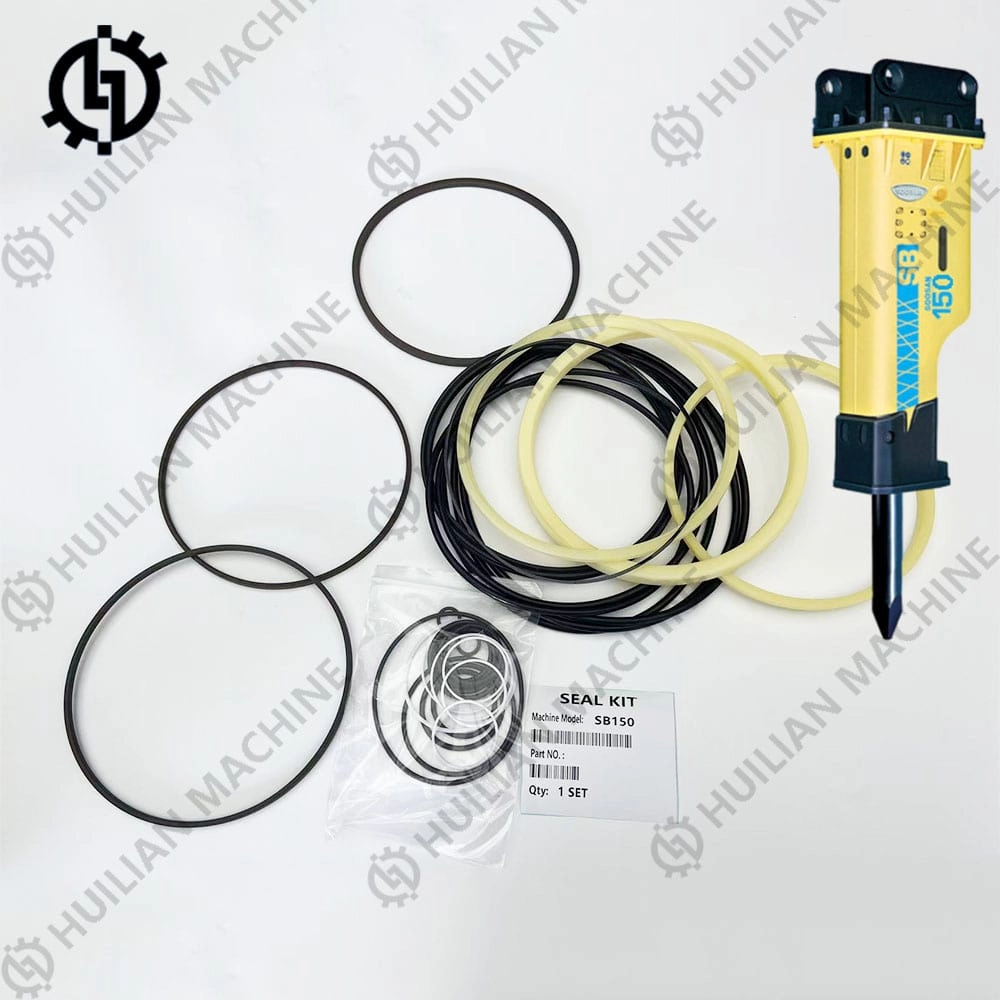
SOOSAN Breaker Spare Parts SB151TSP SQ150 SB151 Seal Kit SB150 SB157TRF SB152 C7X003 C71010 Oil Repair Kit For Excavator Hydraulic Rock Hammer

Huilian Hydraulic Rock Hammer Breaker SB10 for 0.5-1.2 Ton Mini Excavator Breaker
Side-type hydraulic breaker : Easy to control, convenient positioning, durable, high working efficiency, strong striking force, long service life, stable operating performance, and convenient after-sales service.
Top type hydraulic breaker : Strong impact power; excellent environmental performance; exquisite manufacturing technology; easy maintenance, fast after-sales service
Box-type hydraulic breaker: leading heat treatment technology, enhanced heat resistance, and wear resistance. Under the condition of keeping the oil pressure constant, the cylinder volume is reduced and the fuel consumption is reduced. The self-developed core is adopted to make the piston cylinder body durable and the service life longer. Exposed decks are made of high-strength steel plates to reduce wear. The best efficiency matching with excavator and loader is realized

Huilian HL100 Hydraulic Hammer Rock Breaker Excavator Attachment
 About us
© 2025 HUILIAN MACHINE. All rights reserved