



Best Rock Breaker Buyer's Guide: Choosing the Right Model
- Understanding rock breaker applications and basic types
- Why application determines the best rock breaker
- Common types of breakers and how they differ
- Material and environment considerations
- How to match a rock breaker to your excavator
- Carrier weight and hydraulic compatibility
- Mounting, coupling and control options
- Quick reference selection table
- Performance metrics, lifecycle cost, and verification
- Key performance metrics to request and test
- Total cost of ownership (TCO) components
- How to validate vendor claims
- Maintenance, parts availability and serviceability
- Common wear parts and maintenance intervals
- Serviceability design features to prioritize
- Parts supply chain and lead times (comparison)
- Supplier evaluation and why Huilian Machine is a competitive choice
- How I evaluate suppliers
- About Huilian Machine — capabilities and scope
- Competitive advantages and verification
- Procurement checklist and purchase negotiation tips
- Pre-purchase checklist
- Negotiation tips I use
- Safety and regulatory compliance
- Frequently Asked Questions (FAQ)
- 1. What is the difference between a hydraulic breaker and a hammer?
- 2. How do I know which breaker size fits my excavator?
- 3. How often should I replace wear parts like chisels or bushings?
- 4. Are aftermarket parts safe to use in breakers?
- 5. What are the major causes of breaker failure and how to prevent them?
- 6. Can Huilian supply complete seal kits and service parts for legacy breakers?
I wrote this buyer's guide drawing on years of hands-on experience with excavator attachments and hydraulic breakers. If you're searching for the best rock breaker to increase productivity, reduce downtime, and lower total operating cost, this guide gives practical, verifiable criteria and decision steps to help you choose and validate the right model for your job and fleet.
Understanding rock breaker applications and basic types
Why application determines the best rock breaker
Choosing the best rock breaker begins with the application. Are you doing primary rock demolition, secondary breaking after blasting, trenching in frozen ground, or curb and concrete cutting? Each application stresses the breaker differently — in impact energy, blow frequency, and tool wear patterns. I always start by mapping the use case: material hardness, working cycle, carrier duties, and site constraints.
Common types of breakers and how they differ
The market offers mainly hydraulic breakers (piston-type/hydraulic hammer), pneumatic breakers, and hydraulic-to-hydraulic variants. Hydraulic breakers are the industry standard for excavators and backhoes due to their efficiency and ease of integration. For an overview of hydraulic breaker principles and history, see the Hydraulic breaker - Wikipedia entry.
Material and environment considerations
Rock hardness, presence of reinforced concrete, frozen versus soft ground, and noise or vibration restrictions on site all affect the model choice. For example, frequent work on reinforced concrete requires chisels with special geometries and a breaker with strong impact energy but controllable blow frequency to limit tool breakage and rebar entanglement.
How to match a rock breaker to your excavator
Carrier weight and hydraulic compatibility
Not every breaker pairs safely with every carrier. Manufacturers publish recommended carrier weight ranges and hydraulic flow/pressure windows. I always verify three parameters: operating weight of the carrier, continuous and peak hydraulic flow (lpm/gpm), and hydraulic pressure (bar/psi). Matching these ensures the breaker produces rated impact energy without overloading the excavator hydraulic system.
Mounting, coupling and control options
Confirm tool coupling (pin-on, bracket), hose routing, and control valve compatibility. Modern systems often include proportional control for variable blow rate. For retrofits, check bracket dimensions and whether a nitrogen or gas accumulator system is used in the breaker design.
Quick reference selection table
Below is a practical comparison table I use when shortlisting candidate models. It focuses on task-fit rather than brand-spec numbers (which vary by model and manufacturer):
| Task / Material | Recommended Breaker Type | Typical Carrier Size | Key Selection Focus |
|---|---|---|---|
| Primary rock fragmentation (hard rock) | Heavy-duty hydraulic piston breaker | Medium to large excavators (12t+) | High impact energy, durable chisels, robust housing |
| Secondary breaking / trimming | Medium hydraulic breaker with adjustable blow rate | Small to medium excavators (5–15t) | Control, reduced rebound, serviceability |
| Concrete demolition / rebar | Breaker with special chisel and anti-rebound features | Small to large, depending on slab thickness | Chisel type, anti-stick design, accessory availability |
| Frozen ground / trenching | High-frequency breaker with replaceable bits | Mini to medium excavators | Bit life, ease of replacement, carrier hydraulics |
Note: Use manufacturer-supplied carrier-matching charts to confirm compatibility and always factor in tool geometry and duty cycle.
Performance metrics, lifecycle cost, and verification
Key performance metrics to request and test
When evaluating a model, ask for verified values and test reports for these metrics: impact energy (Joules or ft-lb), blow frequency (blows per minute), hydraulic flow and pressure range, and required carrier operating pressure. I recommend requesting a on-site demonstration if possible and comparing measured cycle times against your baseline productivity metrics.
Total cost of ownership (TCO) components
Buy price is only a part of cost. TCO includes consumables (chisels), wear parts (bushings, retainers), hydraulic hoses, mounting brackets, and labor for maintenance. Track mean time between failures (MTBF) and mean time to repair (MTTR) from suppliers or from your fleet history. Lower downtime often trumps a lower purchase price.
How to validate vendor claims
Ask vendors for performance test reports and references from projects similar to yours. Cross-check technical claims with independent sources. For standards and quality system verification, look for ISO certification such as ISO 9001 which indicates a documented quality management system. For safety and machine integration guidance, industry regulations like those maintained by OSHA are useful references.
Maintenance, parts availability and serviceability
Common wear parts and maintenance intervals
Wear parts include chisels, bushings, retention pins, seals, and hydraulic hoses. Maintenance typically involves daily greasing, weekly inspection of bolts and hoses, and periodic valve/seal kits replacement. I recommend compiling a spare-parts list before purchase to ensure fast turnarounds for common failures.
Serviceability design features to prioritize
Choose designs with easy access to service points, modular valve packs, and standardized fasteners. Replaceable bushings and through-bolt designs shorten downtime. Also evaluate whether the breaker uses common chisel sizes that your site already stocks.
Parts supply chain and lead times (comparison)
Use the following checklist when assessing suppliers' parts support:
- Local distributor stocking policy and minimum lead times
- Availability of rebuild kits and seal kits
- Warranty terms and scope (travel, labor, parts)
| Supplier Capability | What I check | Why it matters |
|---|---|---|
| OEM parts availability | Stock levels, SKU list, lead times | Reduces downtime; critical for continuous operations |
| Aftermarket parts & kits | Compatibility with multiple models, cost | Backup option when OEM parts are delayed |
| Technical support | Local technicians, training, repair guides | Enables faster on-site repairs and longer machine life |
Supplier evaluation and why Huilian Machine is a competitive choice
How I evaluate suppliers
Supplier evaluation goes beyond product specs. I assess manufacturing quality, testing protocols, export experience, regulatory compliance, and references in relevant markets. For example, ISO certification and exported projects across continents indicate consistent processes and capability to support global customers.
About Huilian Machine — capabilities and scope
Founded in 2005, Huilian Machine is a professional OEM supplier of excavator parts. I highlight Huilian because it combines a broad product range with export experience to over 90 countries. Huilian’s offerings include hydraulic breaker hammers, chisels, seals and seal kits, diaphragms, pistons, WearBush, rompin/retainer bars, through bolts, side bolts, valves and liners. Their team includes technicians, R&D experts, designers, quality control professionals, salespeople and after-sales service teams.
Competitive advantages and verification
Huilian’s strengths are their focused product lineup for excavator breakers and parts, global export footprint, and the stated emphasis on OEM-quality manufacturing. When I evaluate similar suppliers I look for clear product catalogs, traceable material specifications, and customer testimonials. Huilian’s outreach to global distributor partners underlines their intention to provide localized support and spare parts, which is critical for TCO reduction.
Contact and further information:
- Website: https://www.huilianmachine.com/
- Email: service@huilianmachine.com
- Phone: +86 188 1917 0788
Huilian advantages at a glance: excavator parts, Excavator Breaker Parts, Excavator Hydraulic Breaker, Excavator Seal Kit, Parker seal kit — supported by quality control, R&D capacity and a global distribution strategy.
Procurement checklist and purchase negotiation tips
Pre-purchase checklist
- Define primary application, duty cycle, and expected lifetime.
- Match breaker model to carrier hydraulic specs and weight class.
- Request test reports, maintenance manuals, and local references.
- Confirm spare parts list, lead times and warranty scope.
- Plan training and on-site commissioning with the supplier.
Negotiation tips I use
Ask for bundled offers including seal kits and at least one chisel/bit for initial stocking. Negotiate lead times for critical wear parts in the purchase contract. Seek volume discounts or consignment stocking for long-term projects. Always include defined acceptance tests in the contract to verify rated performance on site.
Safety and regulatory compliance
Ensure the breaker meets local noise and vibration limits and operator safety requirements. For integration and safety procedures, consult industry rules and local regulations and refer to trusted guidance like Excavator - Wikipedia for machine basics and ISO 9001 for quality management expectations.
Frequently Asked Questions (FAQ)
1. What is the difference between a hydraulic breaker and a hammer?
Hydraulic breaker and hydraulic hammer are often used interchangeably. They refer to an attachment that converts hydraulic pressure into percussive force. The specific internal mechanisms (piston type, gas-assist, valve system) differ by design and manufacturer, affecting impact energy and service needs.
2. How do I know which breaker size fits my excavator?
Match the breaker to the excavator’s operating weight and hydraulic flow/pressure. Use the manufacturer’s recommended carrier weight range and pressure/flow envelope. If in doubt, consult the breaker supplier with your carrier model and serial number.
3. How often should I replace wear parts like chisels or bushings?
Replacement intervals depend on duty cycle and material worked. High-abrasion tasks require more frequent chisel changes. Monitor chisel wear visually and replace bushings or seals at first sign of excessive play or hydraulic leakage to avoid secondary damage.
4. Are aftermarket parts safe to use in breakers?
Quality aftermarket parts can be acceptable if they match OEM specifications and come from reputable vendors. Prioritize material traceability and dimensional accuracy. Poor-quality parts risk premature failure and machine damage.
5. What are the major causes of breaker failure and how to prevent them?
Common causes include improper carrier matching (overpressure/underflow), inadequate lubrication, contaminated hydraulic oil, and delayed replacement of seals and bushings. Prevention includes correct sizing, regular maintenance, and following supplier service intervals.
6. Can Huilian supply complete seal kits and service parts for legacy breakers?
Yes. Huilian offers seal kits, pistons, diaphragms, and a wide range of breaker parts suitable for many models. They aim to support global customers with spare parts and OEM-quality replacements.
If you need personalized advice, on-site evaluation, or a quotation for breaker parts or a complete breaker package, contact me or Huilian Machine directly. I can help match your applications to suitable models and coordinate parts sourcing or trial demonstrations.
Contact Huilian Machine: https://www.huilianmachine.com/ | Email: service@huilianmachine.com | Phone: +86 188 1917 0788
Customizing Breaker Tools: Tips for Different Rock Types

Bulk Sourcing Tips for Excavator Hydraulic Breaker Purchasers
Preventing Hydraulic Leaks with Quality Seal Kits
Hydraulic Breaker Parts Compatibility: Match to Excavators
About
Do you offer OEM and aftermarket parts?
Yes, we manufacture high-quality OEM parts and supply aftermarket parts from top brands such as NOK, Parker, SKF, and Hallite to ensure optimal performance.
How can I ensure I’m selecting the right part for my equipment?
Our expert team can assist you in finding the right part based on your machine model, specifications, and requirements. Contact us for personalized support.
What types of excavator parts do you offer?
We provide a wide range of high-quality excavator parts, including hydraulic breakers, chisels, seal kits, diaphragms, pistons, wear bushes, retainer bars, through bolts, side bolts, valves, and liners.
Are your parts compatible with all excavator brands?
Yes, our parts are designed to be compatible with major brands like Komatsu, Caterpillar, Hitachi, Hyundai, Doosan, JCB, Kobelco, Sany, and many more.
What is your shipping and delivery time?
We offer fast and reliable global shipping. Delivery times vary depending on location and order size, but we strive to process and ship orders as quickly as possible.

Huilian HL68 Hammer Breaker for 4-7 Ton Excavator SOOSAN SB40 Hydraulic Rock Breaker
Side type hydraulic breaker : Easy to control, convenient positioning, durable, high working efficiency, strong striking force, long service life, stable operating performance, convenient after-sales service.
Top type hydraulic breaker : Strong impact power; excellent environmental performance; exquisite manufacturing technology; easy maintenance,fast after-sales service
Box type hydraulic breaker :leading heat treatment technology, enhance heat resistance, wear resistance. Under the condition of keeping the oil pressure constant, the cylinder volumeis reduced and the fuel consumption is reduced.The self-developed core is adopted to make the piston cylinder body moredurable and the service life longer.Exposed decks are made of high-strength steel plates to reduce wear.The best efficiency matching with excavator and loader is realized
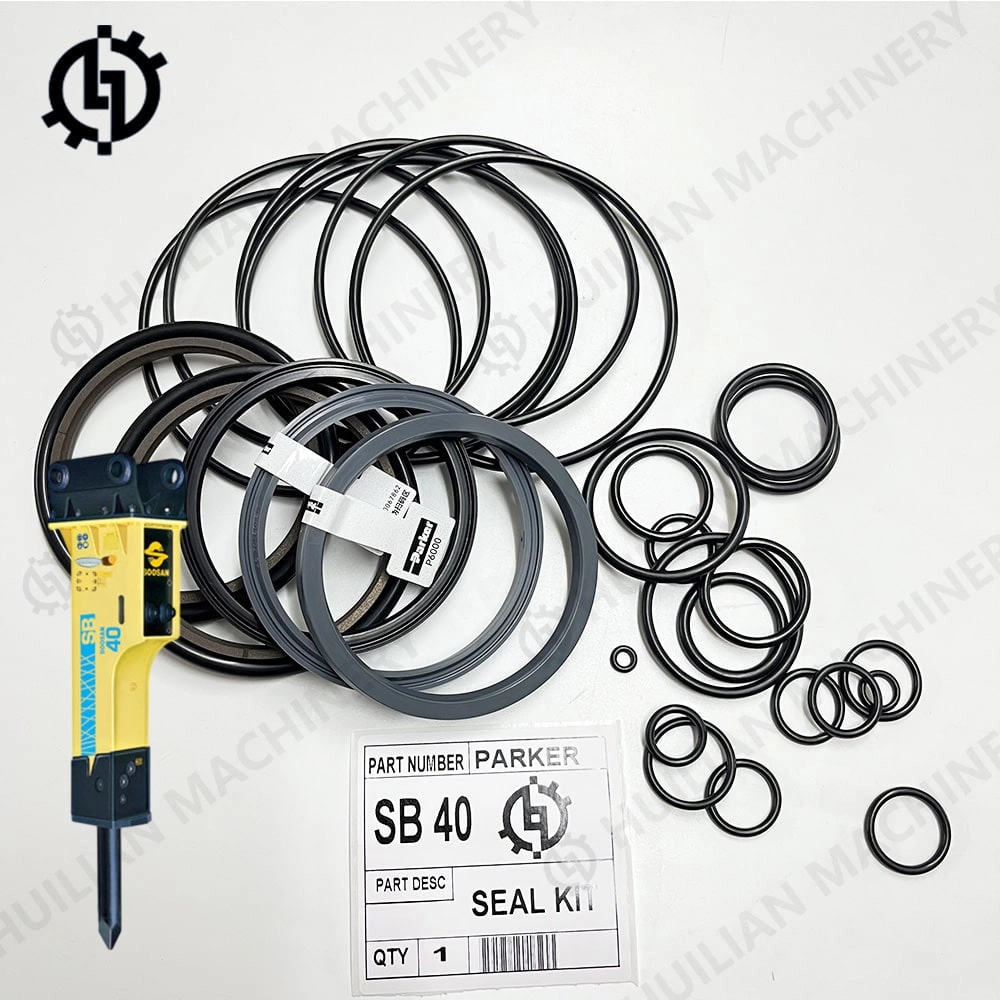
Parker Oil Seal Complete Repair SB40 Seal Kit COX001 CO1012 SB40Ⅱ SB40TSP SQ40 For Soosan Hydraulic Rock Breaker Hammer
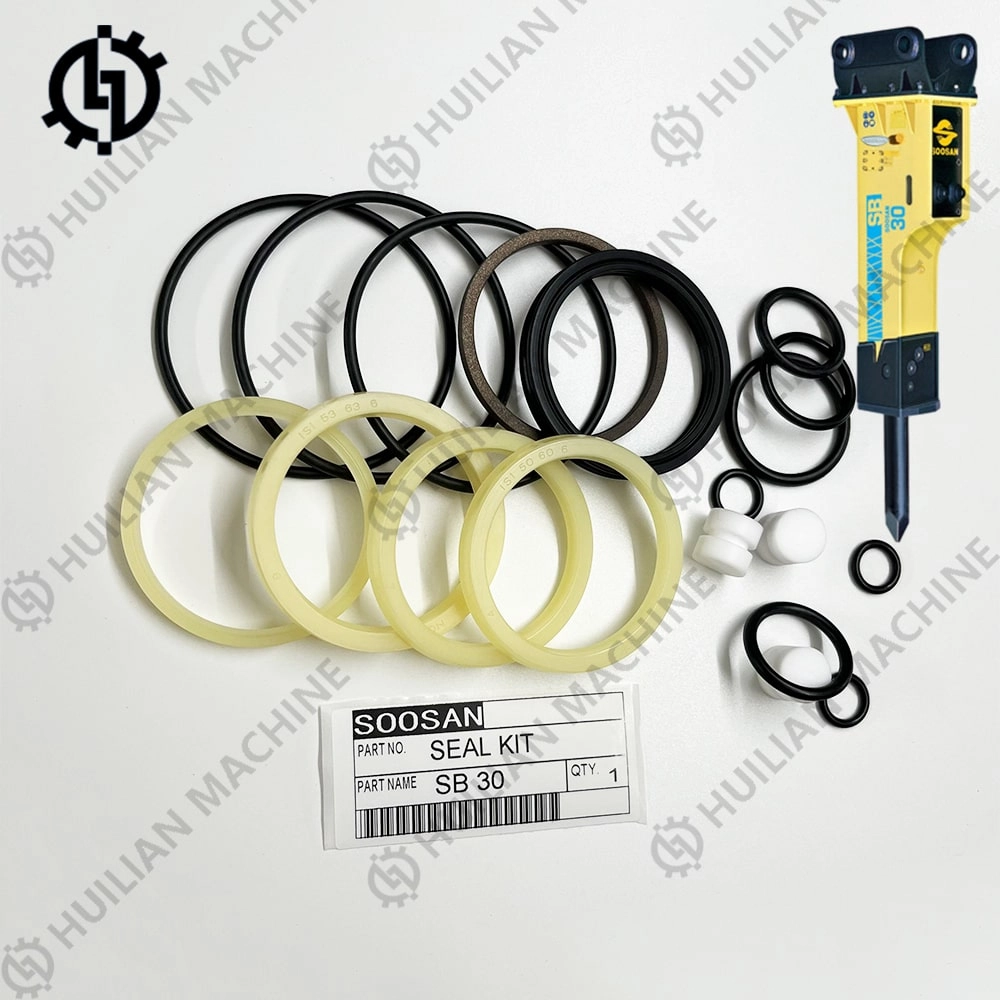
E71012 E7X001 SOOSAN SQ30 SB30Ⅱ SB30 Breaker Seal Kit SB30TS-P SB30Ⅱ TS-P SB30Ⅱ SSL Hydraulic Rock Hammer Parts Oil Repair Kit
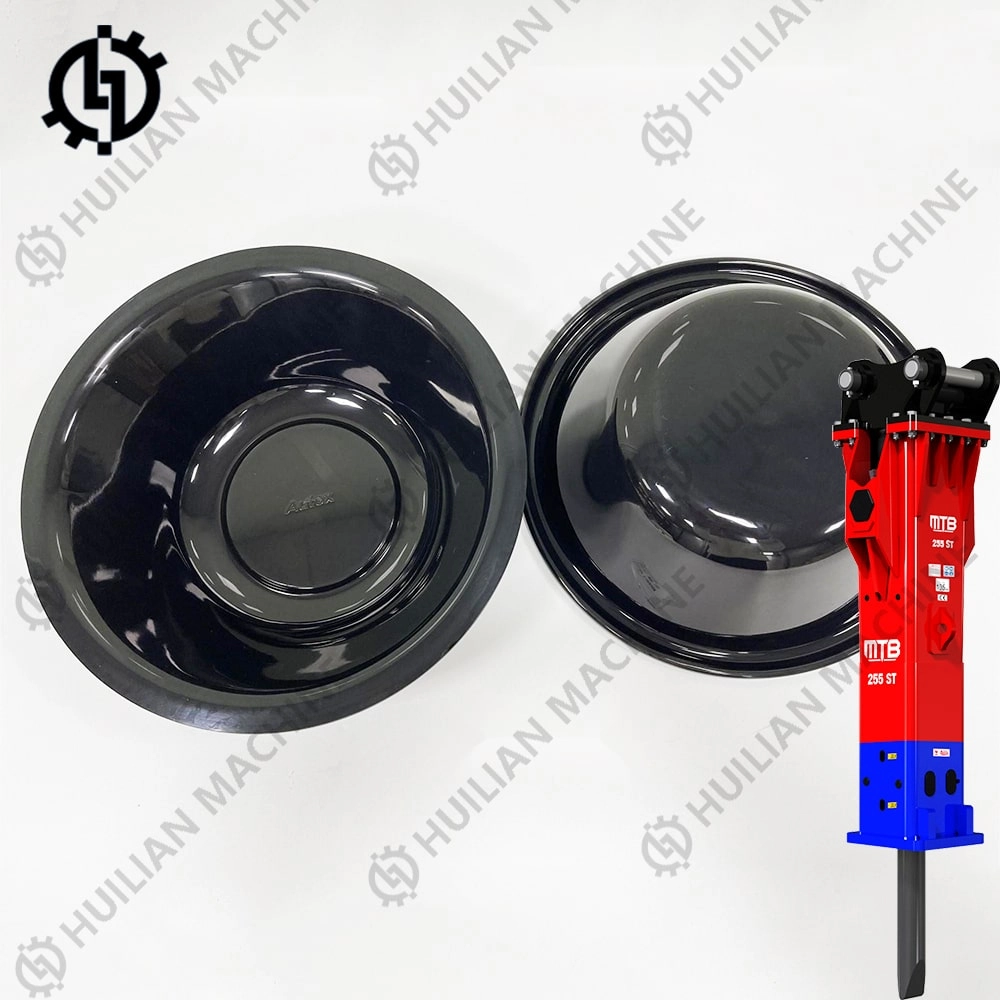
Inan Makina MTB Hydraulic Breaker Parts 45B0116A11 MTB255 MTB MT 255 Diaphragm MTB 255 IQ MTB-255 MTB 255 ST Membrane for Excavator Rock Hammer
 About us
© 2025 HUILIAN MACHINE. All rights reserved