



Excavator Mounted Hydraulic Breaker Hammer vs. Pneumatic Tools: Why Hydraulic Wins for High-Performance Projects
- Key Takeaways: The Hydraulic Advantage
- What is an excavator-mounted hydraulic breaker hammer?
- Hydraulic vs. Pneumatic: The Mechanics of Power
- 5 Reasons Hydraulic Wins for High-Performance Projects
- Economic Analysis: ROI and TCO (2026 Market Data)
- Operational Guide: Matching Hammer to Carrier
- Expert Tips: Preventing Common Hydraulic Failures
- Future Trends: Smart Hydraulics in 2026 and Beyond
- Conclusion & Call to Action
Key Takeaways: The Hydraulic Advantage
Hydraulic breakers consistently outperform pneumatic tools in heavy-duty applications by leveraging the excavator's existing power source for maximum efficiency.
- Higher Impact Energy: Hydraulic breakers deliver 3-5x more impact energy per blow than comparable pneumatic tools.
- Logistical Simplicity: Eliminating tow-behind air compressors reduces fuel consumption and site congestion.
- Operator Safety: Significantly lower operator fatigue due to excavator-mounted vibration isolation.
- Material Versatility: Superior suitability for high-performance projects involving reinforced concrete and hard rock.
What is an excavator-mounted hydraulic breaker hammer?
An excavator-mounted hydraulic breaker hammer is a heavy-duty percussion attachment that utilizes the carrier machine's auxiliary hydraulic system to drive a piston, delivering high-impact energy for demolition and mining applications.
Unlike pneumatic tools that rely on compressible air, these breakers use incompressible hydraulic fluid (oil) to maximize energy transfer efficiency and impact force. Commonly referred to as a "hoe ram" or "hydraulic hammer," it is the industry standard for breaking concrete, asphalt, and rock without blasting. At Guangzhou Huilian Machines Co., Ltd. (Huilian), we have seen a massive shift since 2005, where contractors prefer these integrated systems over standalone air tools for their sheer crushing power.
Hydraulic vs. Pneumatic: The Mechanics of Power
The core difference lies in the physics of the medium: hydraulic systems use incompressible liquid to transmit force instantly, while pneumatic systems lose energy compressing air.
This fundamental difference impacts excavator demolition attachment efficiency in several ways:
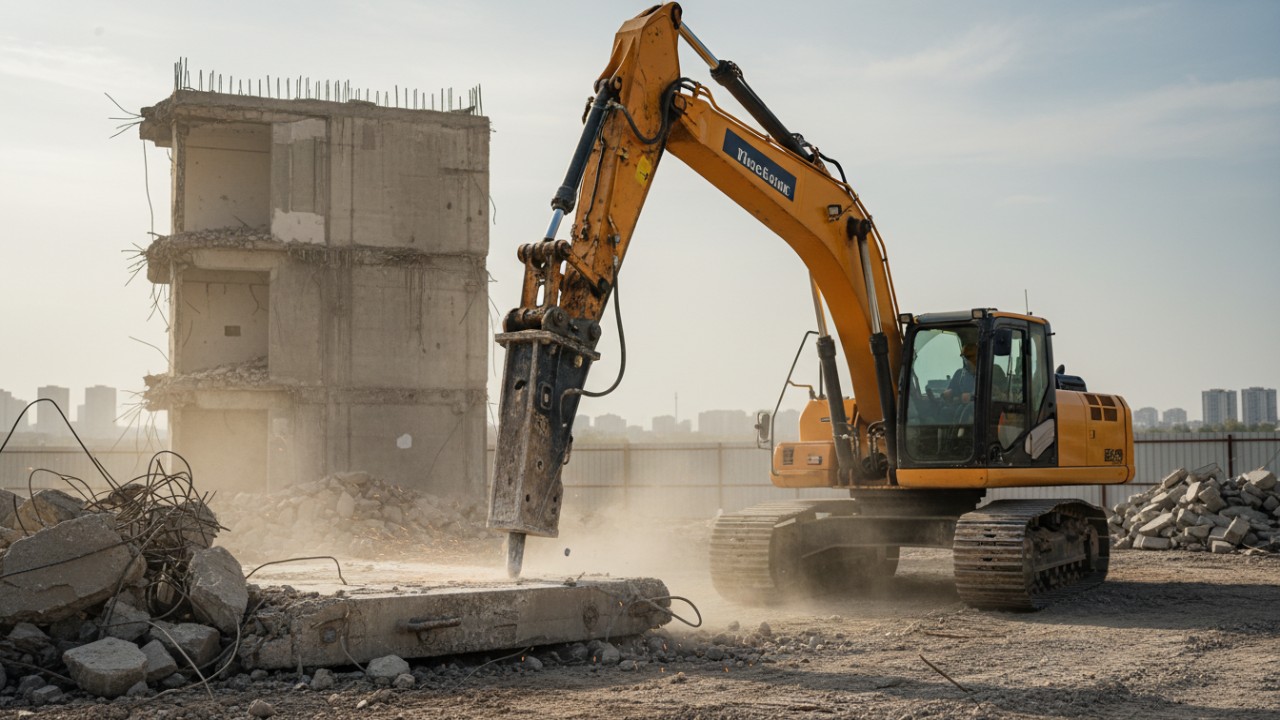
- The Physics (Pascal vs. Boyle): Hydraulic breakers operate on Pascal's Law, which states that pressure applied to a confined fluid is transmitted undiminished. According to NASA, this allows for force multiplication that pneumatic systems (governed by Boyle's Law) cannot match due to the "spongy" nature of compressed air.
- System Efficiency: Hydraulic systems typically operate at 2000+ PSI, whereas pneumatic systems are often limited to 100-150 PSI.
- Energy Transfer: A nitrogen gas chamber in hydraulic breakers acts as an accumulator, amplifying the piston stroke to deliver maximum joules per blow.
- Component Density: Hydraulic components are denser and more powerful, allowing for a compact design compared to bulky air motors.
5 Reasons Hydraulic Wins for High-Performance Projects
For large-scale demolition, hydraulic breakers offer superior power-to-weight ratios and safety profiles that pneumatic handhelds or tow-behind units simply cannot rival.
- Hydraulic Hammer Power to Weight Ratio: Hydraulic breakers provide significantly higher breaking force relative to the attachment weight. A 1,000 lb hydraulic hammer delivers force that would require a much heavier and larger pneumatic setup.
- Mobility & Logistics: There is no need for separate compressors or air hoses; the power source is the excavator itself. This streamlines site logistics.
- Underwater & Extreme Environments: Sealed hydraulic systems allow for underwater operation (with proper kits) where pneumatic tools struggle with water ingress.
- Operator Safety: Mounting the breaker on an excavator removes the operator from the immediate vibration zone. This helps mitigate risks associated with Hand-Arm Vibration Syndrome (HAVS). As noted by the Occupational Safety and Health Administration (OSHA), vibration exposure is a critical workplace hazard that must be managed, and cab-mounted tools are a primary engineering control.
- Precision Control: Modern excavators allow for precise positioning and variable frequency settings, ensuring the heavy-duty concrete breaker comparison leans heavily in favor of hydraulics for structural demolition.
Economic Analysis: ROI and TCO (2026 Market Data)
While the initial investment for a hydraulic attachment can be higher, the Total Cost of Ownership (TCO) is significantly lower due to fuel savings and increased throughput.
When calculating hydraulic rock breaker ROI, consider these factors:
- Fuel Costs: You run one engine (the excavator) instead of two (excavator + diesel air compressor).
- Labor Savings: One operator in a cab can do the work of a crew of 5 laborers with handheld pneumatic hammers.
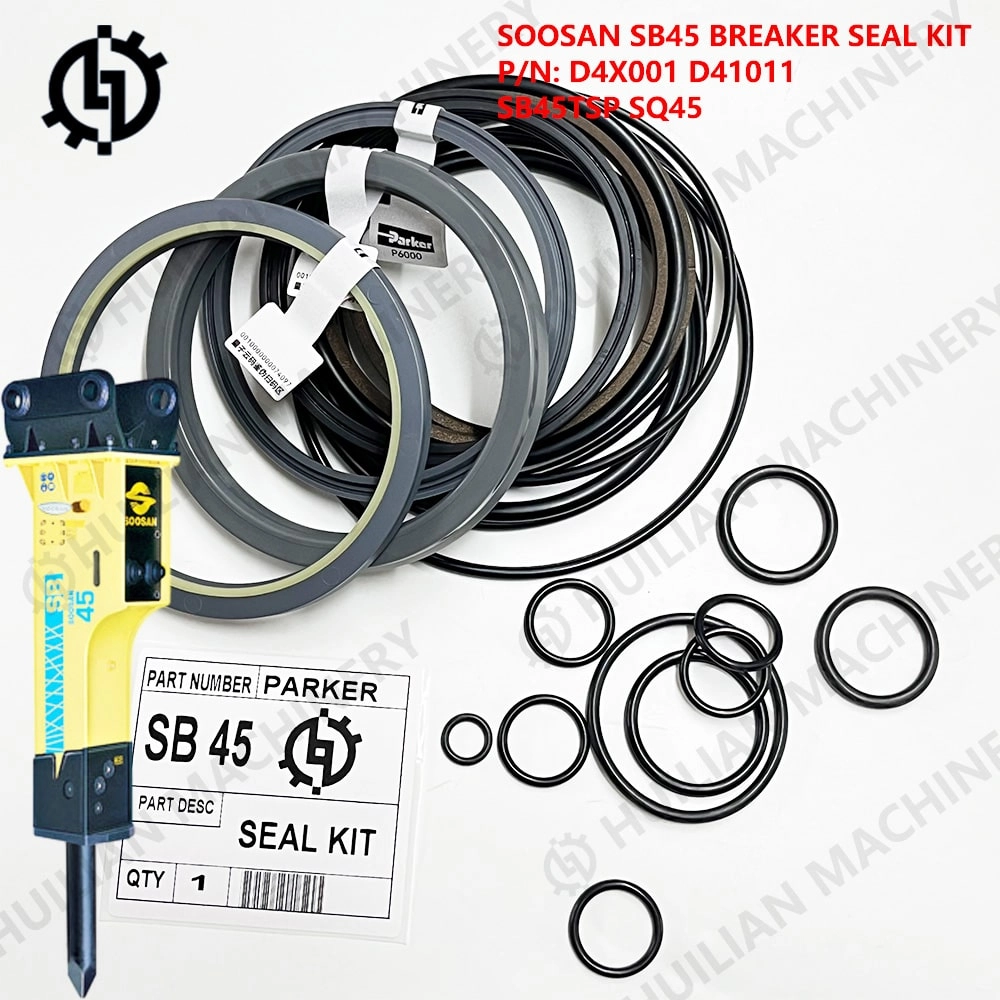
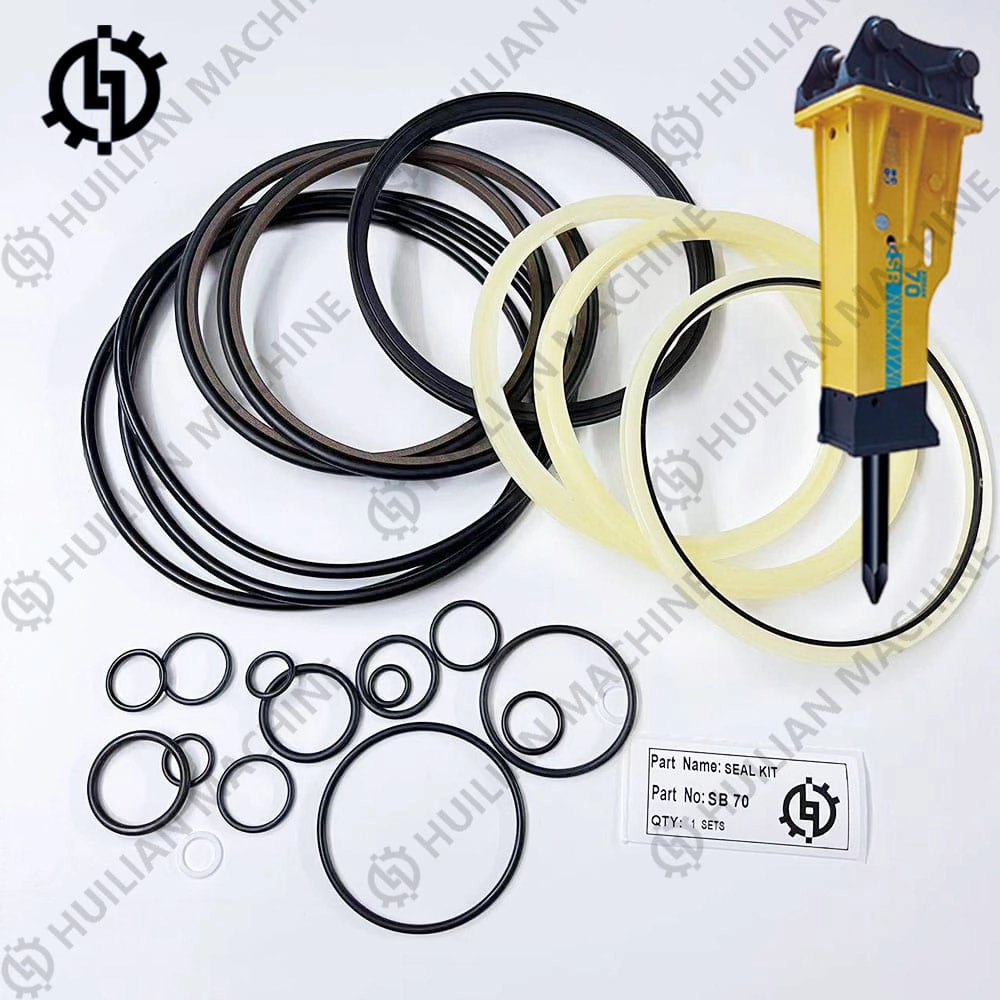
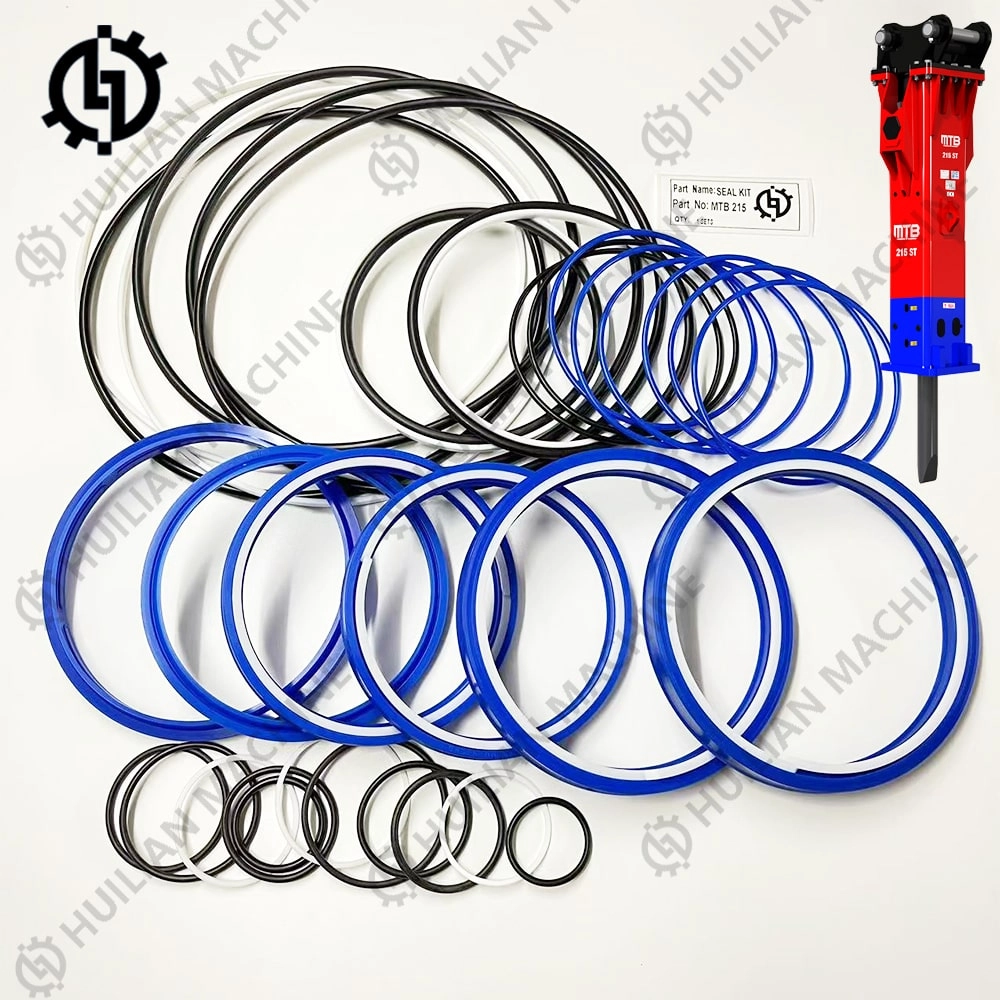
- Maintenance Lifecycle: Hydraulic seals and components generally have longer service intervals than air tool vanes. Huilian's experience with Parker seal kits and high-grade pistons shows that quality parts extend this lifecycle further.
- Resale Value: Equipping excavators with high-quality hydraulic plumbing increases fleet asset value.
Operational Guide: Matching Hammer to Carrier
To prevent catastrophic failure, the hydraulic breaker's flow and pressure requirements must perfectly match the excavator's auxiliary output.
- Flow Rate (GPM) Alignment: Ensure your excavator's pump matches the breaker's required flow to prevent overheating. Too much flow causes cavitation; too little causes sluggish performance.
- Operating Pressure: Relief valves must be set correctly. If the pressure is too high, it can blow seals; too low, and the hammer won't fire.
- Weight Class Rules: A general rule is that the breaker should weigh between 4% and 10% of the excavator's operating weight.
- Industry-Leading Solution: At Huilian, we offer a diverse range of brackets and couplers to ensure a perfect fit for any excavator brand, from Cat to Komatsu.
Expert Tips: Preventing Common Hydraulic Failures
Routine maintenance is the non-negotiable price of performance; neglecting grease or nitrogen levels is the fastest way to destroy a $20,000 attachment.
- Avoid Blank Firing: Never fire the hammer unless it is pressed firmly against the material. This sends the impact energy back into the breaker's internal components, damaging the piston and retainer pins.
- Greasing Protocols: Automatic lubrication systems or hourly manual greasing with moly paste is essential to prevent metal-on-metal friction.
- Nitrogen Checks: Verify gas charge levels regularly. Low nitrogen results in weak impact energy.
- Warm-Up Routine: In cold climates, always warm up the hydraulic oil before full-power operation to prevent thermal shock to the seals.
Future Trends: Smart Hydraulics in 2026 and Beyond
The future of demolition is automated, with smart hydraulic systems that self-adjust to material hardness and report telemetry in real-time.
- Telematics Integration: Real-time impact monitoring and service alerts sent directly to the fleet manager's tablet.
- Auto-Adjust Systems: Flow and pressure systems that adapt to rock hardness instantly, optimizing fuel use.
- Noise Reduction: New dampening technologies are meeting stricter 2026 urban construction regulations.
- Eco-Friendly Fluids: The rise of biodegradable, sustainable hydraulic fluids.
Conclusion & Call to Action
Excavator-mounted hydraulic breaker hammers offer undeniable advantages over pneumatic tools in power, efficiency, and safety, making them the superior choice for modern construction.
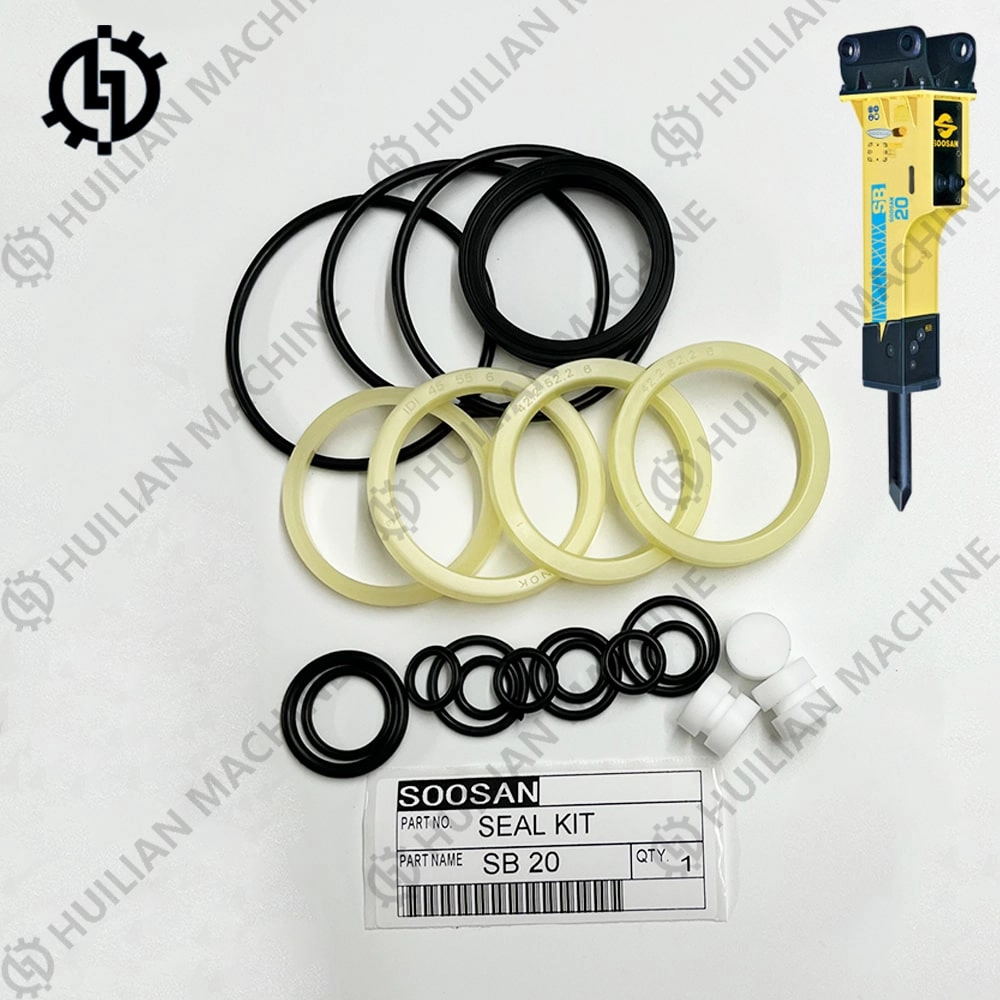
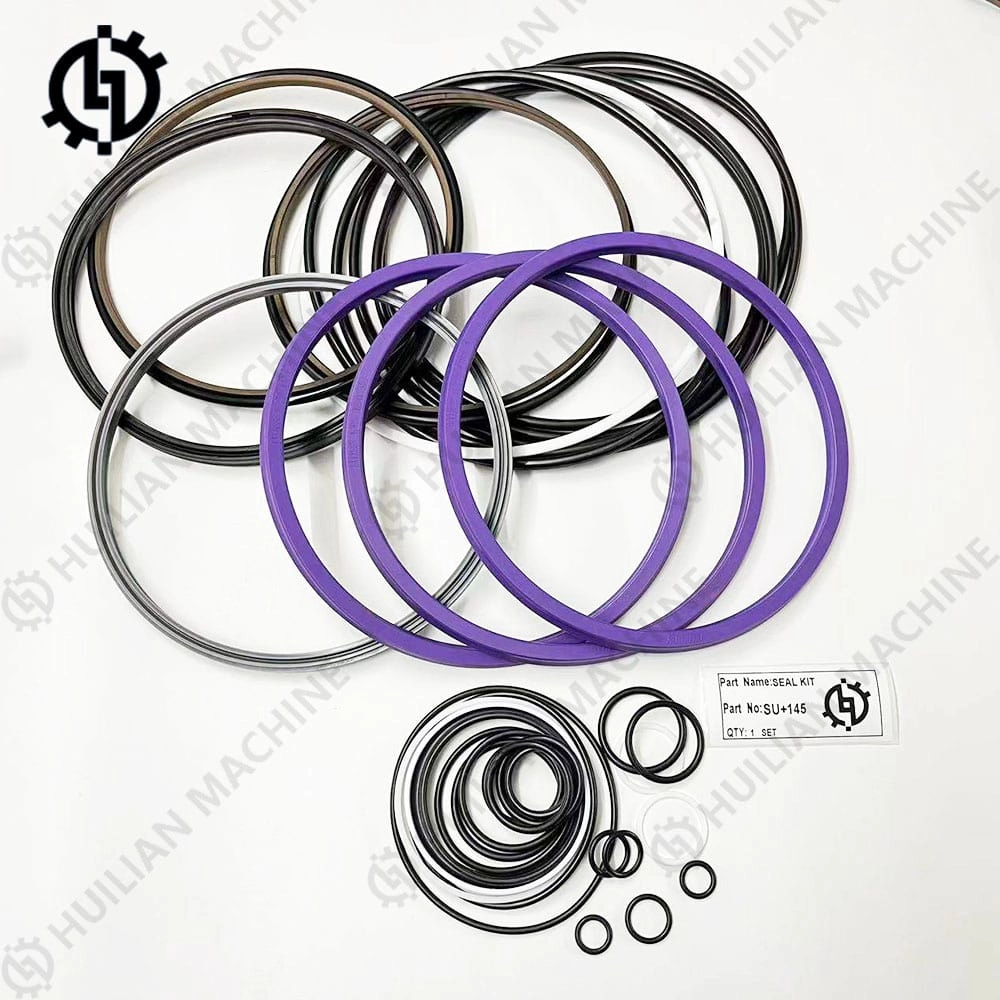
Transitioning to hydraulic attachments transforms your excavator into a multifunctional demolition powerhouse. With over 15 years of experience, Guangzhou Huilian Machines Co., Ltd. is your trusted partner for high-quality hydraulic breaker hammers, seal kits, and spare parts. We export to over 90 countries, ensuring that wherever your project is, you have access to the best hydraulic breaker vs. pneumatic hammer solutions.
Contact us today to discuss your specific needs and request a quote for our premium excavator attachments.


About
Are your parts compatible with all excavator brands?
Yes, our parts are designed to be compatible with major brands like Komatsu, Caterpillar, Hitachi, Hyundai, Doosan, JCB, Kobelco, Sany, and many more.
How can I ensure I’m selecting the right part for my equipment?
Our expert team can assist you in finding the right part based on your machine model, specifications, and requirements. Contact us for personalized support.
What types of excavator parts do you offer?
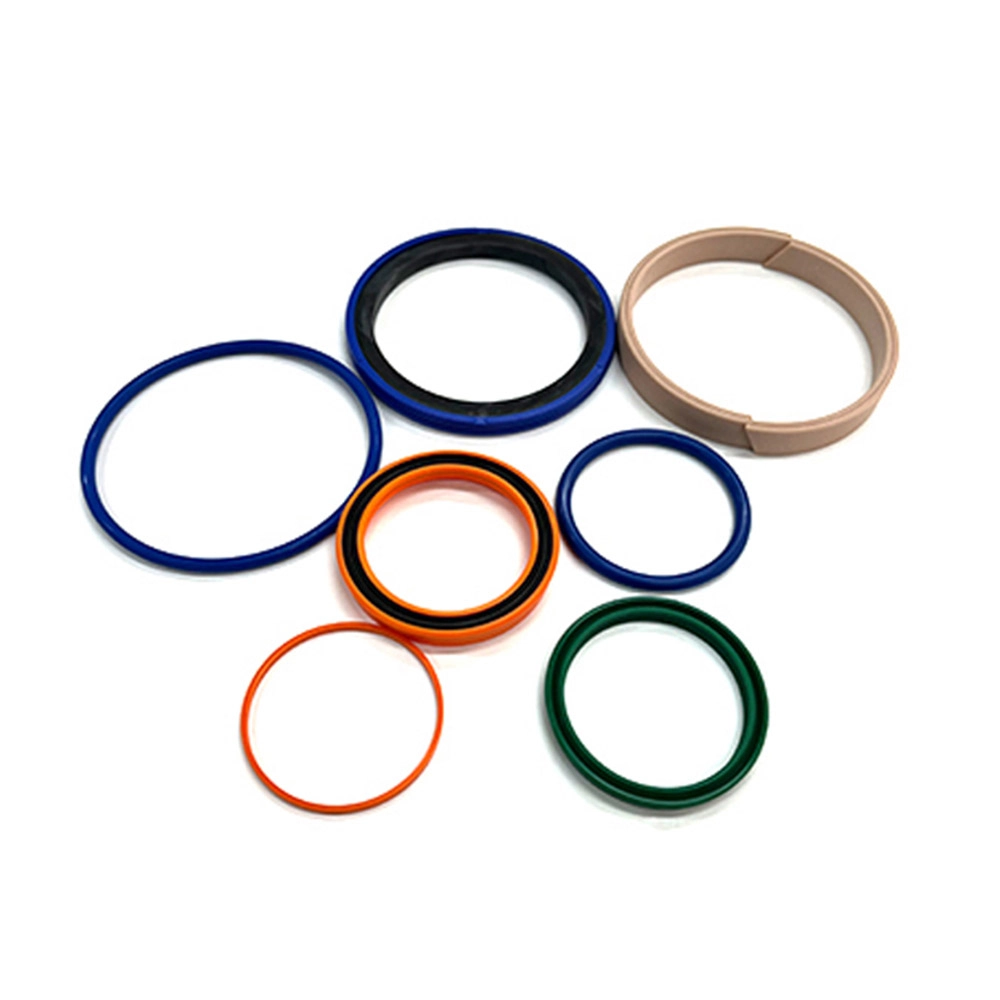
We provide a wide range of high-quality excavator parts, including hydraulic breakers, chisels, seal kits, diaphragms, pistons, wear bushes, retainer bars, through bolts, side bolts, valves, and liners.
What is your shipping and delivery time?
We offer fast and reliable global shipping. Delivery times vary depending on location and order size, but we strive to process and ship orders as quickly as possible.
Do you offer OEM and aftermarket parts?
Yes, we manufacture high-quality OEM parts and supply aftermarket parts from top brands such as NOK, Parker, SKF, and Hallite to ensure optimal performance.


Getting started is easy 
Contact with our experts to find the best excavator parts solutions for your needs. Discover how Huilian can enhance your equipment's performance and efficiency.


Get in touch
 About us
© 2025 HUILIAN MACHINE. All rights reserved